Register for our upcoming webinar: How AI Is Changing Hiring · Friday 7 August, 6PM BST · FreeSave my seatRegister for our upcoming webinar: How AI Is Changing Hiring · Friday 7 August, 6PM BST · FreeSave my seatRegister for our upcoming webinar: How AI Is Changing Hiring · Friday 7 August, 6PM BST · FreeSave my seatRegister for our upcoming webinar: How AI Is Changing Hiring · Friday 7 August, 6PM BST · FreeSave my seat
Career Intelligence

Career Advice & Insights

Strategies, tips, and playbooks to help you land the role you want faster.

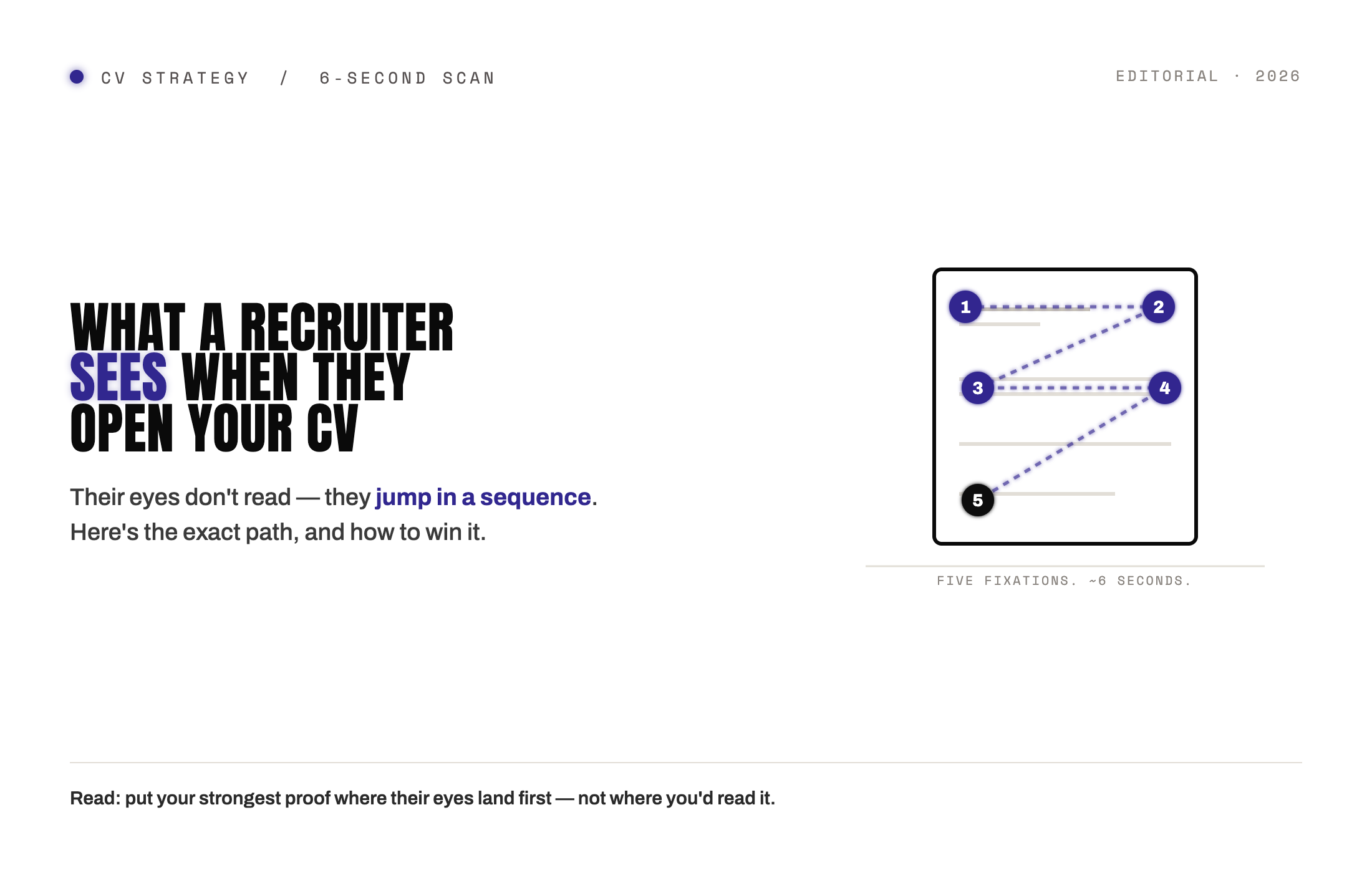
What a Recruiter Sees When They Open Your CV: The Exact Sequence
what does a recruiter see when they open your CV

What a Recruiter Sees When They Open Your CV: The Exact Sequence

There is a widespread assumption about the moment a recruiter opens your application. The assumption is that they open your CV, the document you created, formatted, and exported as a PDF or Word file, and read it. For most large UK employer applications in 2026, this is not what happens.

22 July 202612 min readSidi Saccoh
Read article
Why Do I Keep Getting Rejected From Jobs? The Honest Answer Nobody Is Giving You
why do I keep getting rejected from jobs

Why Do I Keep Getting Rejected From Jobs? The Honest Answer Nobody Is Giving You

If you are qualified for the roles you are applying for and still getting silence, the most important question to ask is not what you did wrong

21 July 202612 min
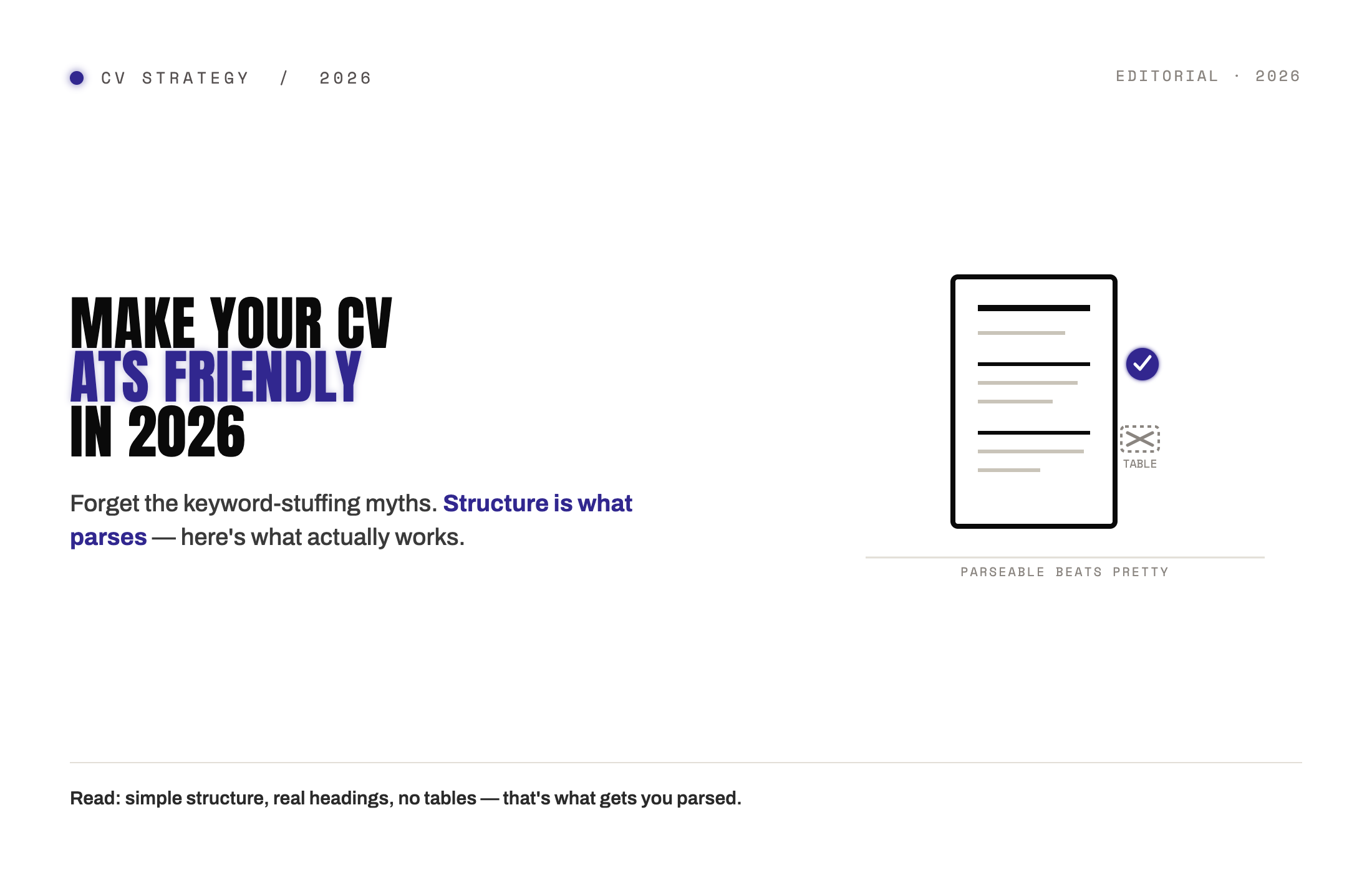
How to Make Your CV ATS Friendly in 2026: What Actually Works

How to Make Your CV ATS Friendly in 2026: What Actually Works

Making your CV ATS friendly is not about passing a robot. It is about ranking high enough in the employer's system to reach a human. Most guides on this topic give you the same checklist: use one column, remove tables, add keywords. That advice is correct. It is also incomplete, because the formatting fixes are the easier half.

20 July 202613 min
Which ATS Do UK Employers Use? The 2026 Sector-by-Sector Guide

Which ATS Do UK Employers Use? The 2026 Sector-by-Sector Guide

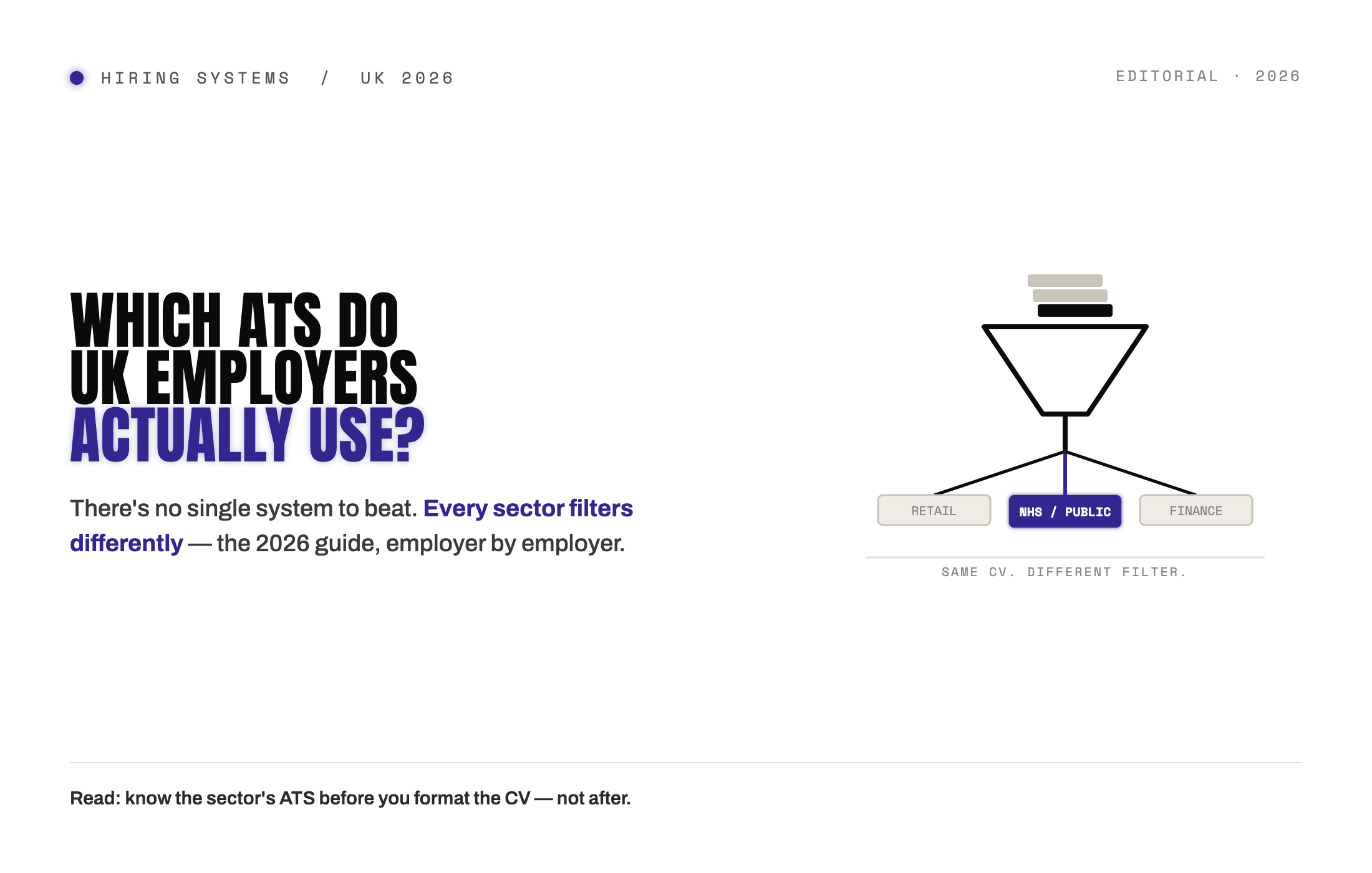
The Applicant Tracking System your target employer uses is one of the most useful things you can know before you apply. It determines how your CV is parsed, how your experience is extracted, which formatting elements will cause parsing failures, and how your application is scored and ranked against every other candidate before any human reads your name. Most job seekers treat ATS as a single uniform system. It is not. The NHS processes applications differently from a FTSE 100 bank. A Civil Service application is evaluated differently from a tech startup. Knowing which system you are applying through, and what that system does to your CV, is the difference between ranking in the top ten percent of applicants and not being read at all. This guide covers every major ATS platform used by UK employers in 2026, sector by sector, and what each one means for your application.

17 July 20269 min
How to Negotiate Your Salary in 2026: What Has Changed and What Actually Gets You More
How to Negotiate Salary in 2026: What Works, What Has Changed, and What to Say

How to Negotiate Your Salary in 2026: What Has Changed and What Actually Gets You More

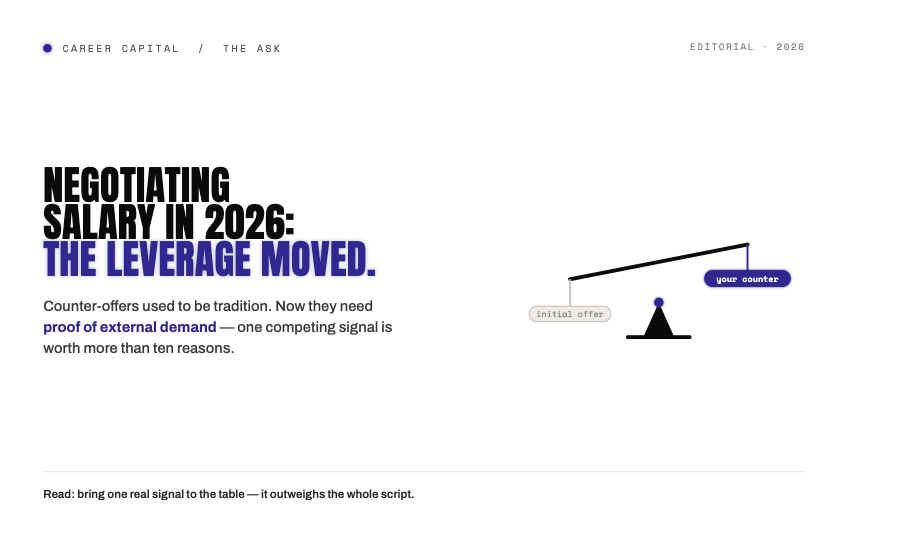
Eighty-eight percent of professionals feel confident negotiating salary. Most of them do not do it. Those who do receive an average 38% more than the initial offer.

13 July 20268 min
How to Prepare for a Job Interview When You Have Not Interviewed in Years
How to Prepare for a Job Interview After Years Out of the Market (2026 Guide)

How to Prepare for a Job Interview When You Have Not Interviewed in Years

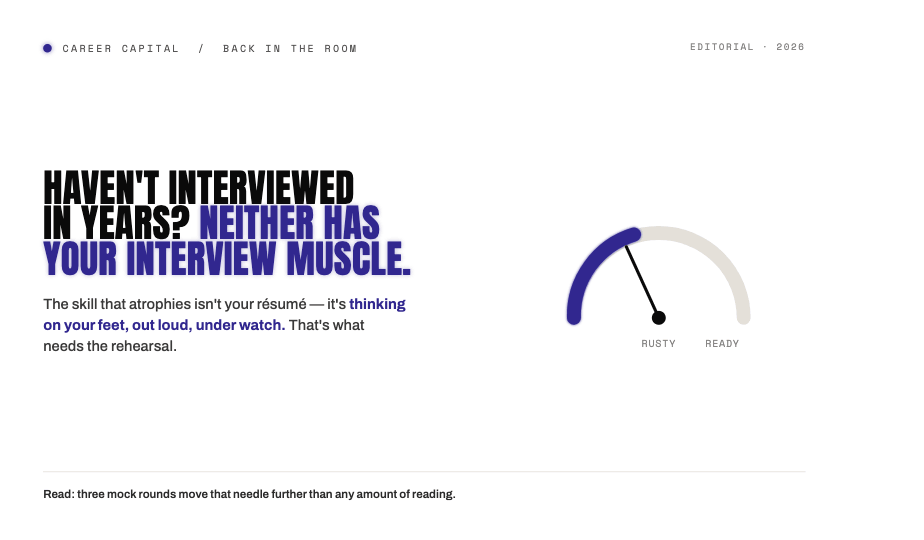
The skills that made you good at your job did not disappear while you were not interviewing. What changed is the process. If your last interview was five or more years ago, you are not refreshing existing knowledge.

10 July 20269 min
How to Build a Professional Network That Actually Opens Doors
How to Build a Professional Network That Opens Doors: The Practical Guide for 2026

How to Build a Professional Network That Actually Opens Doors

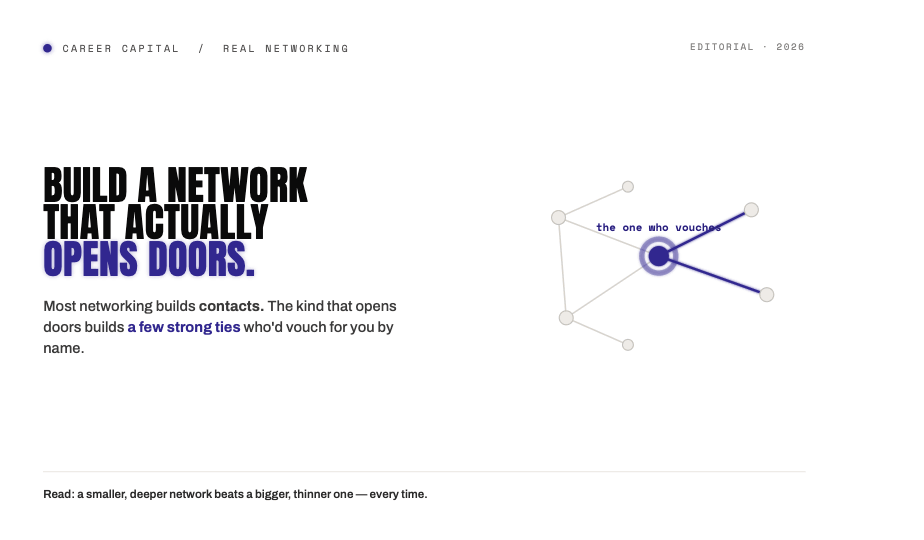
Most professionals have a larger network than they think and use far less of it than the situation warrants. Between 70 and 80% of roles are filled before they are publicly advertised.

9 July 20268 min
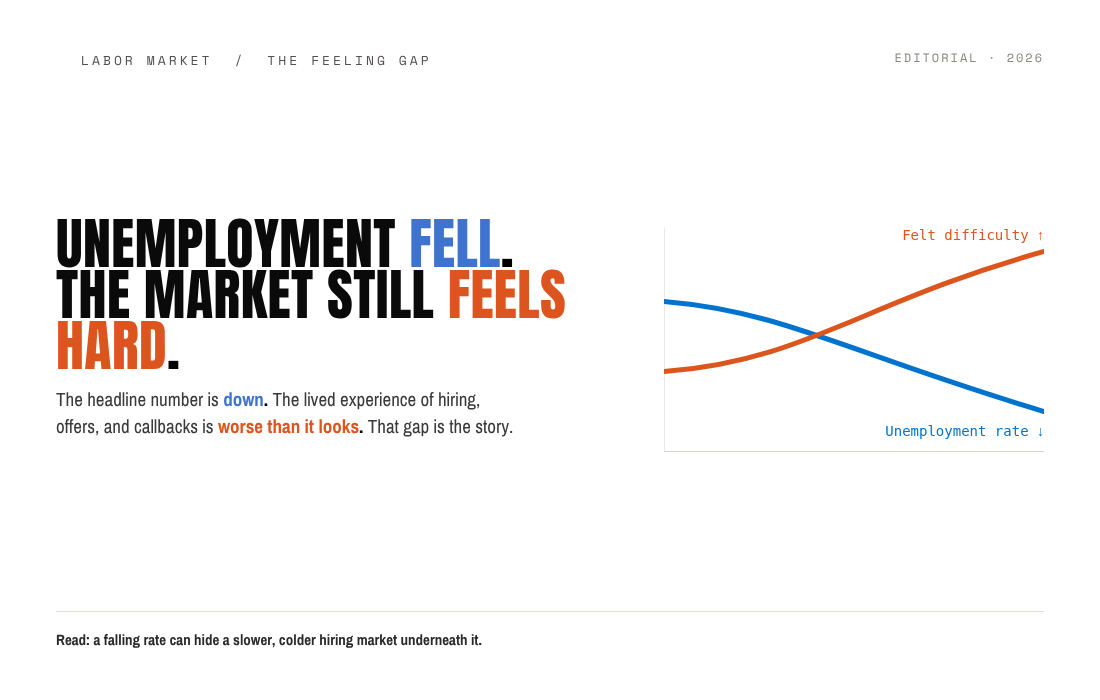
The Jobs Report Says Unemployment Fell. So Why Does the Job Market Still Feel This Hard?
June 2026 Unemployment Rate Fell: Why the Job Market Still Feels This Hard

The Jobs Report Says Unemployment Fell. So Why Does the Job Market Still Feel This Hard?

The unemployment rate fell to 4.2% in June 2026, the lowest in a year. In the same month, 507,000 fewer people were recorded as working and labour force participation hit its lowest point since March 2021.

8 July 20267 min
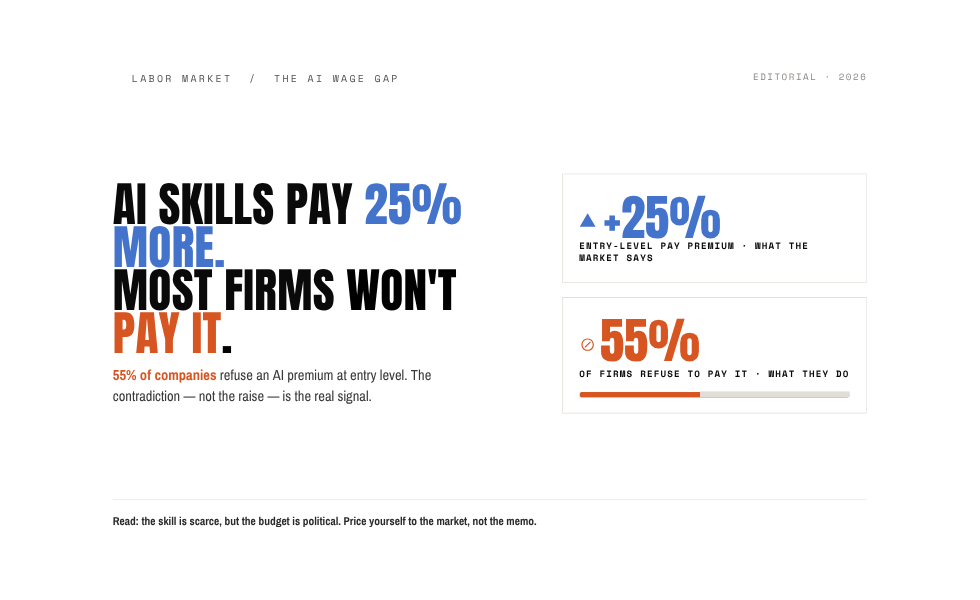
AI Skills Pay 25% More at Entry Level. But 55% of Companies Refuse to Pay a Premium. Here Is What That Contradiction Tells You
AI Skills Salary Premium 2026: Who Gets It and Who Does Not

AI Skills Pay 25% More at Entry Level. But 55% of Companies Refuse to Pay a Premium. Here Is What That Contradiction Tells You

Randstad analysed 50 million job postings and found entry-level workers with AI skills earning 25% more. Payscale surveyed companies and found 55% are not paying any premium for AI skills despite listing them in job descriptions. Both findings are from named primary sources and both are true simultaneously. The resolution to this contradiction explains specifically who captures the AI skills premium and who does not.

6 July 20267 min
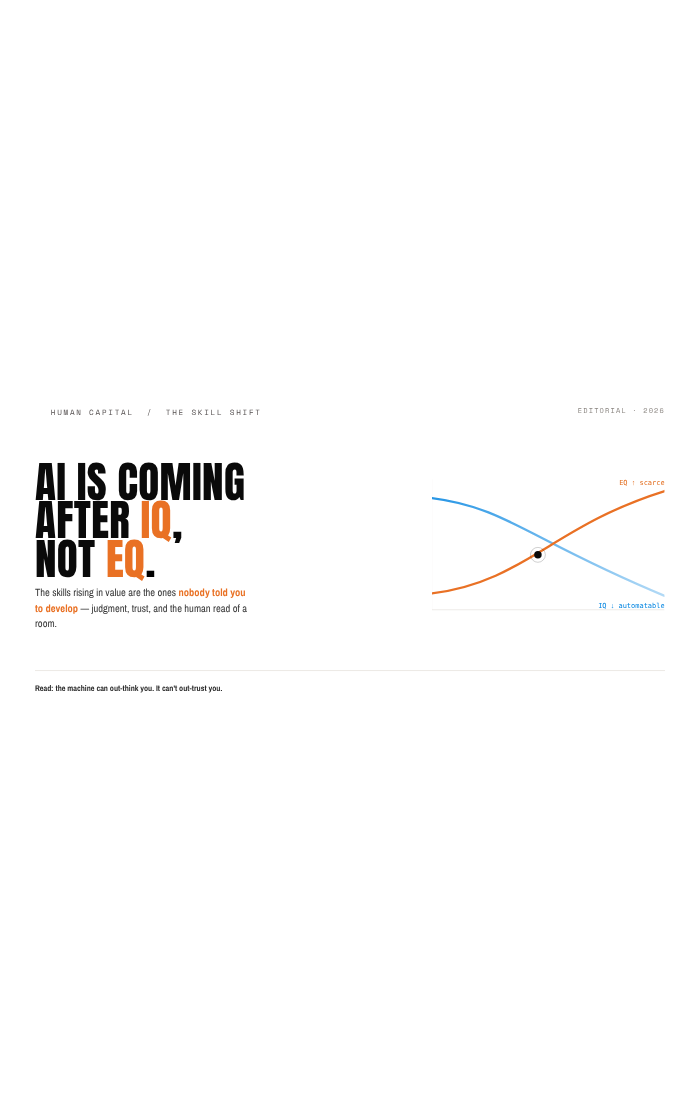
"AI Is Coming After IQ, Not EQ." Why the Skills That Are Rising in Value Are the Ones Nobody Told You to Develop
Skills Rising in Value 2026: Why AI Is Coming After IQ, Not EQ

"AI Is Coming After IQ, Not EQ." Why the Skills That Are Rising in Value Are the Ones Nobody Told You to Develop

AI is absorbing the structured, process-following work that once kept technical skills at a premium. CBS News, CNBC, Washington Monthly, and Forbes all confirmed in the past three weeks that critical thinking, communication, cultural reasoning, and judgment are now the capabilities employers are struggling to find. The problem is not that professionals lack these skills. It is that most career systems were never built to surface them clearly. Here is what the research shows and what to do with it.

3 July 20267 min
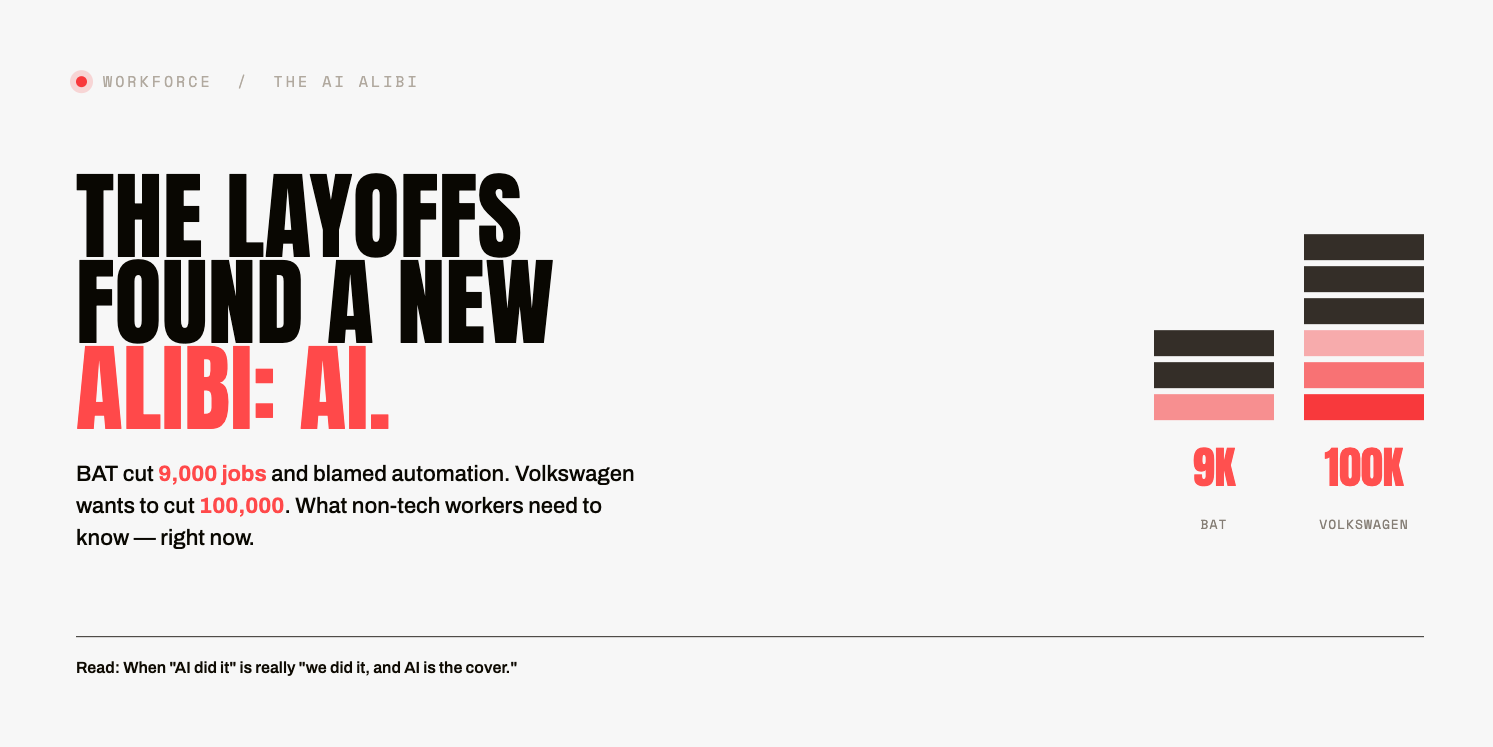
BAT Cut 9,000 Jobs and Blamed AI. Volkswagen Wants to Cut 100,000. What Non-Tech Workers Need to Know Right Now
BAT Volkswagen Layoffs 2026: What Non-Tech Workers Need to Know About AI Restructuring

BAT Cut 9,000 Jobs and Blamed AI. Volkswagen Wants to Cut 100,000. What Non-Tech Workers Need to Know Right Now

British American Tobacco cut 9,000 jobs on 29 June and cited its AI partnership with Accenture as the driver. Volkswagen is eyeing 100,000 cuts. The AI restructuring wave has left Silicon Valley. If you work in a traditional industry and assumed your sector was different, the pattern in this week's announcements suggests the timeline between "we are adopting AI" and "we are reducing headcount" is roughly twelve to eighteen months. Here is what non-tech professionals should do now rather than waiting.

2 July 20267 min
AI Job Interviews Outperform Human Recruiters: What the Research Found

AI Interviewed You and You Got the Job. New Research Says That Is Not a Coincidence

A field experiment covering more than 70,000 real job applicants found that candidates interviewed by AI voice agents received 12% more job offers and stayed in their roles 17% longer than those interviewed by humans, for the same jobs, with the same questions. Recruiters predicted AI would fail. They were wrong. This article covers what the research actually found, why it happened, and what it changes about how you should prepare for your next interview.

1 July 20265 min
Job Hugging 2026: Why Workers Are Staying in Jobs They Want to Leave

"Job Hugging": Why 57% of Workers Are Staying in Roles They Want to Leave

Job hugging is when you stay in a role you would otherwise leave, not because it is good, but because leaving feels too risky right now. ResumeBuilder found 57% of US workers now identify this way, up from 45% just six months earlier. The research is consistent: most people are not staying because they want to. They are staying because they are afraid. This article covers what is actually driving the trend, and the uncomfortable finding buried in the data, that for many workers, staying still may carry more risk than the move they keep avoiding.

30 June 20266 min
UK Skilled Worker Visa Jobs 2026: Find Sponsors Actually Hiring

UK Skilled Worker Visa Jobs: How to Find Sponsors Who Are Actually Hiring (Not Just Licensed to Sponsor)

A company holding a Skilled Worker sponsor licence and a company actively hiring international candidates right now are two different things, and confusing them wastes more time in a visa job search than almost anything else. This article covers how to filter the government's sponsor register down to employers genuinely worth your time in 2026, and what to do once you have a shortlist so your application actually converts.

29 June 20266 min
AI Washing Explained: How to Tell a Real AI Layoff From a Cover Story

AI Washing: Why "AI Made Us Do It" Has Become 2026's Favourite Layoff Excuse

AI washing is the term economists now use for a specific habit: blaming layoffs on artificial intelligence when the real cause is overhiring, investor pressure, or plain cost-cutting. Forrester, Wharton, MIT, and even OpenAI's own CEO have all named the pattern directly. Gartner data shows companies cutting jobs over AI are not actually seeing better returns from it than those that are not. Here is how to tell a genuine automation-driven layoff from a washed one, and what the distinction should change about your next move.

27 June 20268 min
referral vs cold application job success rate

Referral vs Cold Application: Why One Gets You a Job and the Other Gets You Ignored

You have been applying. You have been hoping. You have been watching the silence pile up in your inbox while the advice columns tell you to optimise your resume one more time. Here is what nobody is saying plainly enough: the channel you are spending 90% of your effort on has a success rate below 5%. The channel that actually fills most jobs is sitting right inside your existing network, unused. This is the honest breakdown of why referrals win, why cold applications are structurally designed to fail you, and how to change the game before your next application goes out.

26 June 20268 min
Will AI Take My Job? What PwC's 2026 Data Says About Your Career and Skills

Will AI Take My Job? What the Data Actually Says About Your Career in 2026

AI will not take your job in the way most people fear. PwC's 2026 Global AI Jobs Barometer, based on over one billion job advertisements across 27 countries, found the labour market is splitting into two tracks. Workers with AI skills earn 56% more than peers without them. The question for every professional right now is which track their role is moving toward, and what to do about it before the split widens further.

18 June 20268 min
UK Skilled Worker Visa 2026: How to Find Sponsored Roles Fast

The Skilled Worker Visa UK: How to Find Sponsored Roles Faster in 2026

Finding a UK Skilled Worker Visa role requires a thorough understanding of how sponsorship actually works. The salary threshold is now £41,700. The skill level requirement rose to RQF Level 6. The Immigration Salary List expires December 2026. Most international professionals are applying to roles that cannot sponsor them. This article covers what changed, where sponsorship is concentrated in 2026, and the approach that finds sponsored roles faster

15 June 20267 min
Interview Skills for Competitive Professionals in 2026: What the Data Says Works

Interview Skills for the Competitive Professional: What the Research Says You Are Getting Wrong

A lack of capability does not cause most interview failures. They arise from a gap between what the interviewer is actually measuring and what the candidate thinks they are being asked to demonstrate. 47% of candidates fail because they did not research the company adequately. 33% of hiring decisions are influenced within the first 90 seconds. And the STAR method is not broken; most candidates are just using it wrong. This article covers what competitive professionals do differently and why it produces consistently better outcomes.

12 June 20269 min
Career Growth Tools for UK Professionals in 2026: What the Research Says Works

Career Growth Tools for Ambitious UK Professionals: What Actually Works in 2026

Only 17% of British workers say they love their job. A quarter plan to change jobs in the next twelve months. And 53% lack confidence that their employer is investing in their development. The tools that accelerate career growth in 2026 are not the ones most UK professionals are using. This article covers what the research says actually works and the specific practices worth building into your professional life.

9 June 20269 min
How to Know When to Leave Your Job in 2026: The Framework Nobody Gives You

How to Know When to Leave Your Job: A Framework for Making the Decision Deliberately

The decision to leave a job is worth making carefully. Most people make it either too late, after months of diminishing performance, or reactively, after a single bad experience. Neither produces a good outcome. This framework distinguishes between a job worth leaving and a situation worth addressing differently, and gives you the structure to make the decision deliberately rather than under pressure.

8 June 202610 min
What Is a Good Job in 2026: What the Research Actually Says and What to Look For

What Is a Good Job? The Question Millions Are Now Asking (And What the Answer Actually Requires)

A good job is not the highest-paying one available to you. Google's own search data confirms this: the query "careers that help people" has consistently outranked "careers that pay well" since 2020, and the gap is widening. The American Job Quality Study, the most rigorous research of its kind, found that only 40% of US workers are in quality jobs by its criteria. This article defines what those criteria actually are and how to evaluate any job you are considering against them before you accept.

31 May 202611 min
Why Job Descriptions Lie and How to Navigate Hidden Requirements in 2026

The Job Description Lie: What Employers Are Really Looking For (And How to Navigate It Without Losing Your Mind)

Job descriptions do not tell you what employers actually want. They tell you what the person who wrote them thought they wanted, on the day they wrote it, before 400 applications arrived and the comparison began. If you have been rejected from roles where you met every listed requirement, the cause is almost certainly not a gap in your capability. It is a gap in the information the job description gave you. This article names what is actually happening and gives you a practical approach for navigating it.

26 May 202611 min
10 Best AI Job Search Tools 2026: Ranked by Methodology, Not Marketing

The 10 Best AI Job Search Tools in 2026: A Methodology-Backed Ranking That Does Not Spare Anyone

Most rankings of AI job search tools are written by one of the tools being ranked. This one uses a published six-criterion methodology, independent Trustpilot data, third-party test results, and documented user complaints to reach conclusions the author is willing to defend. The result includes some uncomfortable findings about the auto-apply category that the industry is not being honest about, and one clear conclusion about which tool is actually built for the job search problem that professionals face in 2026.

22 May 202617 min
How to Engineer a Career Pivot Without Starting From Zero (2026 Guide)

How to Engineer a Career Pivot Without Starting From Zero

Career pivots are now normal. The average professional changes careers three to four times in their working life, and OECD data show that professionals aged 45 to 54 who make deliberate, voluntary career changes see average wage growth of 7.4%. What separates the professionals who execute a pivot successfully from those who spend eighteen months in a costly transition is not courage or timing. It is a question of whether the move was engineered or improvised. This is the honest account of how to do it deliberately, without compressing the career capital you have spent years building.

17 May 202613 min
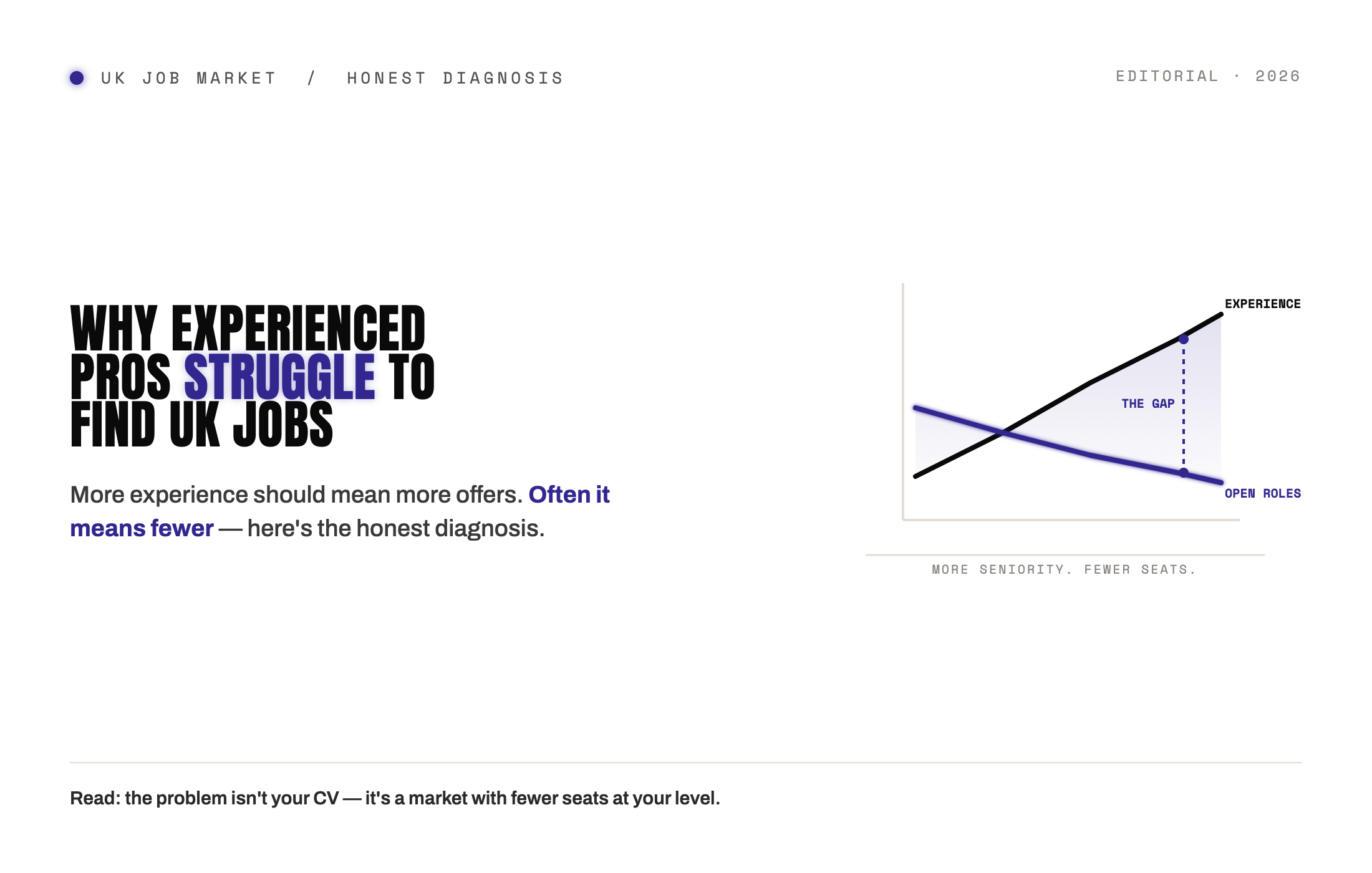
Job Search Tips for Experienced Professionals 2026: The Honest Guide

Job Search Tips for Experienced Professionals in 2026: What Works, What Does Not, and What the Market Will Not Tell You

Job searches at the senior level now average six to nine months in 2026, and the conventional advice available is almost entirely written for someone earlier in their career. White-collar payrolls have contracted for 29 consecutive months. Hiring for roles above $125,000 fell 32 percent year on year. The job board model that works for entry-level candidates does not work at Director, Head of, or C-Suite level, and the professionals who understand why are searching differently. This is the honest account of what actually works.

15 May 202616 min
what does ATS do to your resume

How to Beat ATS Systems in 2026: What Actually Works, What Gets You Flagged, and What the Guides Are Not Telling You

Up to 75% of resumes are filtered by automated systems before a human reads them. In 2026 the system has changed: keyword stuffing is now actively penalised, AI-generated content is flagged, and the five major ATS platforms all behave differently. This is the current state of how these systems actually work, including the platform-specific guidance that no other article is providing and the specific problems experienced and global professionals face that mainstream career advice does not address.

13 May 202622 min
Tech Layoffs 2026: What Coinbase's Cuts Mean for Your Career Right Now

What Coinbase's 700 Redundancies Tell You About the Job Market Nobody Is Preparing You For

Coinbase cut 700 people, citing AI as the reason. Block cut nearly half its workforce earlier this year for the same reason. Pinterest, CrowdStrike, Chegg and Gemini followed. This is not a cryptocurrency story and it is not a cyclical downturn. It is a structural shift in how companies are organised around AI, and the job market that the people caught in it are entering is significantly harder to navigate than most redundancy advice acknowledges. Here is the honest account of what is actually happening and what to do about it.

12 May 202610 min
why do I keep getting rejected from jobs

Why Do I Keep Getting Rejected From Jobs? The Honest Answer Nobody Is Giving You

You have sent the applications either manually or using AI auto-apply tools. You have rewritten the resume. You have done everything the advice columns told you to do. And you are still getting rejected, or worse, hearing nothing at all. Before you conclude that the problem is you, read this. The job market in 2026 is filtering out qualified people at scale, and most of them never find out why. This is the honest explanation nobody else is giving you, and what you can actually do about it.

12 May 202613 min
What Recruiters Look At in Your CV in 6 Seconds (And How to Make Every One Count)

What a Recruiter Does With Your CV in 6 Seconds.What a Recruiter Does With Your CV in 6 Seconds. Here Is Exactly What They Look At.

A recruiter spends an average of six seconds scanning your CV before deciding whether to read it or move on. In those six seconds, four specific things happen in a specific order, and most people have no idea what they are. If you have just been made redundant, or if you have been applying without results, this is the most practical thing you can read today about what is actually happening to your application and what to do about it before the next one goes out.

12 May 20269 min
How to Explain a Career Gap in 2026: ATS, Recruiters, and What to Say

How to Explain a Career Gap in 2026: What Actually Matters and What Does Not

A career gap is not a disqualifier in 2026. An unexplained, poorly formatted, or technically misread gap is. Most advice on this topic addresses the interview conversation while ignoring the part of the problem that happens before any human reads your name, which is where the real damage occurs. This article covers both what ATS systems actually do with employment gaps in your CV, and what a recruiter needs to hear when they ask about it.

12 May 20269 min
Meta Layoffs May 2026: What to Do When Your Employer Brand Stops Differentiating You

The Meta Effect: What Happens to Your Job Search When 8,000 People From the Same Company Hit the Market at Once

Reuters and NPR report that Meta's layoffs affecting approximately 8,000 employees are scheduled to begin on May 20. When thousands of professionals with the same employer brand enter the same market simultaneously, the rules of the job search change in specific and underappreciated ways. Here is what actually happens and what to do about it before the window closes.

10 May 20266 min
Skills-Based Hiring 2026: Why Experienced Professionals Are Still Getting Filtered Out

Skills-Based Hiring Is Here. Here Is Why It Is Making Things Harder for Experienced Professionals, Not Easier

Skills-based hiring was supposed to be the moment experienced professionals finally got credit for what they can actually do, rather than where they went to university or which brands appear on their CV. For many of them, it has made things harder, not easier. If you have a complex, non-linear career history and you are still being filtered out by systems that claim to reward demonstrated capability, this is the honest explanation for why, and what you can actually do about it.

4 May 20269 min

Ready to accelerate your job search?

AI-powered resume analysis, job matching, interview prep, and referral tools — all in one place.

Start for free