

If you have been sending out applications for any length of time without much to show for it, there is a question you need to sit with honestly. Are you actually job searching, or are you just applying to jobs?
Those two things feel the same. They are not.
The data on this is not subtle, and it is not new, but almost nobody in the job advice industry talks about it because the entire infrastructure of job searching, the job boards, the resume builders, the auto-apply tools, is built around the model that does not work. So let us say it clearly. Cold applying to advertised roles is the least effective way to find a job in 2026. It is not the only way, it is not even a bad thing to do in isolation, but if it is your primary strategy, you are spending most of your effort in the most crowded, most filtered, least trusted part of the entire hiring market.
What the numbers actually say
Research consistently shows that somewhere between 70% and 80% of jobs are never publicly advertised. They are filled before a posting ever goes live, or they are created specifically for a person who was already visible to the hiring team. The job board listing you are competing against 300 other candidates for is often the last resort, not the first one.
When a role does get posted, the numbers get worse. The average corporate job posting in 2026 attracts between 200 and 500 applications. Of those, 99% of Fortune 500 companies filter candidates automatically through Applicant Tracking Systems before any human reads a word.
Now look at what happens when someone refers you. Referred candidates are hired at a rate roughly four times higher than candidates who apply cold. The interview conversion rate for referred candidates sits between 30% and 50%, depending on the sector. For cold applicants, it sits below 5% for most roles in the current market. That gap is not marginal. It is structural.
The reason is straightforward. When someone inside a company says your name, they are transferring their own credibility to you. The hiring manager no longer has to take a risk on a stranger. The uncertainty that makes cold applications so easy to filter out simply does not exist in the same way. You have already passed the first and most important test, which is whether someone who knows the company believes in you enough to put their name next to yours.
Why most people are not using referrals even though they know they should
Everyone knows referrals work. This is not hidden information. And yet the vast majority of job seekers still spend 90% of their time on cold applications and 10% on networking, when the evidence says those proportions should be closer to the reverse.
There are a few honest reasons for this.
The first is that a cold application feels like action. You can submit ten applications in an evening and feel like you have been productive. Mapping your network, identifying who knows who, thinking about how to approach someone you have not spoken to in three years, that feels slower, more uncertain, more exposing. It is easier to disappear into a job board than to send a message to a real person and wait for a real response.
The second is that most people massively underestimate the size and strength of their existing network. You do not need to know someone at the company directly. You need to know someone who knows someone. A second-degree connection who is willing to make an introduction is often enough to shift the entire dynamic of an application. But most people never map that territory because they assume the connections are not there.
The third reason is that even when people recognise the value of a referral, they do not know how to ask for one in a way that feels natural rather than transactional. The fear of looking desperate, or of putting someone in an awkward position, stops the ask from happening at all. So the referral path sits unused, and the cold applications keep going out, and the silence keeps coming back.
The mechanics of a referral that actually works
A referral is not just someone mentioning your name. The quality of the referral matters enormously.
A weak referral sounds like this: "I know someone who might be interested." It carries almost no weight. It does not reduce the uncertainty in the hiring manager's mind.
A strong referral sounds like this: "I have worked/or I am connected with this person. Here is specifically how they fit and why it matters for what you are trying to solve right now." That referral changes the entire conversation before your CV arrives.
To get the strong version, three things need to be true. First, you need to reach the right person, not just anyone inside the company, but someone with proximity to the decision being made. Second, you need that person to have enough context about your work to speak about it credibly, which means the connection needs to be real, not manufactured. Third, you need to make the ask in a way that gives the person a reason to say yes and makes it easy for them to do so.
Most people get stuck at the first step because they cannot see the path. They know who they want to reach, but they cannot identify who in their network connects them to that person. And without that map, the referral stays theoretical.
What Candoorai built to solve this
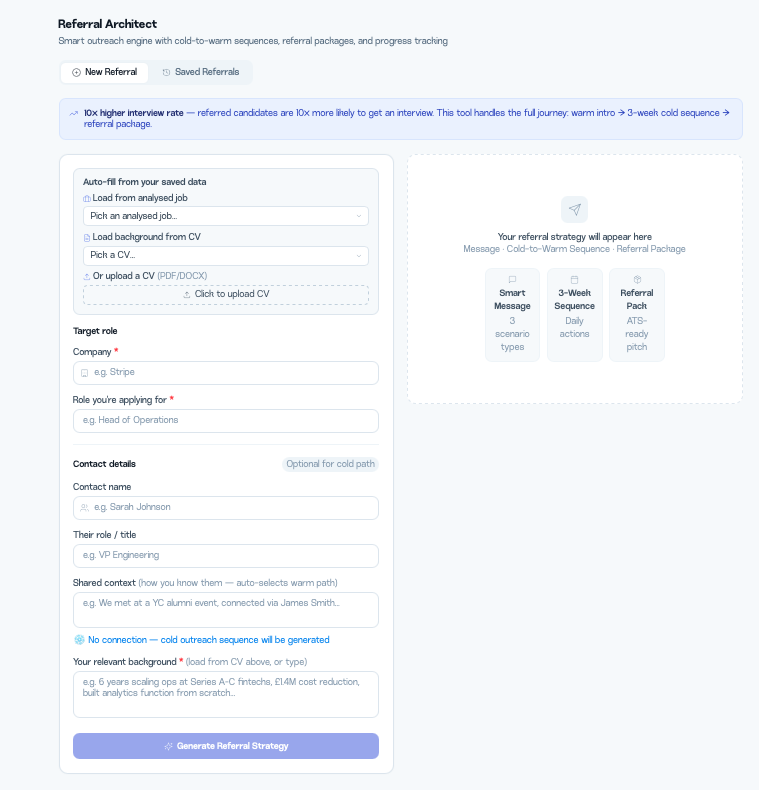
The Referral Architect is one of the core features of the Candoorai platform, and it exists precisely because this is where the job search breaks down for most people.
The tool maps your existing network against any target company and shows you the referral paths that already exist. You → Priya → Hiring Manager. You → Alex → Director. You → Sam → VP of Engineering. It helps you understand each path so you can see where your warmest connection to the decision-maker actually lives, rather than guessing or cold-messaging someone in the hope that it lands.
Once the path is identified, the Referral Architect helps you write the outreach. Not a generic "hope you're well" message that gets ignored, but a specific, contextual message that explains why you are reaching out, what you are asking for, and makes the ask as easy as possible to say yes to. The outreach is grounded in your actual relationship with that person and the specific role you are targeting.
The logic is simple. Systematic, not hopeful. Most referral attempts fail not because the connection was wrong but because the execution was vague. The Referral Architect removes the vagueness.
The three moves that change the result
If you step back from the tool for a moment and look at what a successful referral-based job search actually requires, it comes down to three things that have to happen in sequence.
The first is mapping your network to your target companies. Not your whole network abstractly, but specifically, who do you know, and who do they know, at the places you actually want to work. This is intelligence work, not social performance.
The second is finding the shortest path to the decision-maker. Not the HR contact, not the recruiter, not a junior employee who does not influence the hire. The person who has the authority to say yes, and the person who is closest to them in your network.
The third is making the ask impossible to refuse. A clear, specific, low-friction request that tells the person exactly what you need and makes it easy for them to help you without putting themselves in an awkward position.
That is it. That is the whole game. Every referral that successfully converts a job search into an interview follows this structure, whether the person doing it knew that explicitly or not.
What this means for your job search right now
If you have been applying cold and wondering why nothing is moving, the answer is almost certainly not that your resume is wrong or that you are not qualified. The answer is that you are operating in the hardest, most competitive channel in the market, while a significantly easier and more effective channel sits largely unused.
This is not about abandoning job applications entirely. It is about rebalancing how your effort is allocated. Every hour you spend identifying a warm path to a company you want to work for is statistically worth more than every hour you spend optimising a cold application to beat 300 other CVs into an ATS.
The job market has always rewarded visibility over paperwork. In 2026, with the volume of applications at an all-time high and AI filtering making cold applications harder to penetrate than ever before, that gap has widened to the point where strategy is no longer optional. It is the whole job.
You are not losing because you are not good enough. You are losing because you are late. And being late is fixable.
Explore the Referral Architect