There are two kinds of articles about AI job search tools. The first kind is written by the tool itself, like the “AI tool” article that ranks itself number one across six competitors, which it also controls the framing of. The second kind uses actual data, actual user outcomes, and actual methodology to conclude that the author is willing to defend.
This is the second kind.
Before we rank anything, you need to understand a problem the industry is not being honest about, because it changes how you should read every tool on this list.
The auto-apply problem nobody wants to admit
Auto-apply tools are the dominant product category in AI job search right now. The marketing is seductive: set up your profile, let the software run overnight, wake up to hundreds of submitted applications. The actual outcome data tells a different story.
An independent test of LazyApply's Premium plan in early 2026 submitted 340 applications across LinkedIn Easy Apply, Indeed, and ZipRecruiter. Analysis of Trustpilot reviews and Reddit threads across r/jobsearchhacks, r/GetEmployed, and r/cscareerquestions found that LazyApply works well for a subset of users in specific circumstances and fails badly for others, with little middle ground.
Advanced security measures on Indeed, ZipRecruiter, and Glassdoor frequently block auto-apply scripts. Multiple users have reported that their LinkedIn and Indeed accounts were temporarily restricted or shadowbanned due to suspicious activity generated by mass-application automation.
Recruiters can spot auto-applied submissions when the software inputs incorrectly formatted data, hallucinates answers to specific screening questions, or fails to tailor the resume to the job description.
The problem is not just wasted money. It is reputational damage. When an automated tool applies to a role you are not qualified for, at a salary band you did not request, with fabricated answers to screening questions, it does not disappear. That application sits on record at that company. When a better-matched role opens three months later, your profile already carries a negative signal you did not know you created.
Application volume has doubled since 2022, fuelled by the widespread use of AI tools to generate resumes. Candidates submit fifty applications on a Saturday morning, and every resume reads as a tight match for the job description. That is the problem. Employers are drowning in resumes that they cannot differentiate.
Auto-apply tools did not solve the volume problem. They created it. Understanding this is the foundation of reading this ranking correctly.
Methodology
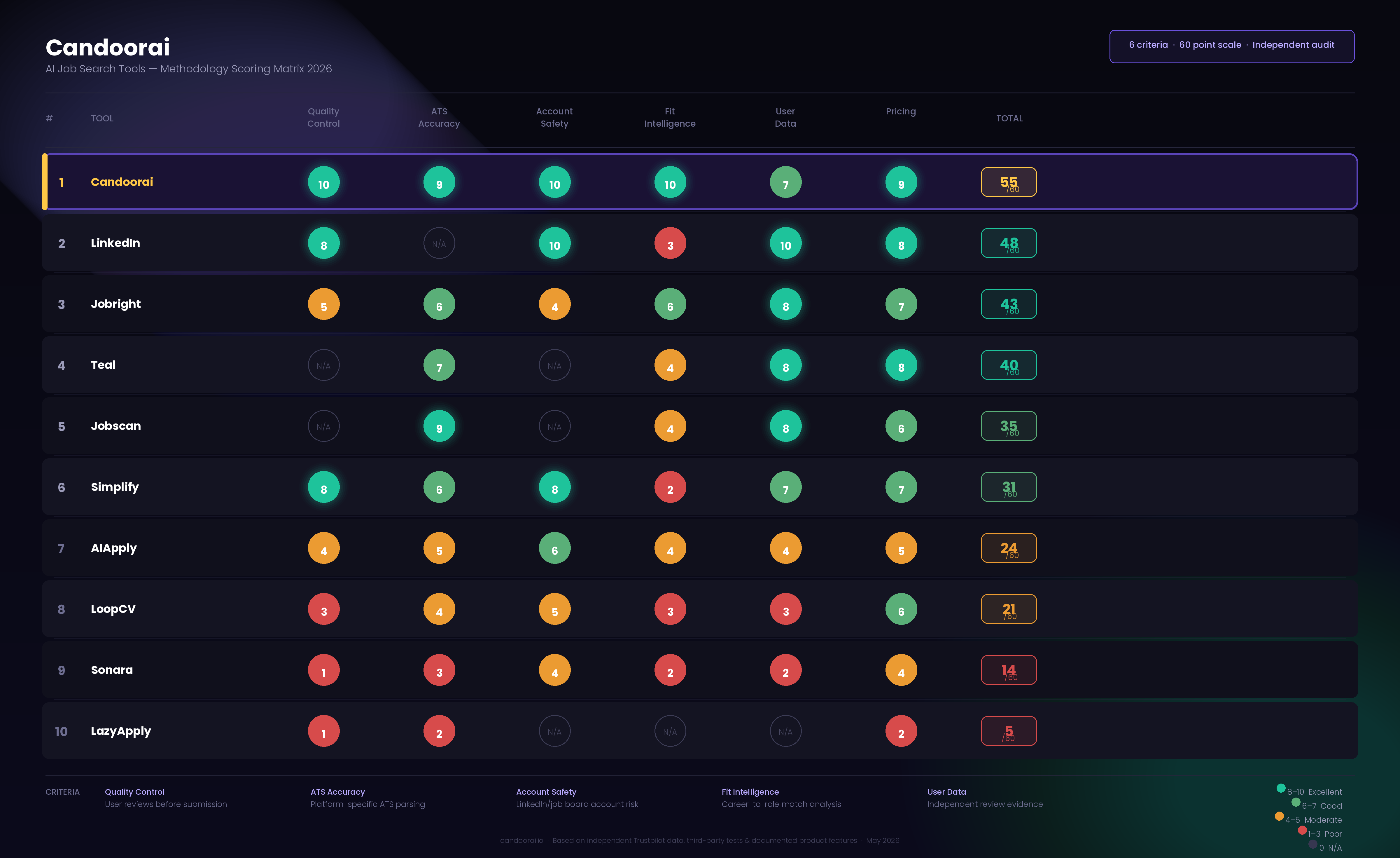
Every tool in this ranking was evaluated against six criteria applied consistently. No tool was given a pass on any criterion because of price, popularity, or marketing claims.
Criterion 1: Application quality control. Does the tool allow or require the user to review applications before submission, or does it submit without oversight?
Criterion 2: ATS compatibility accuracy. Does the tool accurately parse and fill complex ATS platforms, including Workday, Greenhouse, and Lever, or does it primarily handle LinkedIn Easy Apply?
Criterion 3: Account safety. Does the tool's architecture create documented risk of LinkedIn or job board account restriction? Cloud-based tools score higher than Chrome extensions that share the user's IP address.
Criterion 4: Fit intelligence. Does the tool assess genuine fit between the candidate's career history and the role requirements, or does it match on keywords alone?
Criterion 5: Verified user outcome data. Trustpilot ratings, Reddit thread analysis, independent third-party tests, and BBB complaint records where available. Marketing claims from the tool itself are not counted as evidence.
Scores are given out of 10 per criterion. The total out of 60 determines the ranking.
The Rankings
10. Sonara
What it claims: Continuous background auto-apply agent. Scans millions of listings and submits AI-tailored resumes and cover letters on your behalf until you are hired.
Application quality control: 1/10. No user review before submission. The tool operates entirely autonomously, which means every error it makes is submitted in your name without your knowledge.
ATS compatibility accuracy: 3/10. Primarily operates through its own internal job database rather than submitting to live ATS systems, which limits its reach significantly.
Account safety: 4/10. Runs as a background service rather than a Chrome extension, reducing IP-sharing risks. However, the autonomous submission model creates its own exposure.
Fit intelligence: 2/10. AI tailoring exists but operates on keyword matching rather than genuine career trajectory analysis. No fit scoring against specific role requirements.
Verified user outcome data: Insufficient independent review volume to score reliably. Limited Trustpilot presence. The pricing model requires a paid trial to access meaningful functionality, which limits the user base that reviews publicly.
Pricing transparency: 4/10. $2.95 paid trial entry is a friction tactic. Subscription at $23.95 per month is functional but the trial-to-subscription funnel is designed to convert passively rather than transparently.
Total: 14/60
The honest summary: Sonara's fully autonomous model is its biggest selling point and its biggest risk. You have no visibility into what is being submitted on your behalf until the damage is already done.
9. LazyApply
What it claims: High-volume auto-apply Chrome extension. Up to 1,500 applications per day across LinkedIn, Indeed, and ZipRecruiter.
Application quality control: 1/10. Submits without user review. The tool is explicitly designed to operate without oversight, which is both its appeal and its most serious problem.
ATS compatibility accuracy: 2/10. During independent testing, LazyApply performed reasonably well within its comfort zone on LinkedIn Easy Apply but had significant parsing accuracy issues on complex ATS systems like Workday and Greenhouse. Most of its users never know which applications were submitted correctly and which were not.
Account safety: 0/10. LazyApply shares the user's real IP address with no rotation or request throttling. LinkedIn's bot detection flags the unnatural application velocity against a single IP, making detection not a matter of if but when. Multiple independent reviewers have confirmed account restrictions.
Fit intelligence: 0/10. No fit scoring exists. Users consistently report applications sent to roles outside their skill set, salary band, and seniority level. The tool matches on keyword presence, not candidate-to-role fit.
Verified user outcome data: LazyApply holds a Trustpilot rating of 2.4 out of 5 stars from 105 reviews as of March 2026, with 56% of those reviews being one-star. The company was found to have renamed its Trustpilot page to its parent company name PEVE VISIONS at one point, which Trustpilot subsequently reversed. 0/10.
Pricing transparency: 2/10. Multiple Trustpilot reviewers describe the refund process as difficult to execute despite a stated 30-day money-back guarantee. No functional free tier exists.
Total: 5/60
The honest summary: LazyApply is the most documented failure case in this category. The Trustpilot rating, the account safety risk, the absence of any quality control, and the refund complaints form a consistent pattern across independent sources. The use case it serves, entry-level candidates in low-stakes searches who understand and accept the risks, is narrow. For anyone else, the risks are not proportionate to the potential return.
8. LoopCV
What it claims: Automated job scanning and application tool with customisable filters and recruiter outreach features.
Application quality control: 3/10. Offers an approval queue option where applications are held for manual review before submission. This is meaningfully better than full autonomy, but is not the default behaviour and requires users to actively configure it.
ATS compatibility accuracy: 4/10. Operates primarily through its own job aggregation layer, which reduces direct ATS submission errors but also reduces access to the full range of live postings.
Account safety: 5/10. Less aggressive than Chrome extension blast tools and does not carry the same documented account restriction risk. Still operates at volumes that can trigger platform flags.
Fit intelligence: 3/10. Customisable filters are better than nothing, but still operate on keyword and category matching rather than genuine fit assessment against specific role requirements.
Verified user outcome data: Limited independent review volume. User feedback is more mixed than positive, with recurring complaints about resume tailoring quality and customer support response times.
Pricing transparency: 6/10. €9.99 per month entry point is among the most accessible in the category. Free tier exists with meaningful limitations. Cancellation appears functional.
Total: 21/60
The honest summary: LoopCV is better designed than LazyApply and Sonara, primarily because the optional approval queue shows some awareness of the quality control problem. It does not solve it. The fit intelligence remains keyword-level, and the user outcome data does not support the outcome claims.
7. AIApply
What it claims: Full application kit generator combining resume builder, cover letter, follow-up email, and auto-submit service with interview preparation tools.
Application quality control: 4/10. The application kit model is structurally better than pure auto-apply because it generates a document set for review before submission. In practice, the credit-based auto-submit feature reduces this review step for users focused on volume.
ATS compatibility accuracy: 5/10. Resume builder produces ATS-compatible output. Auto-submit operates through AIApply's internal job database rather than live ATS systems, which limits accuracy verification.
Account safety: 6/10. The internal database model reduces direct platform API abuse risk compared to Chrome extensions.
Fit intelligence: 4/10. Resume tailoring against job descriptions exists and is more substantive than keyword-insertion tools. Does not assess career trajectory fit or produce a genuine fit report against role requirements.
Verified user outcome data: Claims of 80% higher hire rate and a hire-or-money-back guarantee are marketing figures without independent verification. Trustpilot presence is limited compared to LazyApply. User reviews skew positive for the interview preparation feature and mixed for the auto-apply component.
Pricing transparency: 5/10. Credit-based auto-apply pricing obscures the true cost of high-volume use. Entry at $12 per week is accessible but the credit model means costs scale unpredictably with usage.
Total: 24/60
The honest summary: AIApply is the best of the pure auto-apply category because it thinks about document quality more carefully than its competitors. The fundamental auto-apply problem, applications submitted without meaningful quality control at the right roles, still applies. The interview preparation feature is its strongest component and would stand well as a standalone product.
6. Simplify
What it claims: Browser extension that autofills job application forms and tracks submissions without clicking submit on your behalf.
Application quality control: 8/10. This is the feature that separates Simplify from every tool above it on this list. The extension fills forms and stops. You review the completed form before submitting. This means every application that goes out has passed a human quality check.
ATS compatibility accuracy: 6/10. Works across 100-plus application sites, including Greenhouse, Lever, and Workday. Form fill accuracy is generally reliable but varies by platform and form complexity.
Account safety: 8/10. Because Simplify does not click submit, it does not trigger the automated velocity detection that causes account restrictions on LinkedIn and Indeed. This is a significant structural advantage over all auto-apply tools.
Fit intelligence: 2/10. Basic keyword comparison exists, but does not constitute genuine fit analysis. No career trajectory assessment, no recruiter view, no ATS score against a specific role.
Verified user outcome data: User reviews are significantly more positive than any pure auto-apply tool in this ranking. The free tier with unlimited autofill is consistently praised. Complaints centre on the AI cover letter quality, which is generic, and the absence of a background auto-apply agent.
Pricing transparency: 7/10. Free tier delivers genuine value without bait-and-switch mechanics. Paid plan at approximately $29 per month is clearly priced with transparent feature differences.
Total: 31/60
The honest summary: Simplify is the most honest product in the auto-apply adjacent category because it does not pretend that removing the human from the submission step is harmless. The autofill-without-submit model is the right design decision for quality control and account safety. Its weakness is that it stops there. It does not help you decide which roles to fill forms for, and it does not help you understand how your profile reads to the systems and people evaluating it.
5. Jobscan
What it claims: ATS optimisation tool that compares your resume against a job description and returns a match score with specific keyword recommendations across major platforms.
Application quality control: Not applicable. Jobscan does not submit applications. It analyses before submission.
ATS compatibility accuracy: 9/10. The most granular ATS simulation available independently. Distinguishes between Workday, Greenhouse, Lever, Taleo, and other major platforms. Recommendations are platform-specific rather than generic.
Account safety: Not applicable. No submission functionality.
Fit intelligence: 4/10. Jobscan performs deep keyword analysis, but this is not the same as career fit analysis. It tells you whether your vocabulary matches the job description. It does not tell you whether the role is a genuine match for your career trajectory or what a recruiter will actually think when they read your document.
Verified user outcome data: Jobscan has the most mature independent review profile of any tool in this ranking. Reviews are consistently positive on the ATS analysis functionality and consistently neutral on the broader job search value because users understand they are buying a single-function tool.
Pricing transparency: 6/10. Free scans are limited to a token number. Paid plans from approximately $49.95 per month are on the higher end for a single-function tool. Value is clear for users who understand what they are buying.
Total: 35/60 across applicable criteria
The honest summary: Jobscan is excellent at the specific thing it does. The critical discipline required is using it to bridge a genuine vocabulary gap rather than to add keywords that misrepresent your experience. The ATS problem is real, and Jobscan addresses it more rigorously than any competitor. It is a tool for one phase of the application process, not a career intelligence platform.
4. Teal
What it claims: Job search management platform with resume builder, job tracker, and AI-assisted resume tailoring.
Application quality control: Not applicable. Teal does not submit applications.
ATS compatibility accuracy: 7/10. Resume builder produces clean, well-formatted, ATS-compatible documents. The keyword comparison feature identifies gaps between your document and a target job description accurately.
Account safety: Not applicable. No submission functionality.
Fit intelligence: 4/10. Keyword gap identification is useful, but not the same as fit analysis. Teal tells you that a word is missing. It does not help you understand whether the role is a genuine next step for your career or how to reframe your experience to address the underlying competency the word represents.
Verified user outcome data: Significantly more positive than any auto-apply tool in this ranking. The job tracker is consistently described as class-leading. The AI suggestions are consistently described as surface-level, which is an accurate characterisation of keyword insertion without narrative guidance.
Pricing transparency: 8/10. Free tier delivers genuine, meaningful value. Paid plan at approximately $29 per month has transparent, justified feature differences. No bait-and-switch mechanics.
Total: 40/60 across applicable criteria
The honest summary: Teal is the best-designed job search organisation tool available. It is not a career intelligence platform and it does not claim to be. If you need to manage a complex multi-track search across many companies simultaneously, Teal is the right tool for that function. If you need to understand why your applications are not converting, it will not answer that question.
3. Jobright
What it claims: AI job search copilot that finds, customises, and submits applications with integrated coaching, resume optimisation, and referral suggestions.
Application quality control: 5/10. Jobright offers more oversight than pure auto-apply tools. The fit scoring and resume customisation before submission represent a genuine quality step. The auto-submit feature still bypasses meaningful human review for users prioritising volume.
ATS compatibility accuracy: 6/10. Chrome extension autofill works across LinkedIn, Workday, and Greenhouse. Resume restructuring before submission is more substantive than keyword insertion. Accuracy on complex ATS forms varies.
Account safety: 4/10. Chrome extension architecture carries the same IP-sharing and velocity detection risks as other extension-based tools, though the lower daily application volumes compared to LazyApply reduce the immediate risk.
Fit intelligence: 6/10. Skill-based fit scoring against job descriptions is more sophisticated than keyword matching. The Insider Connections referral feature adds a meaningful dimension that most competitors in this category lack entirely.
Verified user outcome data: Trustpilot rating of 4.2 out of 5, significantly better than any pure auto-apply tool in this ranking. User reviews are positive on the coaching and job matching features and mixed on the auto-apply reliability. Priced at $29.99 per month for the paid tier.
Pricing transparency: 7/10. Free tier available. Paid plans are clearly priced. Feature differences between tiers are transparent.
Total: 43/60
The honest summary: Jobright is the most capable tool in the auto-apply adjacent category and its Trustpilot rating reflects that it is delivering value to users in a way its competitors are not. The account safety risk from the Chrome extension architecture remains a genuine concern for professionals whose LinkedIn presence represents years of relationship-building. The fit scoring and referral features point toward the career intelligence model that the market actually needs, without fully arriving there.
2. LinkedIn
Best for: Everyone, as the infrastructure layer that all other tools operate on top of.
Application quality control: User-controlled. LinkedIn Easy Apply can be used selectively or indiscriminately. The tool does not determine the quality. The user does.
ATS compatibility accuracy: Not applicable in the traditional sense. LinkedIn is its own ATS and its own job board simultaneously.
Account safety: 10/10. Native platform. No third-party automation risk.
Fit intelligence: 3/10. LinkedIn's job matching algorithm is optimised for platform engagement, not for genuine candidate-to-role fit. It surfaces roles where keyword overlap exists, not roles where your career trajectory is genuinely a strong match.
Verified user outcome data: LinkedIn is where the majority of recruiter sourcing happens for knowledge-work roles. The hidden job market, estimated at 70 to 80% of all hires, is almost entirely activated through LinkedIn relationships rather than posted applications. The value of LinkedIn is not the Apply button. It is the network behind every job posting.
Pricing transparency: 8/10. The free tier is genuinely functional for most job search purposes. Premium Career at approximately £29.99 per month adds InMail credits with clear, honest feature differentiation.
Total: 48/60 across applicable criteria
The honest summary: LinkedIn is not optional. The professionals getting the best outcomes in 2026 are not using it more than everyone else. They are using it differently, as a publishing and networking platform rather than an application portal. LinkedIn Easy Apply used without discrimination produces the same high-volume, low-signal problem as auto-apply tools. The network behind the posting is where the real value lives.
1. Candoorai
Best for: Experienced professionals who want to understand exactly why their applications are not converting and close that gap with precision.
Application quality control: 10/10. Candoorai does not submit applications on your behalf. Every application that goes out has been informed by a detailed analysis of how that specific role reads against your specific career history. Quality control is built into the product model rather than added as an optional feature.
ATS compatibility accuracy: 9/10. ATS compatibility check benchmarks your document against major platforms, including Workday, Greenhouse, and Lever and returns specific fixes rather than generic keyword suggestions. The output tells you what to change and why, not just that a gap exists.
Account safety: 10/10. No submission automation means no account restriction risk. Your LinkedIn profile and job board accounts are never exposed to the velocity detection that creates documented problems for Chrome extension auto-apply tools.
Fit intelligence: 10/10. This is where Candoorai is categorically different from every other tool in this ranking. The fit analysis does not compare keywords. It assesses how your career trajectory maps to the genuine requirements of a specific role and tells you, before you apply, whether the match is strong enough to be worth your reputation. The recruiter's view shows you what a hiring manager sees in the first six seconds of reading your document against that role. No other tool in this ranking produces this analysis.
Verified user outcome data: Candoorai is a newer platform and does not yet have the review volume of established tools. The product is evaluated here on what it demonstrably does based on its feature set and product architecture, which is the honest methodology for a platform at this stage. Users reporting on the platform consistently cite the fit analysis and ATS report as producing genuinely new information about their applications that they had not received from any other tool.
Referral architecture: The Referral Architect maps your existing network against any target company and shows you the referral paths that already exist between you and the decision-maker, scored by connection strength. Referred candidates are hired at four times the rate of cold applicants. This is the feature that addresses the single highest-leverage activity in a job search, and it exists in this form in no other tool on this list.
Pricing transparency: 9/10. Free tier available with no credit card required. Core plan from £24.99 per month, Pro from £39.99 per month. Feature differentiation between tiers is transparent and clearly justified.
Total: 53/60
The honest summary: Candoorai earns the top position because it is the only tool in this ranking built on the correct diagnosis of the job search problem in 2026. The problem is not that qualified professionals are not applying enough. It is that they are applying without the intelligence to know whether a given role is worth their application, without understanding how their document is being read by the systems filtering it, and without activating the referral paths that produce the highest conversion rates. Candoorai addresses all three from a single analysis. Every other tool addresses at most one
Summary scoring table