

A company holding a Skilled Worker sponsor licence and a company actively hiring international candidates right now are two different things, and confusing them is the single biggest time-waster in the UK visa job search. According to UK Visa Jobs' own analysis of the government register, the vast majority of the more than 124,000 organisations listed do not actively hire foreign nationals, and many barely hire at all. If you check a hundred companies a day from the list, it would take roughly three years to get through it, and most of that time would be spent on names that were never going to respond.
This article covers two things: how to filter the sponsor register down to companies genuinely worth your time, and what to do once you have a shortlist so that your application actually converts rather than just qualifying on paper.
The Register Tells You Who Can Sponsor. It Does Not Tell You Who Will.
The UK government's Register of Licensed Sponsors is the correct starting point and the only fully authoritative source, since holding a sponsor licence is a legal precondition for hiring you on a Skilled Worker visa. But the register answers a narrow legal question, not the practical one. It confirms eligibility. It says nothing about whether that employer is actively recruiting internationally this quarter, whether the specific role you want sits at the right skill and salary level, or whether the licence is even being used at all rather than held defensively.
This is the gap that several existing directory sites, including SponsorIntel and SponsorList.co.uk, have tried to close by making the register more searchable, filterable by city and sector, and checkable for licence status in real time. That is genuinely useful and worth doing. But it still leaves you with a list of names rather than a strategy, and it still requires you to do the harder, slower work yourself: checking which of those licensed companies have a live opening at your level, in your function, paying above the current threshold.
What Changed in the Rules and Why It Narrows Your List Further
The threshold for the general route rose to £41,700 per year as of July 2025, and you must meet whichever is higher between that figure and the specific going rate published for your occupation code. The skills threshold rose at the same time from RQF Level 3 to RQF Level 6, which is degree level, removing eligibility for more than 110 occupations that were previously sponsorable, including several skilled trade and care roles. From 8 January 2026, new applicants must demonstrate English at CEFR B2, up from B1.
The practical effect of these changes is that a meaningful share of the roles on general job boards mentioning sponsorship no longer actually qualify, because either the salary or the skill level falls short of the new bar. Several roles on the Immigration Salary List and Temporary Shortage List still carry a reduced threshold, around £33,400 for ISL occupations and £29,000 for Health and Care Worker roles specifically, but both lists are scheduled to be reviewed and potentially phased out by the end of 2026 under the wider Immigration White Paper changes. Checking a role's published going rate against the current threshold, not just relying on a job advert's claim that sponsorship is available, is now a necessary step rather than an optional one.
Where Sponsorship Is Genuinely Concentrated in 2026
The sectors with the deepest and most consistent sponsorship activity have not changed much, even as the rules around them have tightened. The NHS remains the single largest sponsor in the country by volume, covering doctors, nurses, allied health professionals, and a wide range of clinical roles, many of which sit on the reduced Health and Care Worker threshold. Large professional services firms including Deloitte, PwC, and similar consultancies sponsor consistently across audit, tax, consulting, and technology advisory functions, generally at salary levels well above the general threshold. Technology and engineering employers, including Amazon's UK technical and operations roles and major defence and aerospace engineering employers, sponsor for cloud, software, cybersecurity, and specialist engineering functions. Pharmaceutical and life sciences firms sponsor for research, regulatory affairs, and clinical operations roles. Education sponsors specifically for STEM secondary teaching shortage subjects.
The pattern across nearly all of these is the same: the roles being sponsored sit comfortably above the new salary threshold and at a genuine degree-equivalent skill level. If a role you are targeting sits close to the £41,700 floor with no shortage-list discount, it is worth checking the specific going rate for that occupation code before investing time in the application, since a role advertised as "open to sponsorship" can still fail the threshold test on close inspection.
The Part the Sponsor Lists Do Not Help You With
Even a perfectly filtered shortlist of genuinely active sponsors only gets you to the point where you are allowed to apply. It does nothing to tell you whether your specific CV will clear that employer's applicant tracking system, whether your experience reads as a strong match for the specific role, or whether you have any route into the company other than a cold application competing against everyone else who found the same public list.
This is where most visa job searches stall. International candidates often spend the bulk of their available time and energy on the sponsor-eligibility question, since it feels like the most pressing legal hurdle, and arrive at the application stage with comparatively little left for tailoring the CV to the specific role or finding a way into the hiring manager's actual queue rather than the general applicant pool. Given that even well-qualified candidates report applying to fifty or more roles before securing sponsorship, the quality of each application matters more here, not less, than in a domestic job search where the stakes per application are lower.
Candoorai's visa-sponsored job matching is built to close exactly that gap. Rather than handing you a static list of licensed companies and leaving the verification and tailoring work to you, it filters specifically for UK Skilled Worker sponsorship eligibility, current going rate compliance, and skill level, then runs the same fit analysis and ATS compatibility check used across the rest of the platform against each matched role. That means by the time a role appears in your feed, the sponsorship-eligibility question has already been answered, and what is left to evaluate is whether your specific CV and experience genuinely match what that specific employer is asking for, which is the question that actually determines whether you get an interview.
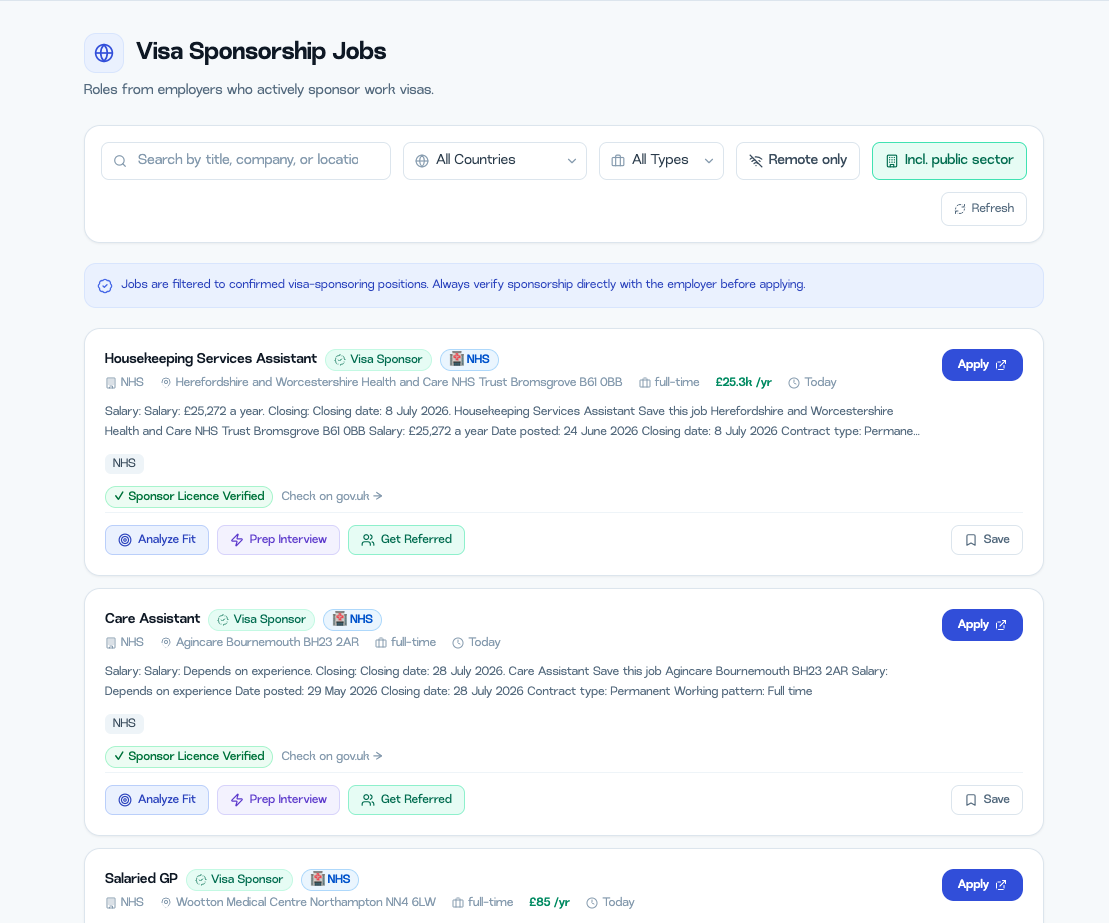
The referral layer matters even more in a visa-constrained search than in a domestic one, because your pool of viable target companies is already narrower by definition. Candoorai's referral mapping looks at your existing network against your shortlist of eligible sponsors and surfaces any warm path that already exists, which is consistently the fastest route past a crowded general applicant pool, whether or not visa sponsorship is involved.
Browse the live visa-sponsored roles feed and run your CV against a specific opening to see exactly where you stand before you apply, free, at candoora.io.