

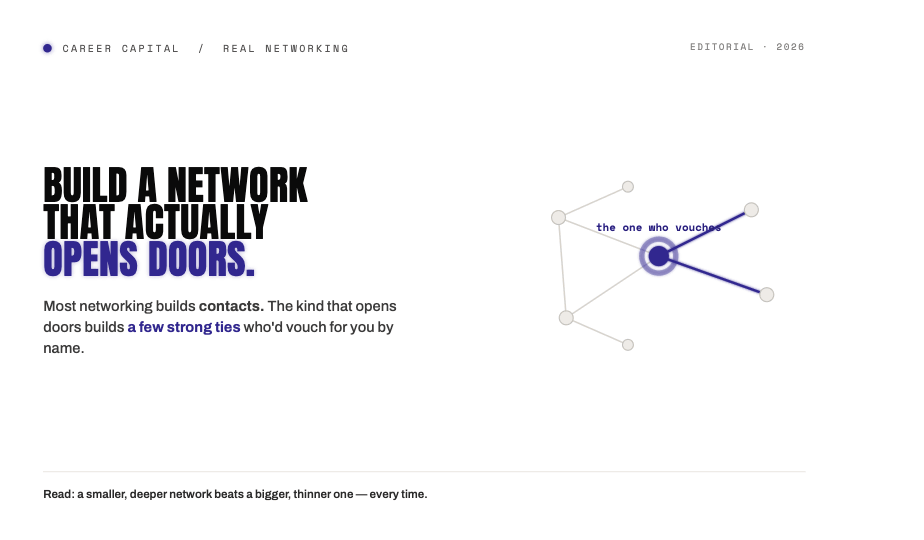
Most professionals have a larger network than they think and use far less of it than the situation warrants. The LinkedIn connection count climbs every year. The number of those connections that would pick up the phone, make an introduction, or pass your name to a hiring manager on request is considerably smaller, and the gap between the two is the difference between a contact list and a network.
Building the kind of professional network that consistently opens doors is not about volume, and it is not about being naturally outgoing. It is about a small number of deliberate practices, applied consistently over time, that most professionals have never been explicitly taught.
Why Networking Produces Results That Applications Do Not
The data on this has not changed in years because the mechanism has not changed. Between 70 and 80% of roles are filled before they are publicly advertised, according to research cited consistently across LinkedIn, Robert Half, and independent recruitment sources. Roles are filled through referrals, through known contacts, through conversations that happen before the job description is written. The candidate who applies through a job board is competing against everyone else who found the listing, for a role that a referred candidate may already have been introduced to before the posting went live.
Referred candidates are hired at four times the rate of cold applicants. This is not primarily because referred candidates are more capable. It is because the referral reduces uncertainty. When a trusted internal contact says this person is worth talking to, the hiring manager begins the conversation with confidence rather than scepticism. The evaluative burden shifts. The interview becomes a confirmation rather than an interrogation.
None of this means cold applications are useless. It means that if your search is built entirely around posted roles and direct applications, you are competing in the most crowded, most filtered, and least trusted channel in the market, while the more efficient channel sits largely unused inside your existing network.
The Architecture of a Network That Works
The distinction that matters in professional networking is not between a large network and a small one. It is between a maintained network and a dormant one.
A dormant network is one you built at some point through jobs, conferences, and colleagues, and then left untouched until you needed something from it. Dormant networks produce poor results when activated under pressure because the relationships have atrophied. Reaching out to someone you have not spoken to in four years to ask for a referral puts both parties in an uncomfortable position, and the introduction you receive, if you receive one, carries less weight than one from a relationship that has been actively maintained.
A maintained network is one where regular, lightweight contact keeps relationships warm without requiring large investments of time or emotional labour. A comment on a LinkedIn post. A brief message acknowledging a career milestone. An article forwarded with a genuine note about why it was relevant. A coffee meeting with someone you find genuinely interesting. None of these takes more than a few minutes, and collectively they mean that when the moment arrives where you want to ask for something, you are asking within the context of an ongoing relationship rather than reactivating a cold contact.
The practical architecture of a maintained network has three layers, and they require different levels of investment.
The first layer is your inner circle: fifteen to twenty people who know your work directly, would speak credibly about your capability without preparation, and have genuine reason to want to help you. These are former managers, senior colleagues, close professional peers, and mentors. This layer requires the most investment but also produces the most valuable referrals because the person making them can speak with specific, first-hand knowledge of your work.
The second layer is your informed network: fifty to one hundred people who know who you are professionally and would recognise your name immediately, but who do not know your work in the same depth. Former colleagues from organisations you passed through, conference contacts where a genuine connection was made, professional community members who have engaged with your thinking. This layer is most valuable for warm introductions because they can connect you to someone they know without needing to vouch in detail for your capability.
The third layer is your extended network: everyone else. This layer has low individual value but collective reach. Its primary function is visibility, ensuring that your professional perspective is present in the communities where your target employers and hiring managers spend time.
How to Activate Your Network Toward a Specific Goal
The most common reason professional networks fail to produce results is not the quality of the relationships. It is the specificity of the ask.
A message that says "I am exploring new opportunities and would love to catch up" asks the recipient to do an indeterminate amount of work for an undefined purpose. Even if the person is genuinely willing to help, they do not know how. A message that says "I am targeting Director-level operations roles at scale-up businesses in the fintech sector. I noticed you know Sarah at Company X. Would you be willing to make a brief introduction?" is a specific, bounded request that the recipient can evaluate and act on immediately.
The specificity of the ask also signals something about you to the person receiving it. A vague ask signals that you have not yet done the thinking about what you want. A specific ask signals that you have thought carefully about your direction, which increases confidence in the introduction they are being asked to make. People are more willing to put their professional reputation behind an introduction when the person they are introducing has a clear, coherent picture of where they are going.
Mapping your network to your target organisations before you make any asks is the step that most professionals skip. The process is straightforward: identify twenty organisations where you would genuinely want to work, then audit your LinkedIn connections and your memory of professional relationships for any first or second-degree connection to each of those organisations. A second-degree connection, someone who knows someone inside your target company, is often sufficient for a warm introduction if the relationship with your intermediate contact is genuine and the ask is specific.
What to Do at Professional Events to Build Something That Lasts
Professional events, conferences, industry forums, and sector gatherings are where most people spend their networking energy and where most of that energy produces the least return, because the default behaviour at events is to collect contacts rather than to build relationships.
Collecting a business card or a LinkedIn connection at an event produces nothing by itself. What produces something is the quality of the conversation that preceded the connection request, and the quality of the follow-up within 48 hours of the event while the conversation is still fresh in both parties' minds.
A follow-up that says "it was great to meet you" is not a follow-up. It is a formality. A follow-up that references something specific from the conversation, shares something you mentioned you would send, or suggests a specific next interaction, creates the thread from which a genuine professional relationship can be built. The professionals who leave every event with three to five genuinely maintained new connections are not the most sociable ones in the room. They are the ones who are most deliberate in the hours after the event.
Building Visibility Without Performing on LinkedIn
Visibility is professional infrastructure, not performance. The purpose of a professional presence in the communities where your target employers are active is not to generate followers or engagement metrics. It is to ensure that when a hiring manager or a potential referrer thinks about who might be right for a specific kind of role or problem, your name comes to mind.
Publishing one genuinely considered piece of professional perspective every two to three weeks, engaging substantively with the content of people in your target community, and contributing meaningfully to relevant professional forums and associations, collectively builds the kind of visibility that compounds over time. It does not require posting every day, performing enthusiasm for an audience, or treating your professional development as content to be optimised for the algorithm.
The professionals who are consistently referred into roles they did not apply for are not the loudest ones on LinkedIn. They are the ones whose professional thinking has been visible in the right places, to the right people, for long enough that their name arrives with context and credibility rather than as a cold introduction.
How Candoorai's Referral Architect Supports This
Building a professional network is a long-term practice. Activating it toward a specific opportunity is a shorter-term, more precise task, and the two require different tools.
Candoorai's Referral Architect takes the network you have built and maps it against any specific target company, scoring the referral paths that exist between you and the decision-makers at that organisation by connection strength. It tells you not just that a path exists but which path is most likely to produce a warm, credible introduction, and it helps you write the specific outreach message that makes the ask easy for your contact to say yes to.
For a professional building toward an H2 job search, the combination of a maintained professional network and a systematic tool for activating it toward specific targets is what separates a referral-led search from a cold-application search. The network is built through the practices above. The precision is added through the Referral Architect, which turns the relationship capital you have accumulated into targeted, trackable action at exactly the moment you need it.