

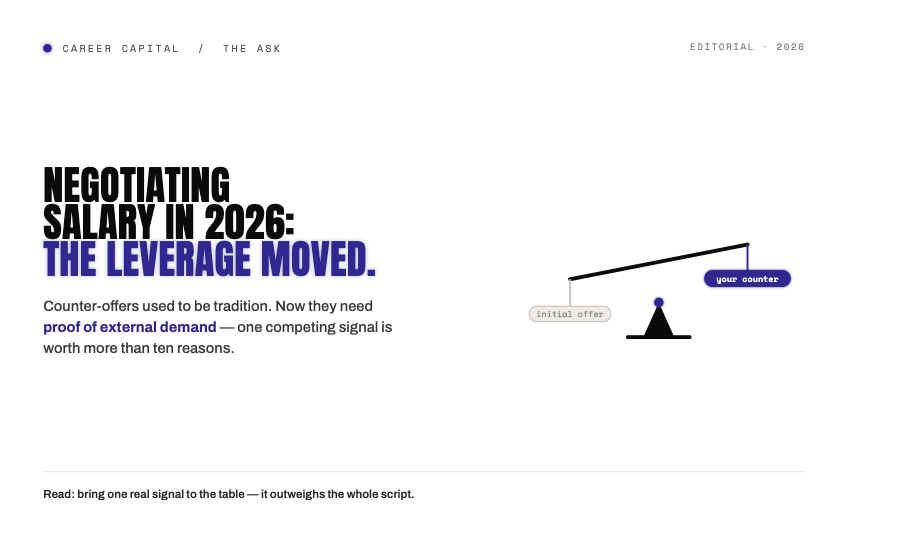
Eighty-eight percent of professionals say they feel confident negotiating salary after a job offer, according to Robert Half's 2026 Salary Guide. The same research shows that most of them do not actually do it. Professionals who do negotiate receive an average 38% more than the initial offer, according to Fidelity research, and 28% receive the full amount they requested. The gap between knowing negotiation works and using it is not primarily a confidence problem. It is a preparation problem, and the preparation most people skip is not about what to say in the conversation. It is about the evidence base you build before the conversation begins.
What Has Actually Changed in Salary Negotiation Since 2023
Three structural changes in the past two years have materially altered both the leverage available to candidates and the preparation required to use it.
Pay transparency legislation has expanded significantly. California, Colorado, New York, and Illinois now legally require salary ranges in job postings, and similar requirements are being adopted progressively across UK and EU markets through emerging pay equity frameworks. This means that in a growing number of cases, you know the employer's range before the conversation begins, which changes the negotiation from an information asymmetry contest into a positioning exercise. If the posted range runs from £55,000 to £75,000, the negotiation is not about getting them to reveal a number. It is about making the case for why your specific profile warrants placement at the upper end.
Skills-based compensation is replacing credential-based compensation in professional services and technology. Robert Half's 2026 Salary Guide found that 76% of managers are concerned about addressing skills gaps on their teams. Adecco's 2026 salary analysis found that candidates who can demonstrate specific, current, measurable skill application command a premium that candidates with equivalent credentials but more generic presentation do not. The negotiation that works in 2026 is not "I have fifteen years of experience." It is "here is what that experience produced, here is how it maps to what you need, and here is why the market rates that combination above your opening offer."
The total compensation conversation has widened. Harvard Business School's Professor Deepak Malhotra has written that fixating on base salary alone is a strategic error. "Focus on the value of the entire deal: responsibilities, location, travel, flexibility in work hours, opportunities for growth and promotion, perks, support for continued education, and so forth." In 2026, remote work flexibility alone carries a documented satisfaction premium significant enough that many professionals would accept a lower base salary to preserve it. Bonuses, equity, professional development budgets, pension contributions, and enhanced leave entitlements are all negotiable elements that are frequently left on the table because the candidate entered the conversation focused only on the headline number.
The Evidence Problem That Most Negotiators Have Not Solved
Harvard Law School's negotiation research programme identifies the same root problem across virtually every failed salary negotiation: the candidate enters the conversation without sufficient specific evidence to make the case they are trying to make. Self-doubt about value, and the widespread and often inaccurate belief that the employer holds all the power, lead candidates to under-ask or not ask at all. The internal concessions happen before the negotiation begins.
The evidence that resolves this is specific, quantified, and attributable to your own work. "I have strong project management experience" is a claim. "I managed the delivery of a £1.2M infrastructure programme across six stakeholder groups, completing it three weeks ahead of schedule and £80,000 under budget" is evidence. One of these creates a foundation for a salary argument. The other does not.
Professionals negotiating at senior levels face a specific version of this problem. The more senior the role, the more the value being negotiated is in the capability applied to complex, ambiguous, high-stakes situations rather than in the execution of a defined process. Evidencing that kind of value requires more than a list of responsibilities. It requires specific examples of decisions made, judgements applied, and outcomes produced in conditions the market recognises as genuinely difficult. Building that evidence base takes months, not hours, which is why the professionals who negotiate best are not those who prepare hardest in the 24 hours before the conversation. They are the ones who have been documenting their impact continuously throughout their career.
The Market Intelligence That Sets Your Anchor
Negotiation research consistently shows that the first number in any negotiation has a disproportionate influence on the final outcome. This is called anchoring, and it works in your favour when you name your number first with justified confidence, and against you when you accept the employer's opening number as the frame for what follows.
Setting a credible anchor requires market intelligence, not confidence. Adecco's 2026 salary guide explicitly warns that using outdated benchmarks is the most common salary negotiation mistake. What you earned in your last role is not market data. What a role of equivalent scope and responsibility commands in your sector, geography, and experience band in 2026 is market data.
Current sources for this intelligence include the Office for National Statistics Annual Survey of Hours and Earnings for UK salary data, LinkedIn Salary, the Glassdoor salary database filtered by company size and location, sector-specific salary surveys from professional bodies including the CIPD, CFA Institute, and relevant trade associations, and pay transparency postings from employers who are already required to publish ranges. Cross-referencing at least three independent sources produces a range you can defend if challenged. A range you cannot defend is not an anchor. It is a wish.
The Conversation Itself: What Works and What Does Not
The most common mistakes in the salary negotiation conversation are not tactical. They are structural, rooted in how the candidate has framed the conversation in their own mind before it begins.
Asking for permission to negotiate is the first and most avoidable mistake. Harvard Law's negotiation faculty is specific on this: do not ask if an offer is negotiable. Treat the employer's proposal as an opening offer and respond accordingly. Asking whether negotiation is allowed subtly signals that you are not sure of your own value and are seeking reassurance before proceeding.
Framing the request around personal need rather than market evidence is the second common mistake. "I need more because of my mortgage" is a personal problem, not a business case. "Based on current market data for this function at this level in this geography, and given the specific outcomes I have delivered in the areas directly relevant to this role, I was expecting an offer closer to £X" is a business case. The first gives the employer no reason to move. The second gives them a defensible rationale for adjusting the offer.
Stopping at base salary when the base is genuinely not negotiable is the third mistake. Adecco, Robert Half, and Harvard Law all note that compensation is rarely a single-variable discussion for a professional role. If the base is fixed by internal banding, the conversation can move to annual bonus target, additional pension contribution, professional development budget, flexible working arrangement, earlier salary review date, or sign-on bonus. Professionals who know what matters most to them in the full package before the conversation starts are better positioned to identify where movement is available and to ask for it specifically.
What a Strong Negotiation Looks Like in Practice
The sequence that works is consistent across the research: receive the offer, express genuine appreciation, ask for time to consider it properly, research or confirm your market position and evidence, and return within 24 to 48 hours with a specific, justified counteroffer.
The counteroffer should be a range, not a single number, with the bottom of your range set at the number you would actually accept and the top set 10 to 15% above the current offer. Kurtzberg and Naquin's negotiation research suggests that making a counteroffer without asking permission, simply naming a number with its justification, produces better outcomes than any more elaborate framing.
A Fidelity survey found that 85% of Americans who negotiated for salary or benefits received at least some of what they requested. The risk of losing an offer for negotiating respectfully is extremely low. Most employers expect it and budget for it. The risk of not negotiating is quantified by Harvard Law: a professional who negotiates their starting salary up by £5,000 and receives 5% raises annually will earn significantly more over a 40-year career than one who accepts the first offer. The compounding effect of a single conversation is larger than most people realise.
How Candoorai Supports This
The negotiation position that works is built on two things: specific evidence of your own impact, and accurate intelligence about the market value of that impact. Both of these are built over time, not assembled in an afternoon.
Candoorai's Career OS builds the evidence infrastructure continuously, capturing your structured career data and your unstructured contributions, your projects, your thought leadership, your advisory work, in a form that makes the impact of your work specific and retrievable rather than vague and reconstructed under pressure. The fit analysis tells you how your specific combination of experience and skills maps against what the employer you are negotiating with is actually pricing for in the current market, which is the market intelligence component a strong anchor requires.
The professional who walks into a salary conversation knowing specifically what they have delivered, knowing what the market pays for that delivery, and able to connect both to what the employer is trying to solve, is in a categorically stronger position than the one who walks in knowing the number they want and hoping confidence carries it. Candoorai builds the first kind of preparation, not the second.