

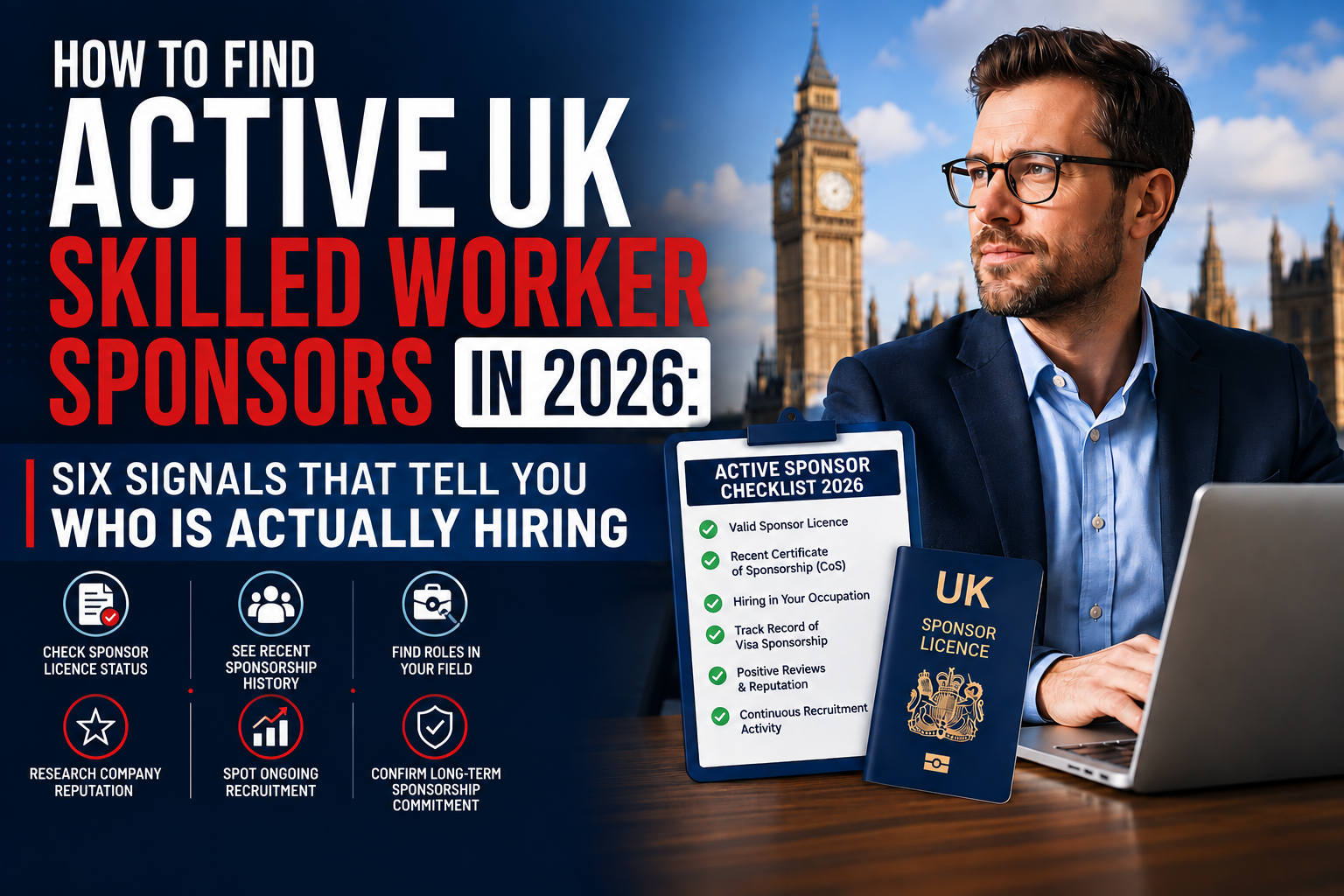
Holding a sponsor licence and actively hiring internationally are not the same thing. This distinction is the most important thing an experienced professional can understand about the UK visa job search in 2026, and it is the thing that most search strategies fail to act on. Over 126,000 organisations appear on the Home Office Register of Licensed Sponsors. Fewer than one in five are advertising sponsored roles at any given time, and within that subset, a much smaller number are sponsoring at senior professional level with an established process for doing so efficiently and reliably. The question is not who can sponsor you. The question is who is genuinely doing so right now for someone with your profile. This article covers the six signals that answer that question before you submit a single application.
Why the Distinction Matters More in 2026 Than in Previous Years
The July 2025 changes to the Skilled Worker route, which raised the skill threshold to RQF Level 6 and the general salary threshold to £41,700, narrowed the eligibility criteria significantly. Approximately 111 occupations were removed from the standard route, and the range of roles that qualify has contracted toward graduate-level professional functions. The effect of this contraction is that the pool of applicants genuinely eligible for the Skilled Worker route is now more concentrated at senior professional level, meaning competition for the roles that remain available is higher than in previous years.
At the same time, the number of organisations on the register has continued to grow. The register has increased by over 130 percent since December 2020, when it contained around 54,000 organisations. Many of those additions are organisations that obtained a licence to address a specific hiring need and have not used it at scale since. The gap between the number of licensed sponsors and the number actively hiring internationally has widened as the register has grown while active sponsorship has become more concentrated in a smaller number of sectors and employer types. For experienced professionals, navigating this gap efficiently is the difference between a job search that produces results and one that produces silence despite effort.
Signal One: Current Sponsored Roles on the Employer's Own Careers Page
The most reliable single signal of active sponsorship is a currently advertised role on the employer's own careers page that explicitly states sponsorship is available. Not a role on a third-party aggregator that lists sponsorship as a possibility. Not a role that was posted six months ago and has not been updated. A current posting on the employer's direct careers portal that either states "visa sponsorship available" or links to the employer's global mobility programme.
The employer's own careers page reflects their current hiring intentions. Third-party job boards reflect a record of their past postings, which may be significantly out of date. An employer who posted a sponsored role on a job board three months ago and filled it internally may still have that listing appearing in aggregated search results with no indication that it is no longer available. Checking the employer's direct careers page before applying is a five-minute verification that eliminates a significant category of wasted effort.
For senior roles specifically, many sponsored positions are filled through executive search or referral before they appear on the employer's own careers page. The absence of a current posting does not mean an employer is inactive. But the presence of one is the clearest confirmation that they are.
Signal Two: Consistent Presence on the Register Over Multiple Years
An employer who obtained their sponsor licence in 2018 and has maintained it through multiple compliance audit cycles without a rating downgrade has demonstrated an established international hiring programme. The compliance obligations of a Skilled Worker sponsor are significant: record-keeping requirements, right-to-work checking, salary compliance monitoring, and change-of-circumstance reporting. An organisation that has maintained these obligations continuously over several years has built the infrastructure to do so reliably.
The Register of Licensed Sponsors shows when each organisation first appears, and this information is available in the downloadable CSV through the registration date column where it is recorded. An organisation that first appeared on the register in 2021 or earlier and has maintained an A-rating continuously is a meaningfully different proposition from one that obtained a licence in 2025. The established sponsor has navigated multiple Home Office compliance cycles, has HR and legal teams familiar with the CoS assignment process, and has the institutional memory to move from offer to visa application without the delays that organisations with new licences frequently experience.
Signal Three: Home Office Visa Issuance Data Matching the Employer's Sector
The Home Office publishes immigration system statistics quarterly, including data on work visa issuances by sector, occupation type, and sponsorship route. The year-ending December 2025 data confirms the sectors and employer types responsible for the largest volumes of Skilled Worker visa issuances. Technology and IT, financial services, professional services, engineering and manufacturing, and healthcare at clinical leadership level account for the majority of senior-level Skilled Worker issuances.
For an experienced professional targeting a specific sector, the Home Office issuance data provides sector-level confirmation that active sponsorship is occurring at meaningful volume in that sector. For function-specific targeting, the data goes further: financial and investment analysts, software developers, civil engineers, management consultants, and corporate lawyers appear consistently in the top Skilled Worker occupation codes. An employer in one of these high-issuance sectors and employer categories is operating in the part of the market where active sponsorship is structurally more common.
Cross-referencing a target employer's sector with the Home Office issuance data for that sector does not confirm that the specific employer is active, but it confirms they are operating in a market context where active sponsorship is the norm rather than the exception. An employer in a low-issuance sector who holds a licence is a higher-risk target than one in a high-issuance sector with the same licence status.
Signal Four: Explicit Mobility Infrastructure Signals
Employers with established international hiring programmes leave visible signals of that infrastructure in their public presence. The most reliable of these is a dedicated global mobility, international talent, or relocation support section on their careers or HR information pages. Major professional services firms, technology companies, and financial services institutions that sponsor regularly have invested in explaining their process, their support for visa applicants, and their relocation assistance. This investment reflects an employer who has processed enough sponsored hires to know that clear communication reduces friction and improves offer acceptance rates.
Secondary signals include: job postings that include specific information about visa eligibility and salary threshold compliance rather than a generic disclaimer; LinkedIn company pages that show a high proportion of international employees, indicating an established practice of international hiring; and press or editorial coverage referencing the employer's international workforce or global talent strategy. An employer whose public presence shows none of these signals may hold a licence but is unlikely to have the institutional readiness to process a sponsored hire efficiently.
Signal Five: No Recent Compliance Incidents on the Register
The register is updated daily, and compliance incidents, specifically downgrades from A-rating to B-rating and full licence revocations, are reflected in those daily updates. The Home Office's February 2026 update removed 42 organisations for compliance breaches and downgraded others. Checking the current rating of any employer you are targeting before investing significant application effort is a basic verification step that takes under five minutes using the GOV.UK register directly.
A B-rated employer is technically still licensed to sponsor, but there are two practical risks for a candidate. The first is operational: a B-rated sponsor is operating under an action plan imposed by the Home Office, which may absorb HR and legal resources and create delays in the CoS assignment process. The second is structural: if the action plan fails and the licence is revoked after you have accepted an offer or during the visa application process, you face significant disruption. For experienced professionals who may have left a previous position to pursue a sponsored role, this risk is material. Targeting A-rated sponsors exclusively is the straightforward risk mitigation.
Signal Six: Sector Intelligence and Insider Information
The sixth signal is the one least accessible from public sources and most valuable when it is available: direct intelligence about an employer's current international hiring intentions from someone inside or closely connected to the organisation. A contact at a target employer who can confirm that their team is actively looking for a sponsored hire at your level, that a CoS budget has been approved for the current fiscal year, or that the organisation's global mobility team is resourced and operational is more valuable than any publicly available signal.
For experienced professionals, this intelligence is often accessible through the professional network they have built over a career. A former colleague who now works at a target employer, a sector peer who has knowledge of that organisation's hiring plans, or an executive search partner who has visibility into upcoming senior mandates are all potential sources of this intelligence. The referral advantage in a visa-constrained search is not only that a referred candidate receives more attention. It is that the referral conversation often provides the intelligence signal that tells you whether the application is worth making before you make it.
Candoorai's Insider Intel module surfaces the company intelligence that is publicly available about your target employers: leadership priorities, recent strategic developments, hiring signals, and the context behind why specific roles are being created or filled. For the intelligence that requires a direct conversation, Referral Architect maps the connections in your professional network to the organisations you are targeting, surfaces the pathways that could produce an inside conversation, and builds the outreach package that makes the approach easy.
The Scam Landscape in 2026 and How to Protect Yourself
The concentration of international professionals seeking Skilled Worker sponsored roles has made this space a target for fraudulent listings and sponsorship scams. In 2026, the scam landscape has specific characteristics that experienced professionals should be able to identify quickly.
The clearest signal of a fraudulent sponsored role is any request for payment in connection with sponsorship. A Certificate of Sponsorship is issued by the employer through the Home Office Sponsorship Management System. It is not sold, it is not transferable, and it does not have a cost that can be passed to the worker. The Immigration Act 2014 makes it illegal for employers to recoup the costs of sponsorship from sponsored workers. Any individual or organisation claiming to sell a CoS or charging fees for sponsorship processing is operating outside the law.
Secondary signals of fraudulent listings include: WhatsApp-only recruitment with no verifiable company contact; job offers made without any interview process; company names that are not on the Home Office register despite claimed sponsorship capability; salary figures significantly below the £41,700 general threshold for a role that would normally require a Skilled Worker visa; and urgency pressure designed to prevent the candidate from taking time to verify the employer's register status.
Verifying any employer's presence on the GOV.UK register before sharing personal documents, attending any meetings, or making any financial commitments is non-negotiable. The register is free, public, and updated daily. Any employer unable or unwilling to confirm their register status should be treated with extreme caution.
How Candoorai Identifies Active Sponsors
Candoorai's visa jobs feed applies daily verification against the Home Office register, filters to A-rated Skilled Worker route sponsors only, and cross-references against live job listings to confirm active advertising. The result is a significantly smaller and more targeted set than the full register provides. Every role in the feed is from an employer who is licensed, A-rated, Skilled Worker route confirmed, and currently advertising a position.
For each employer in the feed, Candoorai's Insider Intel module provides the company intelligence layer: what the organisation is currently working on, what their leadership is publicly prioritising, and the signals that help an experienced professional assess cultural fit and timing before applying. Referral Architect maps your connections to the employer to surface any warm pathway that could provide the sixth signal, the inside intelligence that confirms whether the application is worth making and whether the organisation is genuinely ready to hire.
candoora.io/visa-jobs
candoora.io/insider-intel
candoora.io/job-fit-score
candoora.io/referral-architect