
There is a conversation happening in the hiring world right now that sounds like good news for experienced professionals. Companies are moving away from degree requirements. They are prioritising demonstrated skills over credentials. They are, we are told, finally starting to see people for what they can actually do rather than where they went to university or which brand names appear on their CV.
If you have a complex, non-linear career history and you have been waiting for the system to catch up with your actual ability, this should be your moment.
So why does it not feel like that?
Why are people with decades of real, demonstrable, hard-won skills still getting filtered out before a human reads their application? Why are the professionals who built things across multiple sectors, who ran programmes in difficult environments, who pivoted deliberately and successfully, still being scored as weak matches by systems that are supposedly designed to reward exactly what they have?
The answer is that skills-based hiring, as it is currently being implemented, has a serious and largely unacknowledged problem. And until you understand what that problem is, you cannot work around it.
What skills-based hiring actually means in practice
The theory of skills-based hiring is genuinely good. Instead of using a degree or a prestigious employer name as a proxy for capability, you assess candidates on the specific skills the role requires. You define what good looks like, you measure candidates against that definition, and you hire the person who fits best, regardless of their educational or institutional background.
In practice, what most companies have done is translate this into a different kind of keyword matching. They have replaced "must have a degree from X" with "must demonstrate skills Y and Z," and then they have fed those skills into the same ATS infrastructure that was already filtering people out. The mechanism has changed slightly. The fundamental problem has not.
The ATS still needs to find your skills somewhere in your document. It still needs to match your language to its language. It still cannot read between lines, interpret context, or understand that the skill it is looking for was present in your work, even if you described it differently. The human judgment that would catch those things still does not enter the process until after you have cleared the automated filter.
For the candidate with a conventional career history, skills-based hiring is a modest improvement. For the candidate with a complex, non-linear, or globally distributed career history, it can actually make things harder, because the skills they have are real, but the way they acquired and expressed them does not map cleanly onto the vocabulary the system was trained on.
The translation gap that is costing experienced professionals interviews
Here is a concrete version of this problem.
Someone who spent eight years running accelerator programmes across twelve African countries has developed a sophisticated set of skills. Portfolio management at scale. Stakeholder relationships across government, private sector, and civil society. Programme design under resource constraints. Revenue generation from complex, multi-party deals. Team leadership across cultural and linguistic contexts.
Every one of those skills is directly relevant to senior roles in strategy, operations, programme management, and ecosystem building at major organisations. The person who has done this work is, by any reasonable measure, highly qualified for a range of senior positions.
But when they apply to a role that requires "programme management experience," the ATS is not looking for evidence of running a twelve-country accelerator. It is looking for the words "programme management" appearing in the right density alongside other keywords it was trained to associate with that skill. If the candidate described their work in the language of their sector, which sounds different from the language of a corporate programme management office, the system scores them low.
This is not a skills gap. This is a translation gap. The capability is real. The vocabulary used to describe it does not match the vocabulary the system was built to reward.
And the frustrating part is that the burden of closing that gap falls entirely on the candidate, even though the gap was created by the system, not by them.
Why non-linear career paths are especially vulnerable
A linear career has a built-in narrative logic that systems find easy to read. A person joins the industry, progresses through roles of increasing seniority, and accumulates credentials and titles that signal advancement. Each step reinforces the previous one. The ATS can trace the arc and score it.
A non-linear career does not have that arc, at least not in the form the system expects. It has depth in multiple directions. It has pivots that were strategic but look like breaks. It has roles that carried significant responsibility but existed under titles that do not translate across sectors. It has periods of building something independent that register as gaps rather than achievements.
The professionals most affected by this are not junior candidates who lack experience. They are mid-career and senior professionals with ten to twenty years of real, substantive work who happen to have done that work in ways the system was not designed to credit.
Research from LinkedIn Talent Trends shows that the skills sought by employers are changing 66% faster in AI-exposed occupations than in others. That means the pressure to demonstrate skills clearly and specifically is increasing at exactly the moment when the vocabulary for describing those skills is in flux. The professional who has built their expertise in a rapidly changing environment is being asked to translate that expertise into a stable vocabulary that may not fully exist yet.
That is a genuinely hard problem. And it deserves a more honest acknowledgement than most career advice gives it.
What skills-based hiring means for how you present yourself
Understanding the structural problem does not make it disappear, but it does clarify where the effort needs to go.
The first shift is from describing what you did to demonstrating the skill the role requires. These are related but not the same. "Managed relationships with government partners across West Africa" describes what you did. "Built and sustained multi-stakeholder partnerships at government and institutional level, resulting in programme continuity across three administration changes and two funding cycles" demonstrates the skill in the language a hiring manager will recognise as relevant to their context.
The difference is specificity, translation, and outcome. You are not changing what happened. You are making the capability legible to someone who was not there.
The second shift is from a single resume to contextual positioning. Skills-based hiring, when it works properly, rewards relevance over comprehensiveness. A resume that tries to show everything you have ever done is less effective than a document that shows exactly why you are the right person for this specific role, expressed in the vocabulary this specific organisation uses to describe what they need.
This means your application needs to do active translation work. Not fabrication, not exaggeration, but deliberate, accurate reframing of your real experience in the language of the role you are targeting.
The third shift is from hoping the system sees your value to engineering the conditions under which it can. This is not gaming the system. It is understanding how the system works and refusing to let a vocabulary mismatch be the reason a qualified application fails.
The narrative problem underneath all of this
There is a deeper issue that skills-based hiring does not solve and, in some ways, makes more visible.
Most experienced professionals, especially those with complex or non-linear histories, have never had to articulate a clear, coherent career narrative. They did not need one because the work spoke for itself within the contexts where they were known. The programme they ran was famous in its sector. The results they delivered were visible to the people who mattered. The reputation was established through presence and relationship, not through documentation.
When that person enters a competitive job market, they are suddenly required to compress a decade or more of complex, contextual work into a document that can be read in six seconds and scored by an algorithm. The skills are there. The results are real. But the narrative infrastructure to communicate them in this new context does not yet exist, because it was never needed before.
Building that narrative is not a minor administrative task. It is a substantive piece of intellectual work. It requires understanding how your career arc looks from the outside, which parts of it are legible to the systems and people you need to reach, which parts need translation, and how to tell the story of where you have been in a way that makes clear where you are capable of going.
This is the work that career coaches have historically been paid significant amounts to help with. It is also the work that most job application tools do not touch, because it is hard, it is context-dependent, and it cannot be automated in the way that resume formatting or keyword insertion can.
Where Candoorai fits into this
The Deep Resume Intelligence module inside Candoorai was built specifically for this problem.
It does not just scan your resume for keywords. It analyses how your career history is being read by hiring systems and hiring managers, identifies the gap between how you are currently presenting your experience and how you need to present it for a specific role, and helps you close that gap with precision rather than guesswork.
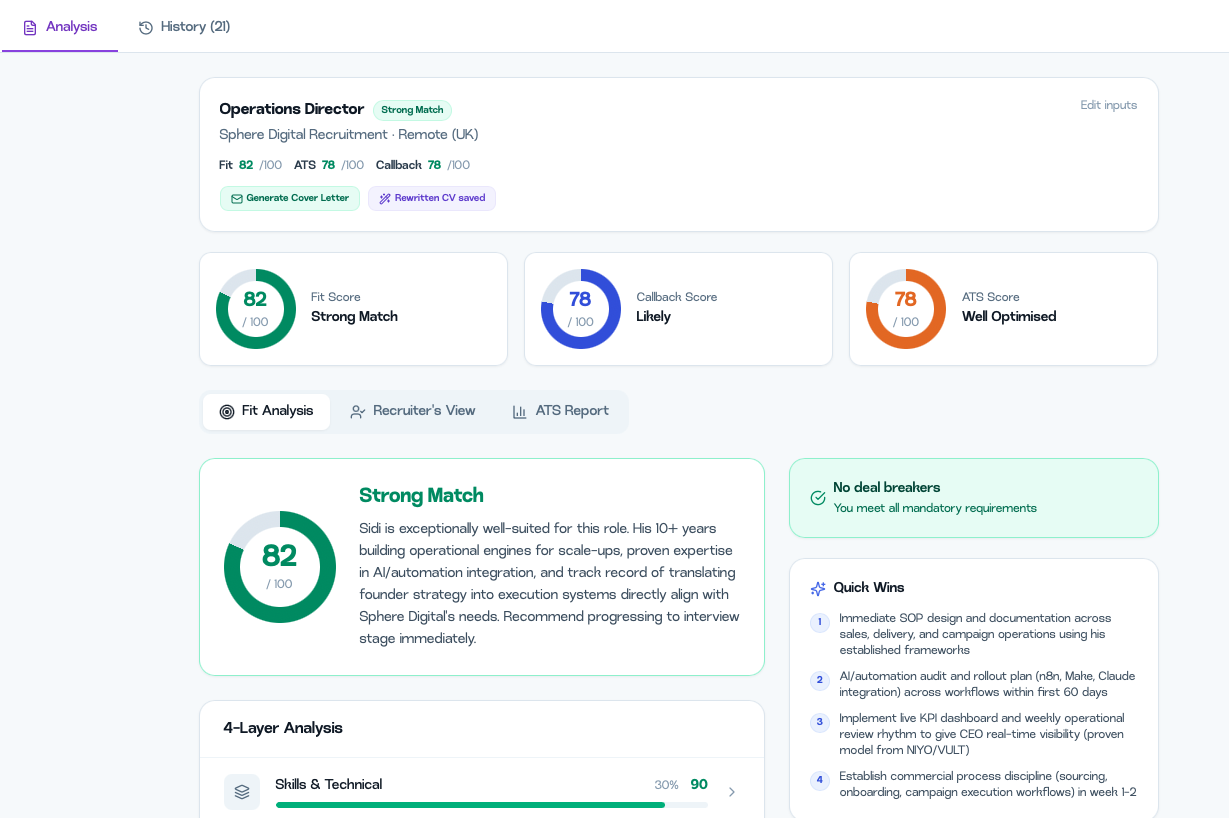
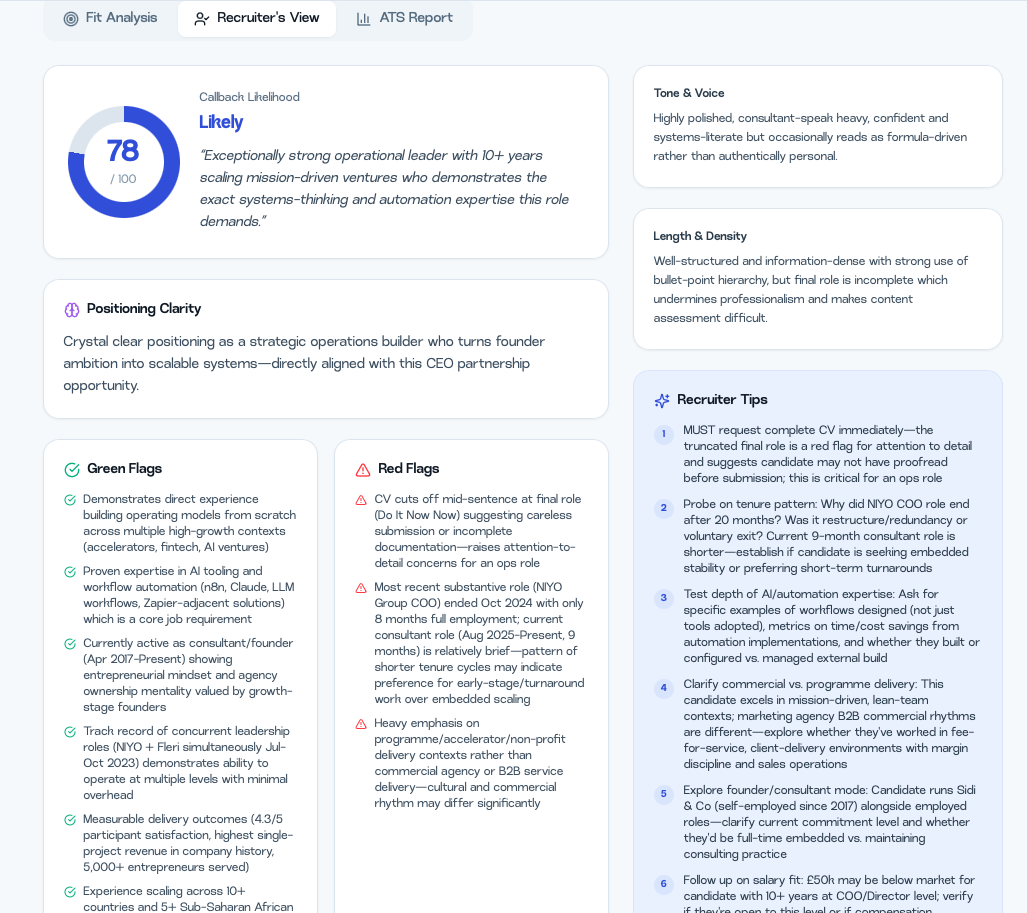
The Narrative Thread feature goes further. It looks across the full arc of your career, including the pivots, the non-linear moves, the roles that do not fit neatly into a single sector, and helps you construct the through-line that makes the whole story legible. Not a sanitised version of your history. The real version, told in a way that the people making hiring decisions can follow and find compelling.
The goal is not to help you sound like a different person. It is to help you sound like yourself, clearly enough that the system and the human on the other side of it can finally see what has been there the whole time.
Skills-based hiring was supposed to be the great equaliser. For experienced professionals with complex career histories, it has not delivered on that promise yet. The gap between what you have done and what the system can read is real. But it is a translation problem, not a capability problem. And translation is a solvable problem.
Analyse your resume for free using our resume intelligence