
If you received a redundancy notice this week, whether from Cloudflare, Coinbase, or any of the other companies that have restructured around AI in the past few months, the instinct is to update your CV and start applying. That instinct is right. The execution of it is where most people lose weeks they cannot afford to lose.
Cloudflare announced yesterday that it is cutting over 1,100 employees, a 20% reduction in its global workforce, with CEO Matthew Prince citing agentic artificial intelligence as having fundamentally changed how the company operates. The company's own usage of AI increased by more than 600% in the last three months alone, which is the internal data that made the restructuring decision feel not just defensible but inevitable to its leadership team.
This pattern is not slowing down. It is the operating reality of the tech labour market in 2026. The professionals who navigate it well are not the ones who move fastest. They are the ones who understand exactly what happens to their application after they hit submit, and they build their search around that understanding rather than against it.
This article walks you through the four things a recruiter actually looks at in those first six seconds, and how to make sure each one works in your favour before your next application goes out.
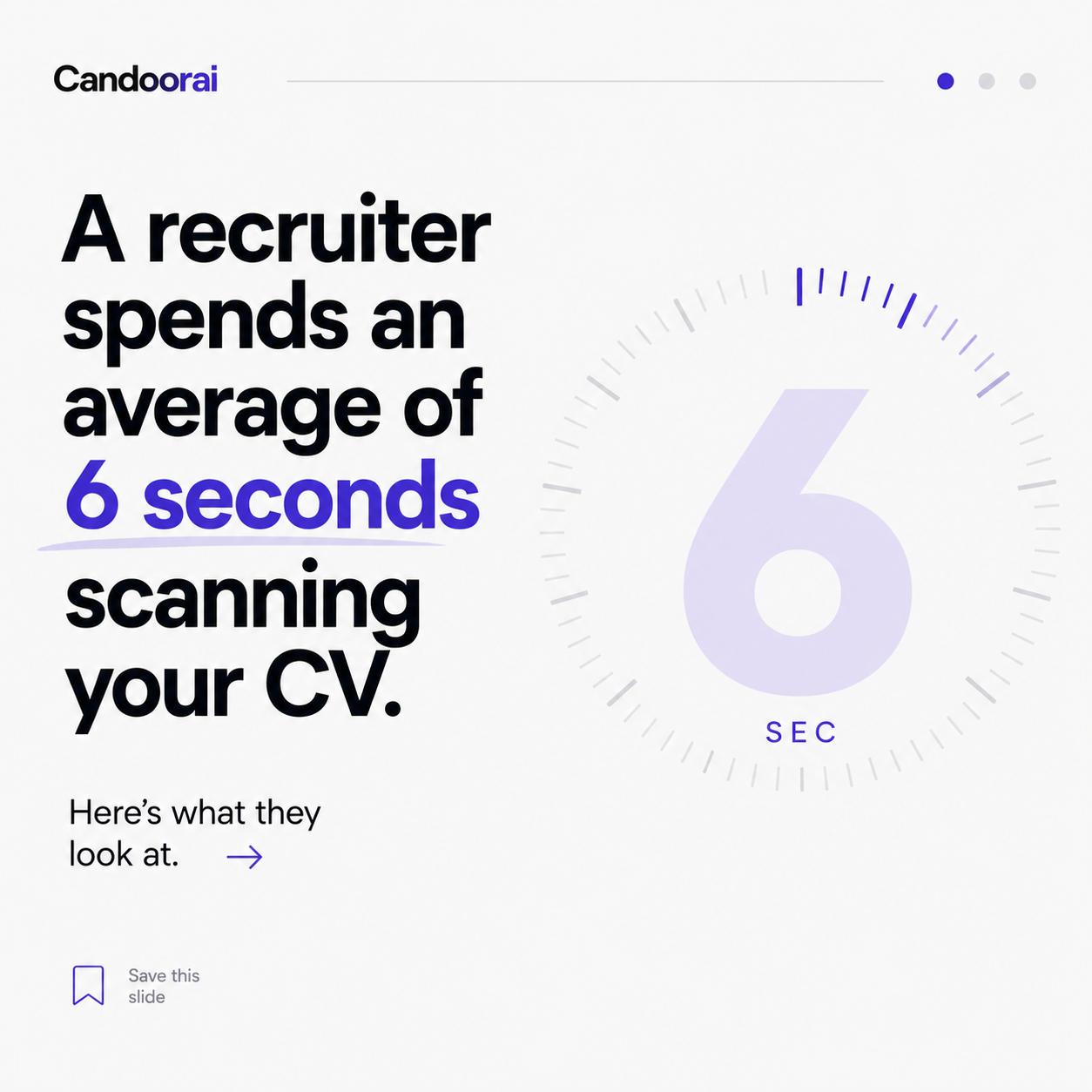
The six seconds that decide everything
A recruiter reviewing 200 applications for a single role does not read CVs. They scan them. Research on recruiter eye-tracking behaviour is consistent: the average initial scan of a CV lasts approximately six seconds before a decision is made to read further or move on. In those six seconds, four specific things are happening in a specific order.
Understanding this sequence is not a trick. It is the difference between a CV that clears the first human filter and one that does not, regardless of how strong your experience is.
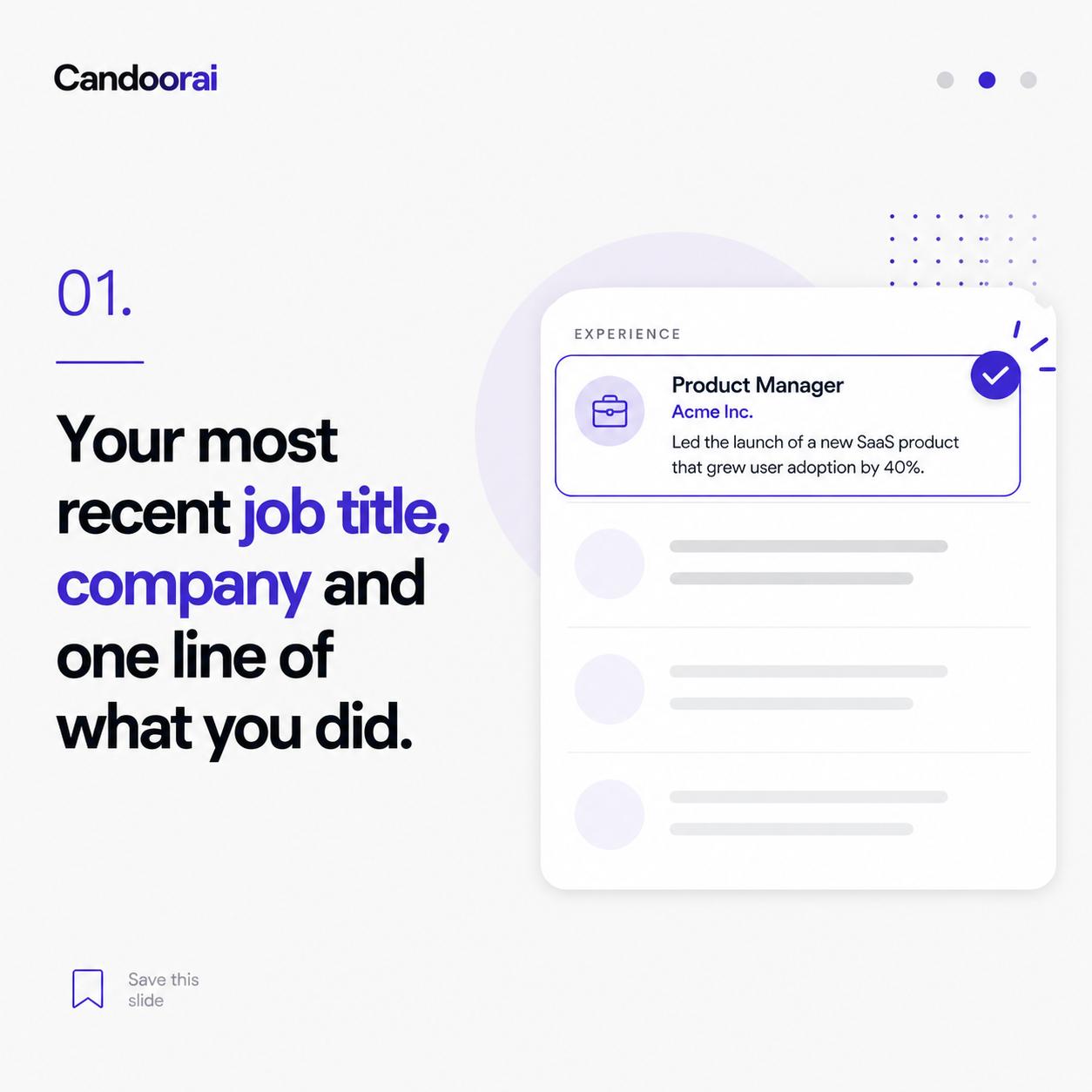
01. Your most recent job title, company, and one line of what you did
This is the first place a recruiter's eye goes. Not your name. Not your summary at the top. Your most recent role.
The question being answered in the first two seconds is simple: Does this person's most recent experience signal proximity to what we need? If the answer is yes, they keep reading. If the answer is no or unclear, the application moves to the reject pile before your professional summary has been read.
This means your most recent role entry has to do significant work without asking the recruiter to do any. The job title needs to be immediately legible, which sometimes means adjusting an internal title that was accurate but cryptic to the outside world. The company name needs context if it is not widely recognised, a single word or phrase in brackets that tells a recruiter what kind of organisation it was. And the first bullet point under that role needs to lead with the outcome, not the responsibility.
"Managed global partnerships" tells a recruiter what you were supposed to do. "Built and managed a portfolio of 40 global partnerships generating £2.3M in annual revenue" tells them what you actually did and what it was worth. One of those sentences earns the next six seconds of attention. The other does not.
The professionals who lose the most ground in a post-redundancy search are often the ones with the strongest experience and the weakest first bullet. They have done genuinely impressive work and described it in internal language that made perfect sense to the people they worked with and means nothing to a recruiter who has never heard of the programme, the initiative, or the company.
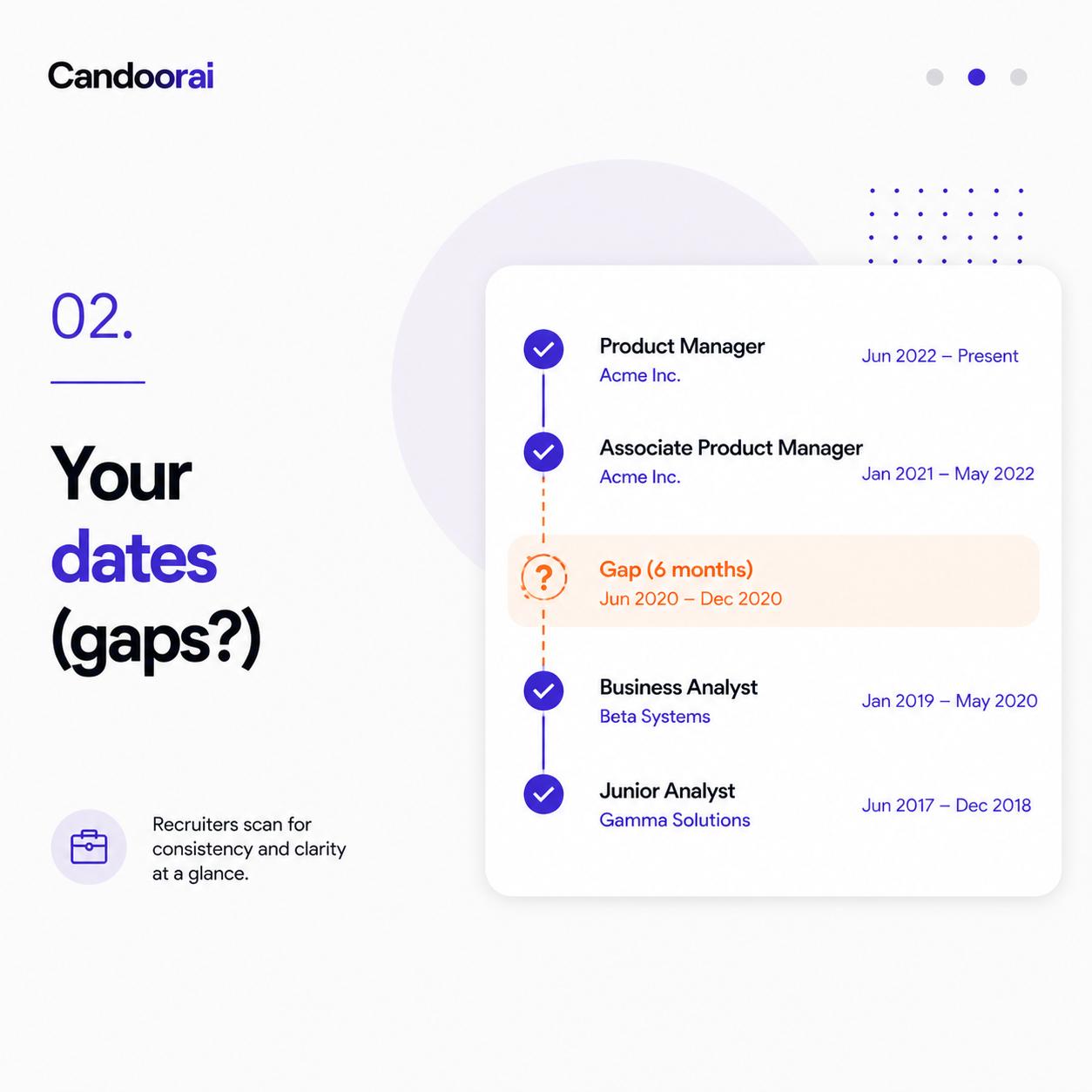
02. Your dates, and whether there are gaps
The second thing a recruiter scans is the timeline. They are looking for two things simultaneously: does the seniority progression make sense, and are there unexplained gaps.
Gaps are not automatically disqualifying. Recruiters know that the tech labour market in 2025 and 2026 has produced a significant number of highly qualified professionals who are between roles through no fault of their own. What they are actually flagging when they notice a gap is not the gap itself but the absence of any explanation for it.
A six-month gap with no context next to it creates a question in the recruiter's mind that they will either ask you about, which means you got an interview, or use as a reason to move to the next application, which means you did not. The fix is not to hide the gap. It is to name it and frame it deliberately. "Career break: advisory work and professional development, Jan 2026 to present" is a complete sentence that closes the question before it opens.
For professionals who have been made redundant in the current wave, the date of their most recent role ending is the most visible thing on their CV right now. Handling it correctly, which means addressing it rather than hoping it goes unnoticed, is one of the highest-leverage edits you can make.
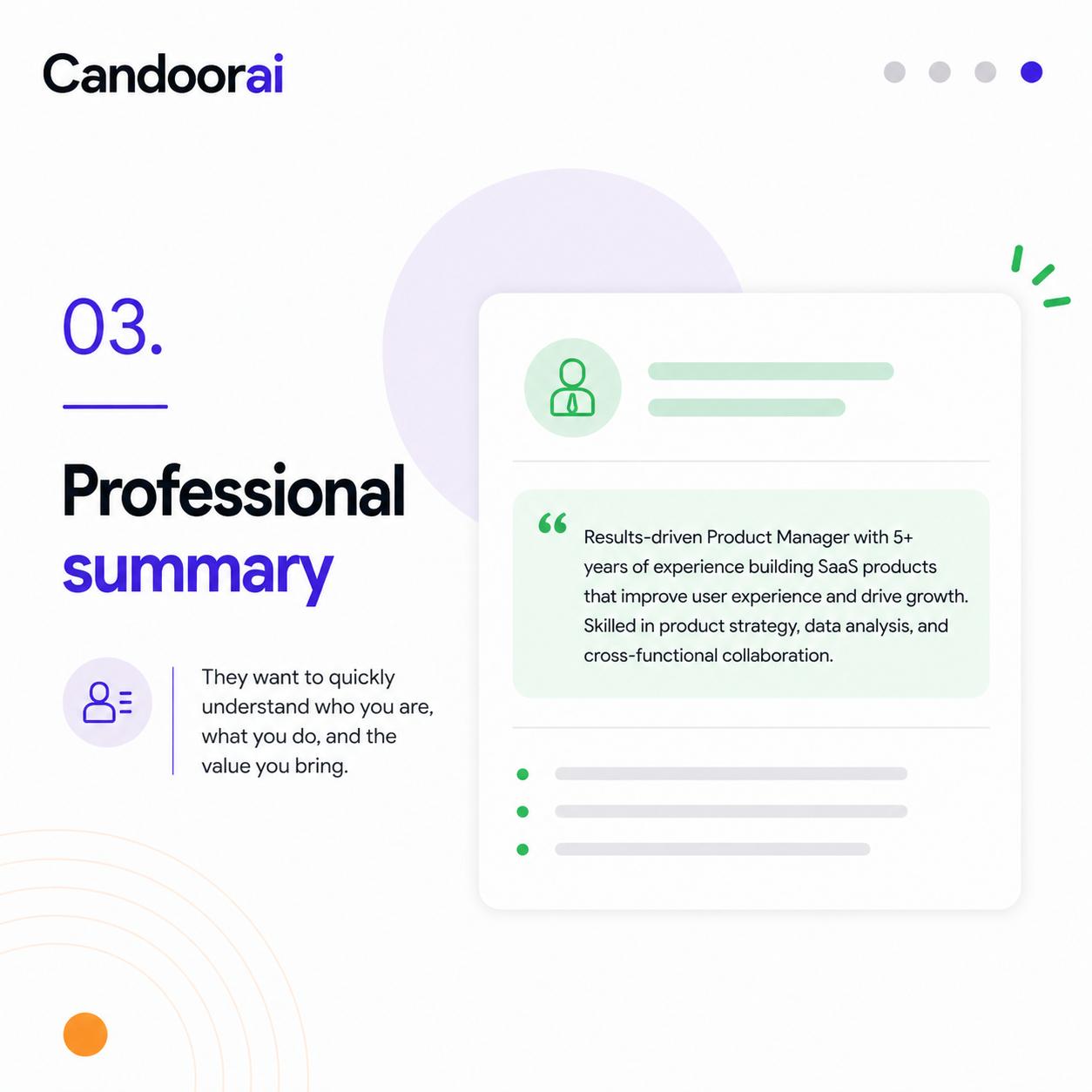
03. Your professional summary
By the time a recruiter reaches your professional summary, approximately three to four seconds have passed, and a provisional judgement has already formed. The summary either confirms that judgment or disrupts it.
Most professional summaries do neither. They are written in generic language that could apply to thousands of candidates. Recruiters read this kind of opening hundreds of times a week. It registers as noise.
A professional summary that earns its position does one specific thing: it tells the recruiter, in two or three sentences, who you are, what you do at a level of specificity that distinguishes you, and what you are looking for next in terms that make it immediately obvious why this role fits. It is not a soft self-description. It is a precise professional claim.
For a senior tech professional affected by the current round of layoffs, the summary is also the place to handle the redundancy narrative directly if appropriate. Not with an apology or an explanation but with confidence. The professional who says, "I have spent the past five years building infrastructure at scale, and I am now looking for the next environment where that capability creates the most value" is making a stronger case than the one who leaves the summary as a generic opener and hopes the recruiter connects the dots themselves.
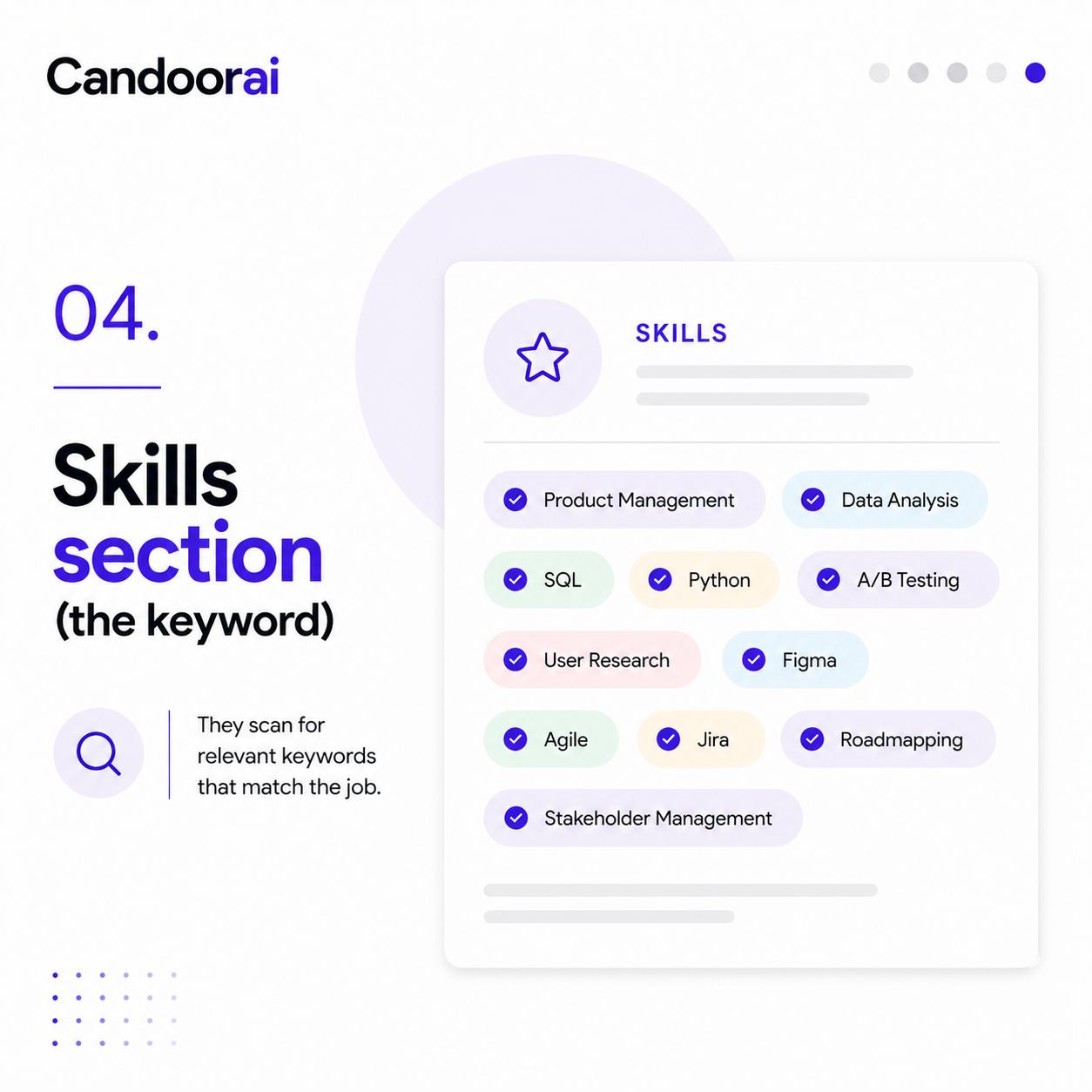
04. Your skills section, which is actually the keyword layer
The skills section is the last thing the recruiter scans in those six seconds, but it is the first thing the ATS scores before the recruiter ever sees your name.
99% of large companies now filter applications through Applicant Tracking Systems before a human reads them. These systems match the language in your skills section and your bullet points against the language in the job description. If you describe yourself using the internal shorthand of your previous employer, and the job description uses different terminology for the same capability, the system scores you as a weak match even if you are the most qualified person who applied.
The skills section is where you close that vocabulary gap deliberately and honestly. Not by listing skills you do not have, but by ensuring that the skills you do have are described in the language the system and the recruiter are scanning for. For tech professionals, this means being specific about tools, platforms, languages, and methodologies in the terms the industry currently uses, not the internal shorthand of your previous company.
The ATS does not know the difference between genuinely relevant experience described in unfamiliar language and genuinely irrelevant experience. It only knows whether the vocabulary matches. Your skills section is your opportunity to make sure it does.
What happens after the six seconds
If your CV clears the initial scan, a recruiter will go to one of two places next. They will look you up on LinkedIn to see whether the profile matches the document and whether your professional presence gives them additional confidence. Or they will check whether anyone they know has worked with you, because a warm signal from a trusted contact will accelerate your application faster than anything on the page.
This is where the hidden job market operates. The 70 to 80% of roles that are filled without ever being publicly advertised are filled because someone's name was already in a conversation before the role was posted. The professionals who navigate the current market most effectively are not just submitting strong CVs. They are simultaneously activating the referral paths that exist in their network to the companies they want to work for.
These two things, a CV that clears the scan and a warm route into the right conversation, are not separate strategies. They are the same strategy executed at two different points in the same process.
How Candoorai was built for exactly this moment
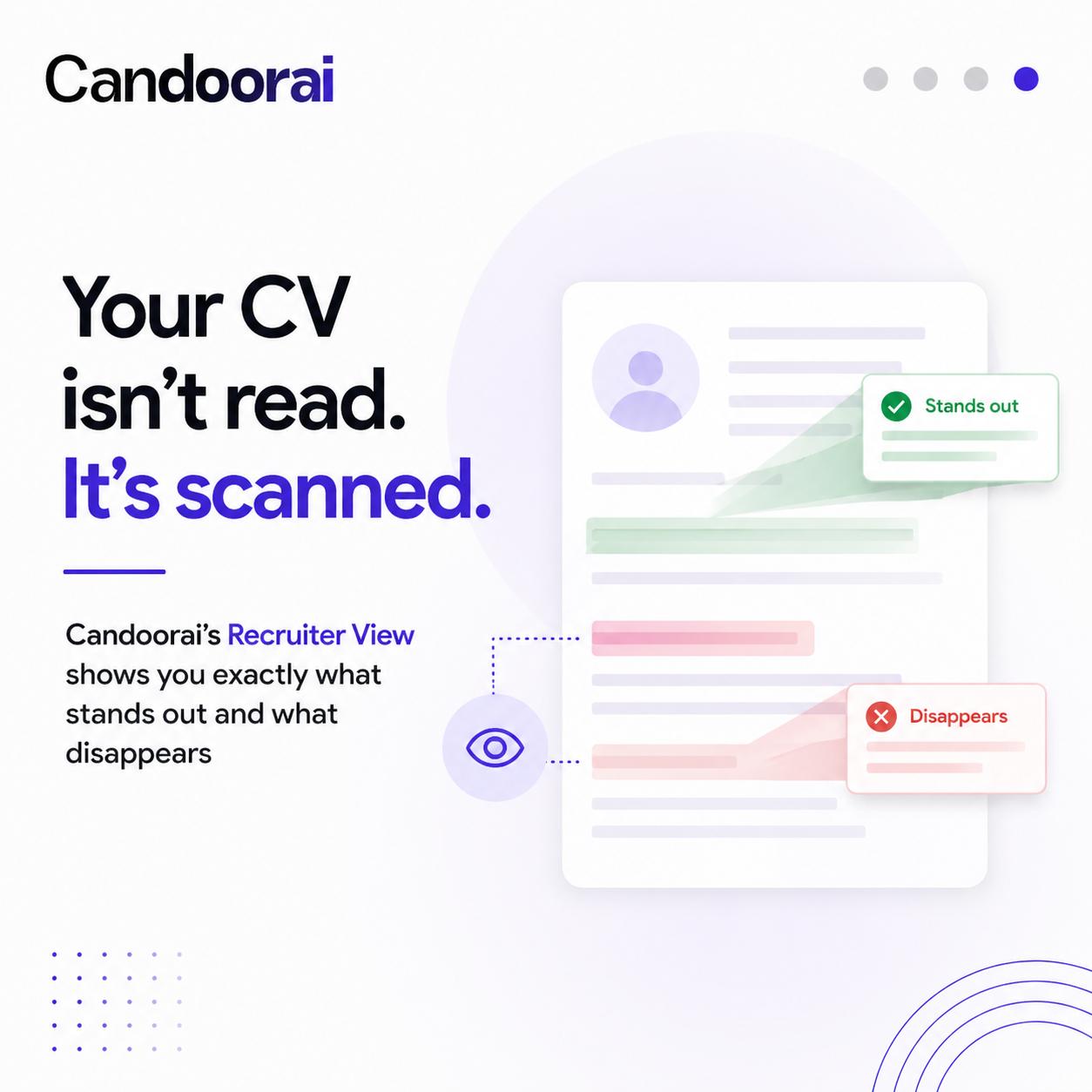
Candoorai's Recruiter View shows you exactly what a recruiter sees when they scan your CV against a specific role: what stands out, what disappears, and what needs to change before you submit. It is not a generic resume scoring tool. It is a role-specific analysis built from the actual job description you are targeting, returned with specific fixes rather than directional suggestions.
The ATS compatibility check runs simultaneously and benchmarks your document across the major platforms so you know before you apply whether the system will surface your application to a human at all.
The Referral Architect maps your existing network against any target company and shows you the referral paths that already exist between you and the decision-maker, scored by strength and accompanied by the outreach message that makes the ask easy to say yes to.
And if you get through to the interview, the preparation is built from the same analysis: your specific career history mapped against the specific role, generating the questions this company at this level is likely to ask, with your own achievements as the raw material for answering them.
If you are one of the 1,100 people affected by yesterday's Cloudflare announcement, or one of the thousands from Coinbase, Block, and the others before them, the six seconds a recruiter spends on your CV should not be the thing that decides what comes next. Not when the gap between a CV that clears the scan and one that does not is, in most cases, a translation problem rather than an ability problem.