

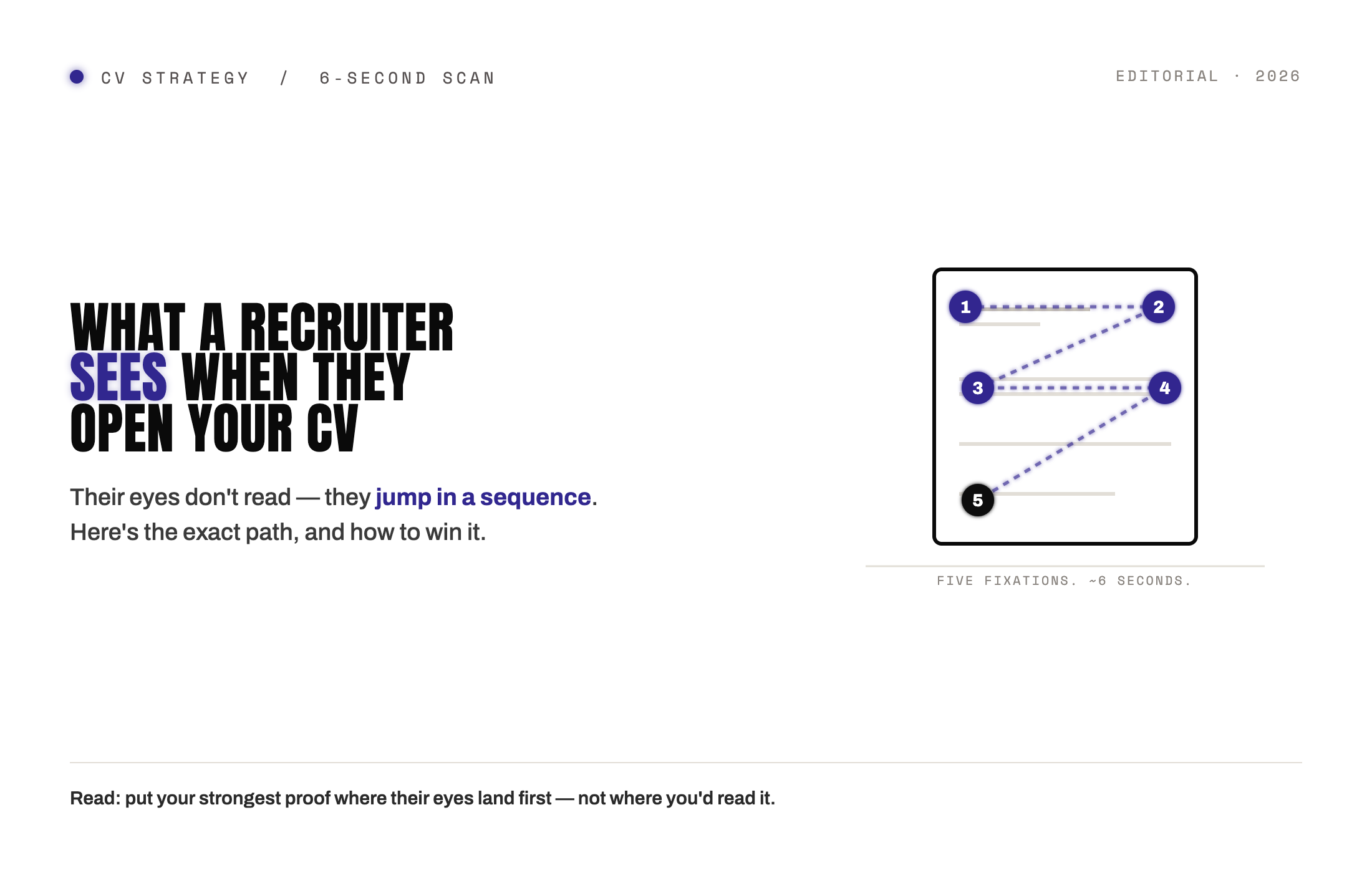
There is a widespread assumption about the moment a recruiter opens your application. The assumption is that they open your CV, the document you created, formatted, and exported as a PDF or Word file, and read it. For most large UK employer applications in 2026, this is not what happens. By the time a human recruiter engages with your application, your CV has already been parsed by an Applicant Tracking System, extracted into structured fields, and converted into a profile view that the recruiter sees inside their recruitment platform. They are not reading your document. They are reading what the system made of your document. Understanding this distinction changes what you optimise for and in what order.
This article covers what a recruiter actually sees when they open your application, in what sequence, what determines whether they keep reading, and what the research says about how that evaluation unfolds. The six-second claim, which remains widely cited despite being significantly out of date, is examined against the current evidence.
The ATS Profile View: What the Recruiter Actually Opens
When you submit an application to a medium or large UK employer, your CV is parsed by the employer's Applicant Tracking System. The parsing process extracts the text from your document, attempts to identify each section, and maps your content into structured data fields: name, contact details, current job title, current employer, work history, education, skills, and qualifications. This structured data is then stored in the ATS as a candidate profile.
When a recruiter opens your application, they typically open this candidate profile, not your original CV document. The profile view organises your extracted information in the format the ATS presents it, which may differ from how you laid it out. Your carefully formatted two-column PDF with a bespoke header design is now a flat, structured record inside a recruitment platform. If the ATS parsed your CV accurately, the profile reflects your content correctly. If it encountered formatting elements it could not read, such as multi-column layouts, text boxes, or content in the document header, sections of your profile will be missing, scrambled, or attributed to the wrong fields.
This is why the recruiter view matters as a distinct concept from the CV document itself. The question is not only "does my CV look good?" but "what does the ATS make of my CV, and what does the recruiter see as a result?" For many candidates, these two things are significantly different. A CV that looks polished as a document can produce a chaotic profile view if the underlying structure caused parsing failures. A recruiter opening that profile sees an incomplete or disordered record and moves on, without ever engaging with the experience or capability the candidate actually has.
How Long Does a Recruiter Actually Spend on Your Application?
The claim that recruiters spend six seconds reviewing a CV has been widely circulated for over a decade. The research behind it does not hold up to scrutiny, and more recent and better-designed studies give a substantially different figure.
A 2023 independent study by Jan Tegze, Director of Technical Recruiting at software developer Tricentis, tracked 114 experienced recruiters reviewing CVs using behavioural analytics software. The recruiters were unaware they were being timed, which eliminates the self-reporting bias that affects most survey-based research. The study found that the average time recruiters spent reviewing a CV was between 17 and 46 seconds, with a shortest recorded review time of 12 seconds and a longest of two minutes and 27 seconds. The variation was driven primarily by CV length and perceived relevance.
A 2024 survey by ResumeGo of 418 hiring professionals found that 47 percent of recruiters spent between 30 seconds and one minute on a CV during initial screening. Only one percent spent less than ten seconds. The survey found that 79 percent of recruiters would spend longer reviewing a CV if there were fewer applicants, and 88 percent would spend more time if they were especially interested in the candidate.
A 2023 academic study by Pina and colleagues, published in Machine Learning and Knowledge Extraction, used eye-tracking technology and machine learning to analyse how 221 recruiters reviewed over 2,000 CVs. The study found that total time viewing the CV and time spent specifically on the Experience and Education sections were the strongest predictors of whether a CV was approved and moved to the next stage. Recruiters who spent more time on these sections were significantly more likely to shortlist the candidate.
The evidence across these three sources is consistent: the average review time for an initial screen is approximately 30 seconds, not six. The six-second figure appears to derive from older, methodologically weaker studies and has been repeated by career advice sources without scrutiny. A recruiter at a senior level at Hays, one of the UK's largest recruitment companies, has noted that they personally spend "a few minutes" reviewing a CV, attributing the speed to having reviewed a very large volume of CVs over a career rather than to a brief review window. A business recruitment partner at CV-Library described around ten seconds to make an initial suitability judgment but emphasised that the first things noticed were formatting and structure, followed immediately by the most recent one to two job roles.
What the Recruiter Actually Looks at First: The Sequence
What a recruiter looks at, and in what order, is not random. The Pina et al. academic study using eye-tracking data confirms a consistent scanning pattern, and the findings from recruiters at major UK hiring organisations are consistent with it.
The recruiter's first attention goes to the top of the profile or document. This means your name, your most recent job title, and the organisation you currently work for or most recently worked for. These three elements are processed in the first few seconds and determine whether the review continues or stops. If your most recent job title is clearly relevant to the role and your most recent employer is a recognisable name in the relevant sector, the review almost always continues. If neither is immediately apparent, the review is more likely to be brief.
The second area of attention is your professional summary, where one is present and visible near the top. The Hays recruiter quoted in the StandOut CV 2025 study emphasised that they look for how experience detailed in the CV matches the job description, and that the professional summary is the section where keyword alignment to the role should be most visible. A generic summary that does not reflect the specific role being applied for uses the highest-value real estate on the profile for content that contributes nothing to the evaluation.
The third area of attention is the work experience section, specifically the most recent one to three roles. The eye-tracking data from the Pina et al. study confirms that the Experience section receives the most total viewing time of any section on a CV, and that time spent on this section is the single strongest predictor of whether a candidate is moved forward. The recruiter is looking for: role titles that show progression or relevance, employer names that signal sector credibility, tenure that does not suggest instability, and evidence of outcome and impact rather than a list of responsibilities.
The fourth area is qualifications and education, which receive attention primarily for roles where specific credentials are required or expected. For experienced professionals, education receives proportionally less attention than experience. The exception is professional qualifications, particularly sector-specific designations such as CIPD, ACCA, PRINCE2, or RICS, which are often searched for specifically and given weight in the overall evaluation.
Skills sections receive attention primarily as a keyword scan rather than a qualitative read. The recruiter is checking for the presence of specific tools, frameworks, or competencies named in the job description. A skills section that lists relevant keywords clearly and concisely aids this scan. A skills section presented as a visual element, a proficiency bar, an icon grid, or any graphical format, is read as a blank space by the ATS and contributes nothing to the profile view the recruiter sees.
What Determines Whether the Review Continues Beyond the First Pass
The initial pass across the top of a profile is a binary gate. The recruiter is making a single judgment: is this worth reading further? The elements that determine that judgment are narrow and consistent.
Job title relevance is the primary factor. If your most recent or current job title closely matches the role being advertised, the review continues. If it does not match, the recruiter needs to be able to infer the relevance quickly from the summary or the employer context. If neither is available, the application is unlikely to receive further time.
Employer credibility is the secondary factor, particularly for senior roles. A candidate whose most recent employer is recognisable and credible in the relevant sector receives more initial attention than one whose employer is not known. This is a structural advantage for candidates coming from well-known organisations and a structural challenge for those coming from less recognised ones, regardless of the quality of their experience. The way to address this is through the professional summary, which can contextualise an employer that may not be immediately recognisable.
Formatting and scannability are the third factor. The ManpowerGroup recruiter in the StandOut CV study noted that the first thing they look for is "the structure and overall first impression," and that 30 percent of CVs they see are difficult to read. A profile view that is clean, structured, and scannable gets more time than one that appears dense, disorganised, or difficult to navigate. This is particularly important for experienced professionals whose CVs are often longer and more complex than those of candidates earlier in their careers.
The Specific Challenge for Experienced Professionals
For senior candidates, the recruiter view creates a particular dynamic that differs from the experience of candidates earlier in their careers. A senior recruiter at ManpowerGroup noted that for more senior and technical roles, they spend up to five minutes reviewing a CV before deciding whether to contact the candidate. This longer review time reflects higher expectations: the recruiter at senior level is not just checking for basic relevance, they are assessing the depth, progression, and specificity of the experience.
This means a senior professional's CV faces a more demanding evaluation than a junior candidate's, not a more forgiving one. The recruiter spending five minutes on a Director-level CV is looking for specific things: evidence of seniority, scale of responsibility, commercial outcomes, and the depth of achievement behind the claim. A CV that lists responsibilities at the same level of generality as a junior CV, without specific outcomes, measurable impact, or evidence of the level of decision-making the role required, will not hold attention for five minutes. It will produce the same brief scan as any other CV and result in the same outcome.
The experience section for senior professionals therefore needs to do something different from what a junior CV needs to do. It needs to communicate scale, not just function. It needs to show outcomes, not just responsibilities. And it needs to do this with enough specificity that the recruiter can verify the depth of the claim through follow-up questions at interview.
What You Cannot See Without a Recruiter View Analysis
The fundamental problem with optimising for a recruiter's initial evaluation is that most candidates are working from assumptions about what the recruiter sees rather than knowledge. They are optimising their CV document without knowing what the ATS made of it or what profile view the recruiter actually opened.
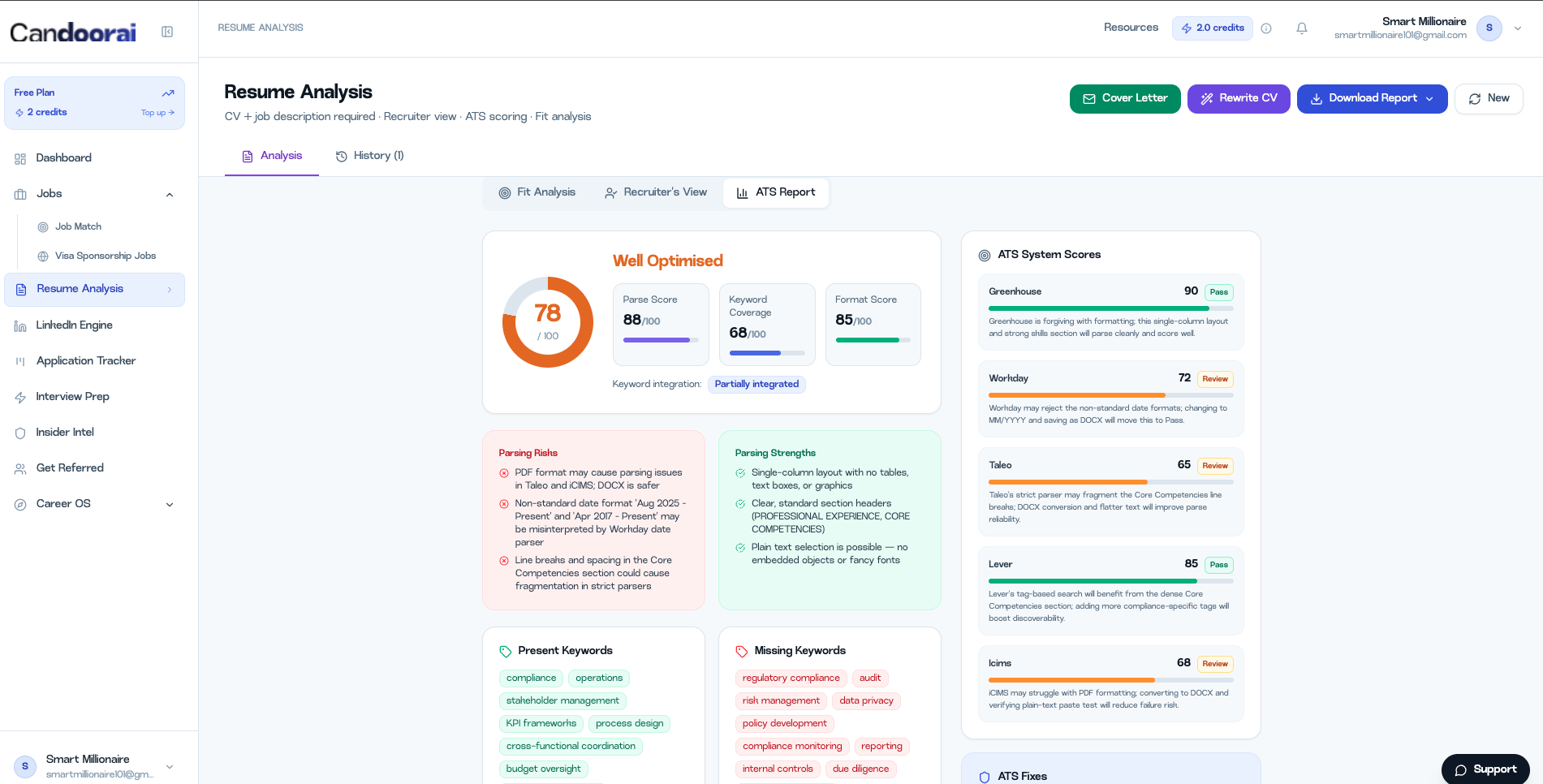
Two things in particular are invisible without analysis. The first is parsing failures. If your CV contained formatting elements that caused the ATS to extract content incorrectly, the recruiter's profile view of your application contains errors that you are not aware of. Your job titles may be attributed to the wrong roles. Your dates may be separated from the positions they belong to. Sections of your experience may be missing entirely. The recruiter opening that profile sees an incomplete or incoherent record that does not reflect your actual career, and you have no way of knowing this without checking.
The second is the order and weight of what the recruiter sees. The profile view organises your extracted content in the ATS's format, which may surface or suppress different elements than your original document layout intended. Your professional summary may appear prominently or be buried. Your most recent role may be clearly labelled or presented ambiguously. Without seeing the profile view, you are optimising a document without knowing what is ultimately presented.
Candoorai's Deep Resume Intelligence module generates a recruiter view of your application as one of four outputs alongside your ATS compatibility score, keyword gap report, and fit score. The recruiter view shows you what a human hiring manager sees when they open your application inside a recruiter dashboard, in the sequence they encounter it, so you can make informed adjustments before you submit. Run your first analysis free at candoora.io.
What to Fix Once You Have Seen Your Recruiter View
Once you have seen what the recruiter actually sees, the fixes become specific rather than general. The most common issues that appear in recruiter view analyses are the following.
The professional summary is either absent or generic. It does not contain the target role title, it does not include keywords from the job description, and it does not communicate the specific value the candidate brings to this role. The fix is to rewrite the summary for each application, placing the target role title and two to four key competency terms from the job description in the first two sentences.
The most recent role is either thin on evidence or dense with responsibilities. A role that lists six to eight duty statements without a single specific outcome tells the recruiter what the candidate was asked to do, not what they actually produced. The fix is to convert at least three of the duty statements into achievement statements: what was the outcome, what was the scale, what changed because of this person's involvement.
Contact details and location are missing from the profile view, usually because they were placed in the document header and were not extracted by the ATS. The fix is to move them into the body of the document at the top of page one.
The skills section is either absent or presented in a format the ATS did not extract. A skills section that is not visible in the profile view contributes nothing to keyword scoring and cannot be scanned by the recruiter. The fix is to include a plain text skills section in the body of the document using the exact terminology from the job description.