

Jobscan built the resume keyword scanning category. It was a genuinely useful innovation when it launched: paste your resume, paste a job description, see which keywords are missing. For candidates who did not know that ATS systems compared their text against job descriptions, this was revealing. For the UK market in 2026, it is the starting point of a much longer process, and Jobscan stops before that process begins in earnest. This article covers what the keyword scanning category gets right, where every tool in it stops, and what experienced UK professionals are using instead to address the full problem of getting seen, getting interviewed, and getting offers.
What Jobscan and the Keyword Scanning Category Get Right
The core function of keyword scanning tools is correct and useful. ATS systems score applications by comparing the text in your CV against the text in the job description. Applications that use the employer's exact terminology for required skills, competencies, and qualifications score higher than applications that describe the same experience in different language. A tool that identifies the gap between your CV's language and the job description's language gives you actionable information that most job seekers do not have without it.
The keyword gap analysis is real. The recommendation to use the employer's exact phrasing rather than synonyms is accurate. The instruction to place keywords in context within the experience section rather than padding a skills list at the bottom is correct. The category is built on a genuine insight about how ATS systems work, and the basic function these tools perform is worth doing.
The question is not whether keyword scanning is useful. It is whether keyword scanning alone is sufficient. For the UK market in 2026, and particularly for experienced professionals navigating competitive roles, it is not. Understanding why requires understanding both what has changed in the UK hiring environment and what the process of getting hired actually involves beyond the initial ATS stage.
What Changed in UK Hiring in 2026 That the Keyword Category Has Not Addressed
On 31 March 2026, the Information Commissioner's Office published its "Recruitment Rewired" report on automated decision-making in recruitment, drawing on evidence gathered from over 30 UK employers between March 2025 and January 2026. The ICO's key finding was direct: many employers using automated recruitment tools believed those tools were providing decision support to human recruiters. In practice, the evidence showed that the tools were making solely automated decisions without meaningful human involvement.
The implication for candidates is significant. In a hiring environment where an automated score is often the entire decision rather than an input into a decision made by a person, the stakes attached to that score are higher than they were when a human was reliably reviewing applications below the automated threshold. A keyword scanning tool that improves your match rate score is more valuable in this environment than it was in 2019. It is also more necessary than ever for that score improvement to be grounded in genuine experience alignment rather than keyword padding, because the next human the application reaches is the interviewer, and the interviewer is testing the depth behind the keywords on the CV.
The ICO also found in its 2024 audit of AI recruitment tool providers that it made almost 300 recommendations to providers for improving compliance with data protection law. The audit found tools filtering candidates based on protected characteristics inferred from application data without candidates' knowledge. This regulatory context matters for job seekers because it describes the environment their applications are entering: automated, lightly supervised at the screening stage, and increasingly subject to regulatory scrutiny that may change how UK employers configure these systems over the coming year.
Why UK Job Seekers Need a Different Tool Than US-Focused Platforms
The majority of keyword scanning tools, including the most widely known, are built for the US market. This creates specific problems for UK job seekers that most comparisons of these tools do not address.
The most practical problem is ATS platform coverage. UK employers use a distinct set of ATS platforms: the NHS uses Trac, the Civil Service uses Oleeo, large financial services firms and FTSE 100 companies predominantly use SAP SuccessFactors or Workday, mid-market employers commonly use Eploy or Workable. A tool calibrated for US ATS platforms such as Taleo, iCIMS, or Greenhouse gives you information about systems that few UK employers actually use and may not accurately reflect how the platforms UK employers use will process your CV.
The British English problem is secondary but real. Tools built for the US market sometimes flag correctly spelled British English as errors: organise, optimise, programme, analyse. For a UK professional applying to UK employers, a tool that tells you to change British English to American English is providing counterproductive advice. UK employers using ATS systems configured for UK-registered organisations will be matching against British English job descriptions. Alignment means matching the employer's language precisely, which for UK roles means British English.
The seniority calibration problem is less visible but more consequential. Experienced professionals applying to Director, Head of, VP, and C-suite roles in the UK face a hiring process that is substantively different from entry-level and mid-career hiring. The ATS scoring thresholds, the recruiter review process, the interview stages, and the decision-making dynamics are all different. A tool designed for the broadest possible user base and calibrated to improve match rates for typical job seekers is not calibrated for the specific dynamics of senior professional hiring in the UK.
Where the Keyword Scanning Category Stops and What Comes Next
The keyword scanning category solves for stage one of a five-stage process. Understanding what those five stages are, and what is needed at each, clarifies why stage one alone is insufficient.
Stage one is ATS optimisation: ensuring your CV is formatted correctly, keyword-aligned to the specific job description, and likely to rank above the employer's shortlisting threshold. Keyword scanning tools address this stage. A well-executed keyword analysis and the CV fixes that follow it will improve your ranking in the ATS. It will not tell you anything about stages two through five.
Stage two is fit scoring: understanding whether your overall profile, skills, seniority, domain experience, and ATS compatibility, is genuinely aligned with the role well enough to produce an offer if you get the interview. A CV that ranks above the ATS threshold and gets a recruiter's attention has passed stage one. If the underlying profile is not a strong match for the role, the application converts at a low rate regardless of how well the keyword analysis was done. Knowing your fit score before you invest tailoring effort tells you whether this application is worth pursuing or whether the same effort applied to a role where your profile is stronger would produce better results.
Stage three is the recruiter view: understanding what a human hiring manager sees when they open your application in the ATS profile view, in what sequence, and whether the first impression supports or undermines the keyword work done at stage one. A CV that ranks well and reflects strong keyword alignment can still fail the recruiter's initial assessment if the profile view is poorly structured, if the most recent job title is ambiguous, or if the professional summary does not communicate relevant value in the opening seconds of review.
Stage four is interview preparation: the company-specific, role-specific, stage-specific preparation that converts an interview invitation into an offer. A keyword scanning tool that gets your CV past the ATS has done nothing to prepare you for the interview that follows. For experienced professionals, where the interview process frequently spans multiple stages and assesses the depth of specific achievements rather than general competencies, the preparation investment is significant and the gap between generic preparation and company-specific preparation is the difference between progressing and not progressing.
Stage five is the referral layer: mapping your professional network to identify who can provide a warm introduction or direct referral to the hiring team. The CIPD Resourcing and Talent Planning Report 2024 noted that referred candidates receive meaningfully more attention from hiring managers than cold applications. A referred application enters the process at a fundamentally different level of attention than an optimised CV submitted cold. No keyword scanning tool addresses this stage.
What Experienced UK Professionals Need That the Category Does Not Provide
Experienced UK professionals searching for a Jobscan alternative in 2026 are usually looking for one of three things, and often more than one simultaneously.
The first is UK-specific accuracy: a tool that knows Trac and Oleeo and SuccessFactors as configured for UK employers, that correctly handles British English, and that is calibrated for the seniority level and sector dynamics of UK professional hiring rather than the US graduate and mid-career market.
The second is coverage beyond stage one: a tool that does not stop at the keyword gap report but carries the intelligence through to fit scoring, recruiter view, interview preparation, and referral mapping, so that a single connected process addresses the whole of getting hired rather than the first checkpoint.
The third is a product built for their level of experience: one that understands that a senior professional's CV presents different challenges to the ATS than a junior candidate's, that the recruiter evaluation of a Director-level application is different from a graduate application, and that the interview process for experienced professionals tests evidence depth rather than general competency.
What Candoorai Provides for Experienced UK Professionals
Candoorai's Deep Resume Intelligence module runs the ATS compatibility check that keyword scanning tools provide, calibrated for the UK ATS platforms your target employers actually use. It returns your compatibility score against the specific role you paste in, identifies your keyword gaps by category in the employer's exact terminology, identifies formatting failures that prevent your CV from being fully parsed, and shows you your fit score across skills, seniority, domain experience, and ATS compatibility as a single connected output.
The recruiter view, the profile that a hiring manager sees when they open your application inside their recruitment platform, is generated as the fourth output of the same analysis. You see what the system made of your CV, in the sequence a recruiter encounters it, before you submit.
Interview preparation, built from your CV, the job description, and Candoorai's Insider Intel research on the specific company you are interviewing with, covers all four hiring stages: screening, technical or competency, cultural, and final round. The preparation is built from the achievements in your own career history, not generic scenarios.
Referral Architect maps your professional network to your target companies, ranks your referral pathways by connection strength and proximity to the hiring decision, and builds the outreach package that makes the referral ask specific and easy for the person you are asking.
Career OS, the long-game layer, manages your evidence vault, tracks your professional credentials, monitors your career growth, and generates any professional profile you need, speaker bio, executive summary, consultant brief, LinkedIn summary, from a single structured record of your achievements.
The first analysis, your ATS score, keyword gap report, fit score, and recruiter view for one role, is free with no card required. Run it at candoora.io.
A Direct Comparison: What Each Stage of the Process Requires
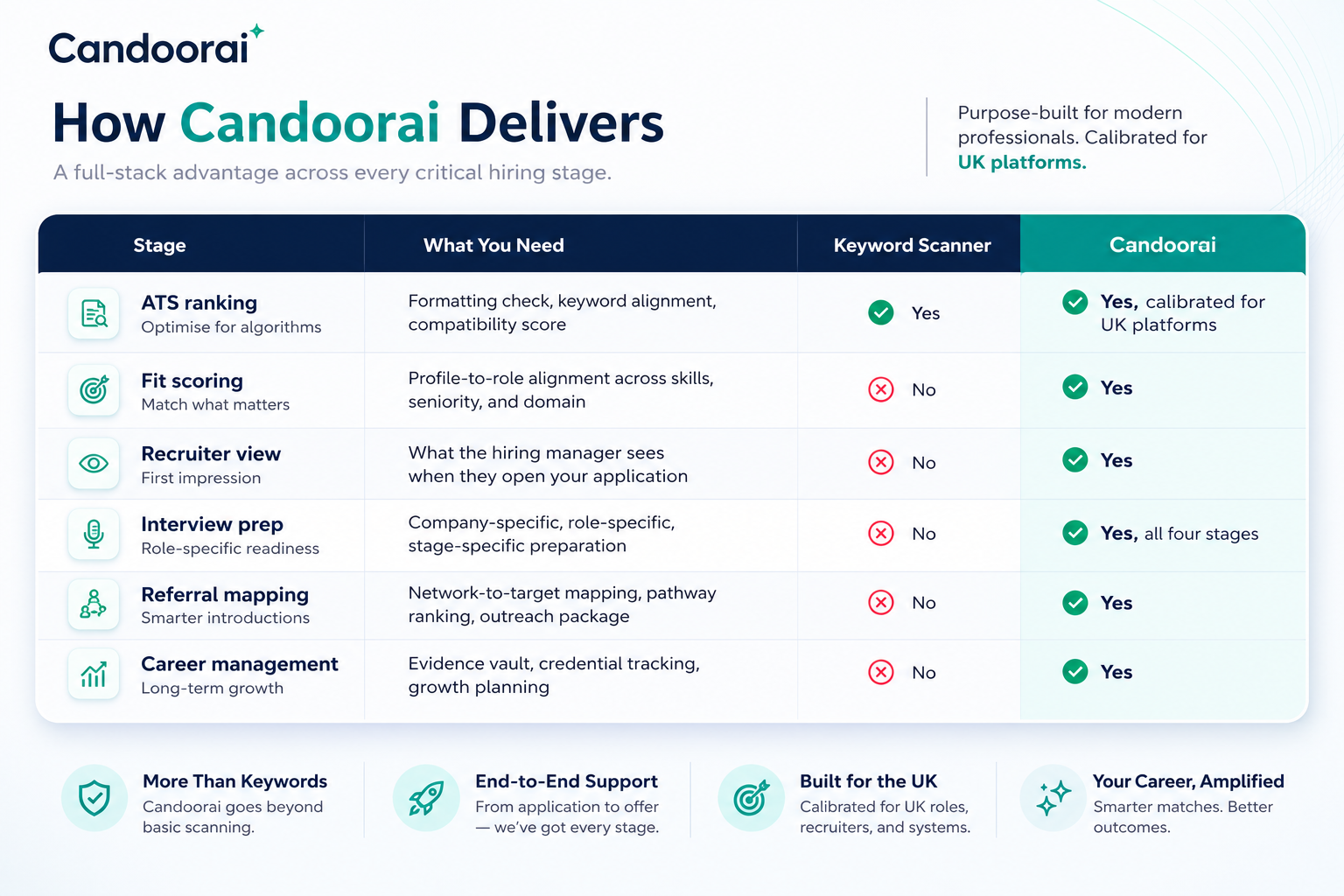
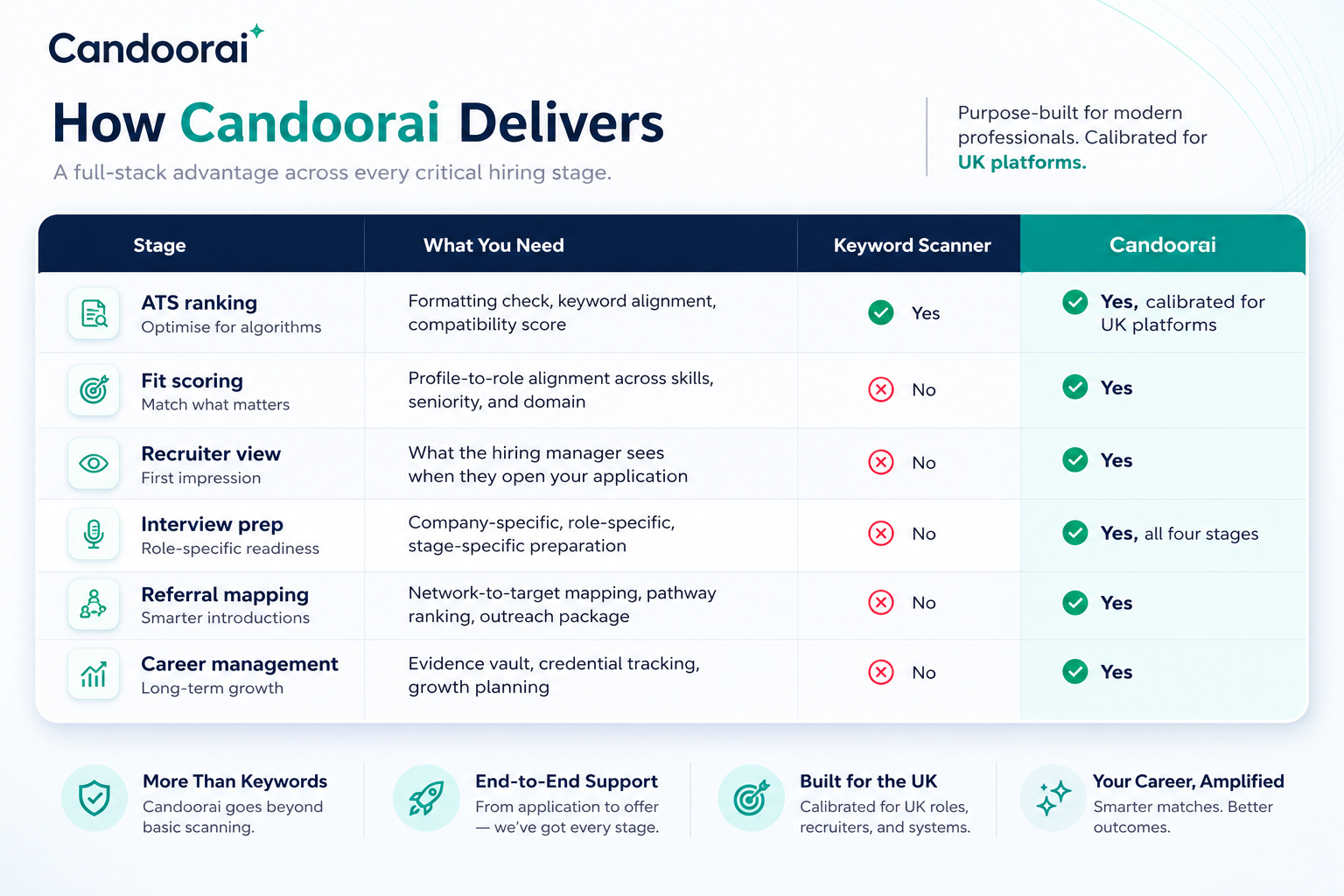
The table below shows what the job seeker needs at each stage of getting hired in 2026, what keyword scanning tools provide, and what Candoorai provides.
The keyword scanning category was built to solve a specific problem: the language gap between how candidates describe their experience and how employers describe what they need. That problem is real and worth solving. In 2026, for experienced professionals navigating a more automated, more competitive, and more consequential UK hiring environment, it is the beginning of the problem, not the whole of it.