
If you are reading this, there is a very good chance you have sent out more applications than you want to admit. You have tailored your resume, rewritten your cover letter, done everything the career advice articles told you to do, and you are still staring at rejection emails, or worse, complete silence. You are starting to wonder whether the problem is you.
It is not. But the full answer is more complicated than that, and you deserve to hear it honestly.
This article is going to walk you through every real reason your job applications are being rejected, including the ones that have nothing to do with your skills or your value. And at the end, we are going to talk about what you can actually do about it in 2026.
The job market in 2026 is not what anyone told you it would be
Before we get into the specific reasons your applications are failing, you need to understand the environment you are operating in, because it has changed dramatically, and most career advice has not caught up.
The average corporate job posting today attracts between 200 and 500 applications. Of those, research from Jobscan shows that 99% of Fortune 500 companies use Applicant Tracking Systems (ATS) to automatically filter candidates before any human being reads a single word. That means the majority of rejections you are receiving are not coming from a person who read your application and decided you were not good enough. They are coming from software that scanned for keywords and scored you against a formula.
This matters because it means the traditional logic of the job search, work hard, submit a strong application, wait to hear back, is operating inside a system that was not designed with you in mind. It was designed for volume management. You are not being evaluated the way you think you are being evaluated.
Knowing this does not make rejection feel better, but it should make it feel less personal. Because most of the time, it genuinely is not.
The most common reasons you keep getting rejected from jobs
1. Your resume is not ATS compatible
This is the single biggest silent killer of job applications, and while most people talk about it, nobody talks about it plainly enough.
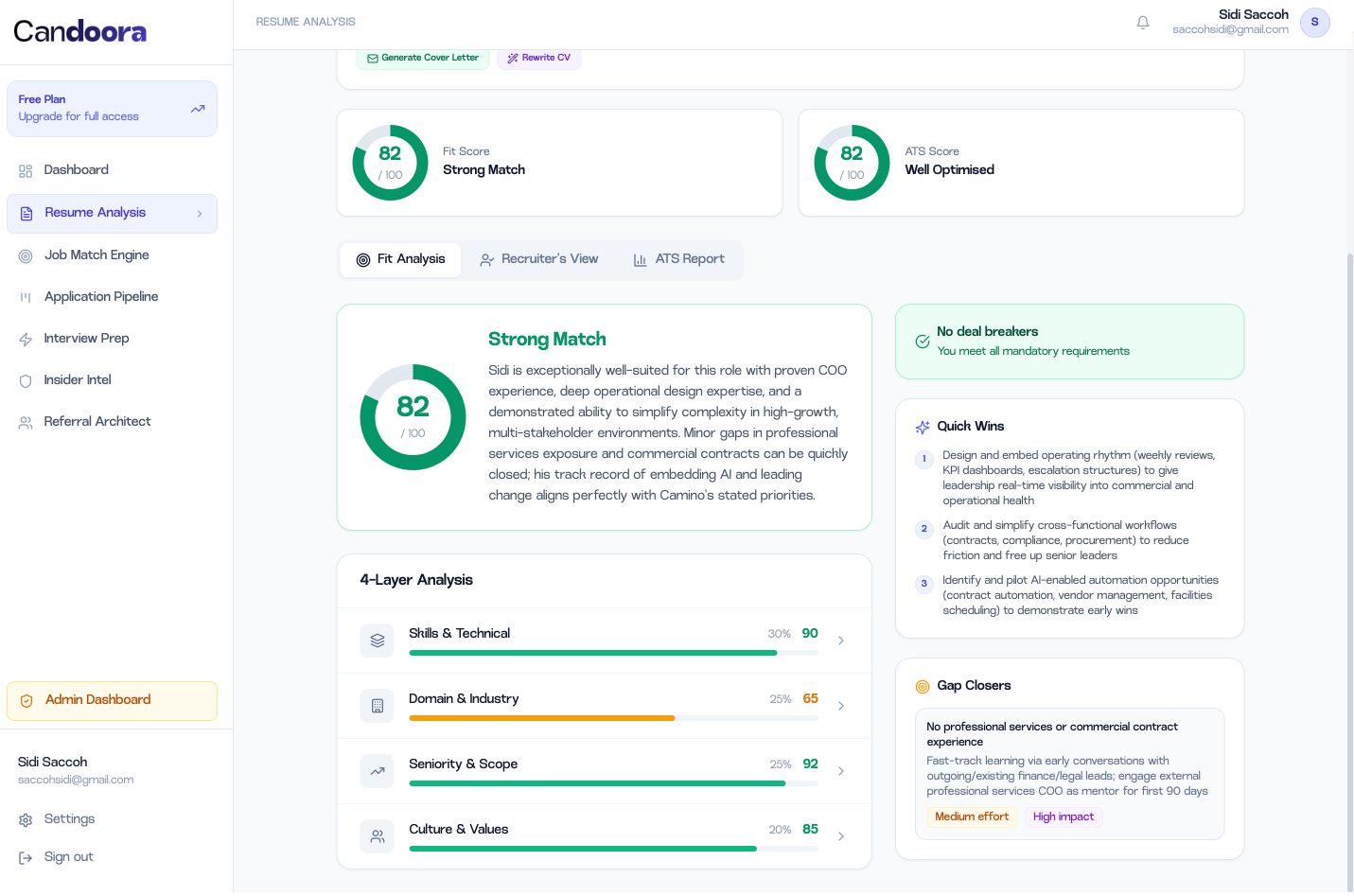
ATS software parses your resume for keywords that match the job description. If you use a creative resume format with columns, tables, graphics, or unusual section headings, the software often cannot read it correctly. Your ten years of experience effectively disappear. You get filtered out before a human ever sees your name.
Even if your formatting is clean, if you are not deliberately mirroring the language in the job description, the ATS scores you low. You might describe yourself as a "senior operations lead" but the job description says "operations manager." To a human, these are the same thing. To the ATS, they are different.
The fix is not to lie on your resume. The fix is to learn how to translate your experience into the language the system is scanning for, without compromising accuracy.
Try our resume analysis for free to see how exactly you perform against the job you are looking to apply to.
2. You are applying to the wrong roles
This sounds blunt, but it is one of the most common patterns among people who are sending out high volumes of applications and hearing nothing back.
There is a difference between roles you are qualified for and roles you are a strong fit for. When you apply to a role where there is a meaningful mismatch, whether in seniority level, sector, specific skill set, or even salary expectation, you register as a weak match in the ATS before a human even enters the picture. And when you apply to dozens of roles that are slightly off-target (which is mostly the case when you use automated application tools), you generate a lot of rejection signals, which is demoralising and also potentially damaging to your professional reputation at companies you genuinely want to work for.
Volume is not a strategy. Precision is.
3. Your cover letter is not doing what you think it is doing
Most application systems today do not require a cover letter with the easy apply tools that some of these platforms have. But the ones that do always have cover letters follow the same structure. "I am excited to apply for this role. My experience in X has prepared me for Y. I believe I would be a great addition to your team." Hiring managers read thousands of these. They remember none of them.
A cover letter that gets read does one specific thing: it makes the person reading it immediately understand why this candidate, for this role, at this company, makes sense. It does not summarise the resume. It does not express enthusiasm in generic terms. It makes a specific, grounded, human case.
If your cover letter could apply to ten different jobs with minor edits, it is not working hard enough for you.
4. Your LinkedIn profile is undermining your applications
I know many of us have been made to believe that LinkedIn does not matter, but it really does, especially now that the market is oversaturated with truly brilliant people. When a recruiter or hiring manager receives your application, the vast majority of them will search your name on LinkedIn within minutes. If what they find does not match the version of you that your resume presents, or if your profile looks sparse, outdated, or inactive, that creates doubt. Doubt leads to moving on to the next candidate.
Your LinkedIn profile is not a secondary concern. For many hiring managers, it is the first real impression they form of you. It needs to tell a coherent, compelling story about who you are professionally and where you are going. Unfortunately for many of us, using automated application tools, your LinkedIn profile is not optimised as fast, so you are also technically excluding yourself before the dust settles. Imagine an AI application sending out an application for a growth consultant, but your LinkedIn says, product designer? if you were the recruiter, would you trust your application?
5. You are not being specific enough about your impact
One of the most persistent patterns in rejected applications is the difference between describing responsibilities and demonstrating outcomes. "Managed a team of eight" tells a recruiter almost nothing. "Led a team of eight through a restructure that reduced delivery time by 30% and retained 100% of client contracts" tells them exactly what kind of operator you are.
Recruiters and hiring managers at the senior level are not hiring job titles. They are hiring specific capabilities to solve specific problems. If your application does not make it clear what problems you have solved and what the measurable result was, you are leaving the most important part of your case unaddressed.
6. You are over-qualified, and nobody is being honest with you about it
If you are at a certain level of seniority and you keep being rejected from roles that feel like a step down or a lateral move, there is a real possibility that the concern is not your lack of qualifications but an excess of them.
Hiring managers worry that over-qualified candidates will be bored, will expect a salary above budget, will leave the moment something better comes along, or will find it difficult to work under less experienced managers. These are not always fair assumptions, but they are common ones. And they often go unspoken in rejection.
If this pattern resonates with you, the answer is not to hide your experience. It is to address the concern directly and early in your application, making a specific, credible case for why this role genuinely represents the right next move for you.
7. The job market genuinely is difficult right now
This needs to be said without softening it. The white-collar job market in 2026 is experiencing a structural contraction that is unlike previous downturns. AI is accelerating automation in knowledge-work roles. Layoffs in tech, consulting, financial services, and media have produced a large pool of highly qualified candidates competing for fewer positions. According to LinkedIn Talent Trends data, the number of applicants per role has increased significantly while the time to hire has extended.
None of that is your fault. Some of the rejection you are experiencing is the product of a market that is absorbing more supply than it has demand for right now. Understanding this does not make it easier financially or emotionally, but it should help you recalibrate what success in this search actually looks like. Getting an interview from one in every fifteen to twenty strong, targeted applications is not a failure. It is the current reality of the market.
Why is sending more applications making things worse
At some point in a difficult job search, almost everyone arrives at the same conclusion: if I am not getting responses, I need to send more applications. It feels logical. It feels like taking action.
The data says otherwise.
We did an Independent testing of the most popular AI auto-apply tools, which showed that only three out of nine produced callback rates above 5%. One user documented on Reddit stated that they submitted over 1,000 applications through an automated tool and received zero offers, most of which came back as rejections from roles he was never qualified for in the first place. The tool had matched his job title to any listing that contained the same words, regardless of sector, salary range, or seniority level. And his experience is not unique; there are 100s of others like him caught up in this painful situation.
Here is what makes this worse than simply wasting time. When you apply badly to a company, many ATS platforms flag your profile. You are not invisible. You are logged in. So when a genuinely good role opens up at that company six months later, the system already has a record of a poorly matched application from you. Volume does not just fail to help. It can actively close doors you have not even tried to open yet.
The logic that governs a successful job search in 2026 is not much different. It is better. Five targeted, well-researched, correctly positioned applications will consistently outperform fifty generic ones.
What nobody tells you about the hidden job market
Research consistently shows that somewhere between 70% and 80% of jobs are filled without ever being publicly advertised. They are filled through referrals, through networks, through people who were already known to the hiring team before the role was even officially created.
This is not a conspiracy. It is simply how human beings make decisions under uncertainty. A hiring manager with ten strong external applications and one strong internal referral will almost always interview the referral first, because the referral carries a trusted signal that no application document can replicate.
This means that if your entire job search strategy is built around applying to posted roles, you are already competing in the most crowded, most filtered, least trusted part of the market. The professionals who are finding roles quickly in this environment are doing so because they are visible in the right networks, not because they are applying the fastest.
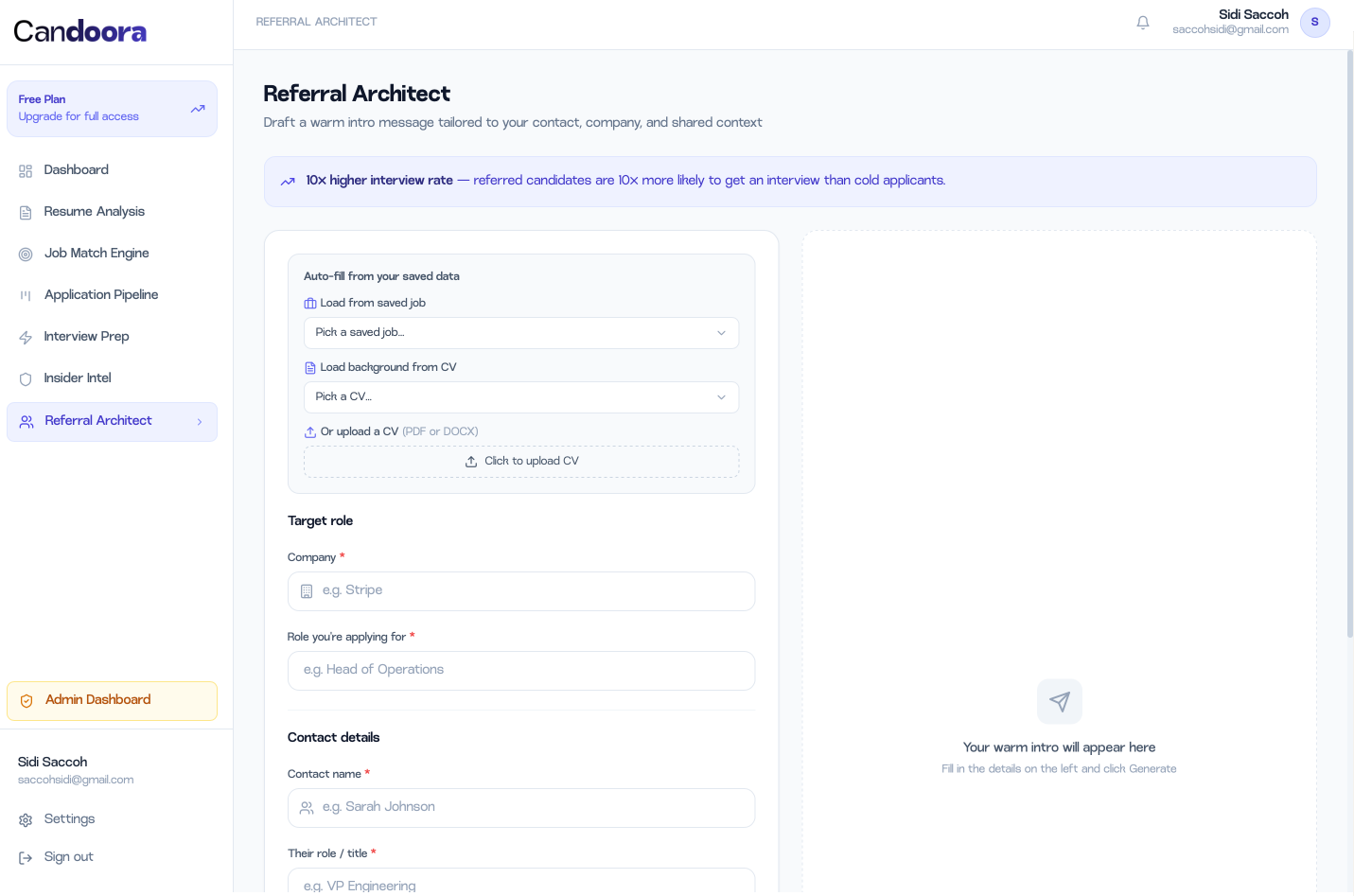
Try out our referral architect to see how we help with engineering the best outcomes for you.
The thing about your career narrative
There is a specific type of candidate who is struggling disproportionately in the current market, and it is not the one who lacks experience. It is the one whose experience does not fit neatly into the template the system was built to read.
If you have had a non-linear career path, if you have built something of your own, if you have worked across multiple sectors, countries, or disciplines, if you took time away for a reason that felt strategically right, even if it looks like a gap on paper, the standard job application infrastructure was not designed for you. The ATS cannot score complexity. The keyword matcher cannot recognise an achievement that was expressed in a context it was not trained on.
This is not a reflection of what you have built. It is a limitation of the tool being used to assess it. But the responsibility for bridging that gap, unfair as it is, falls on you. And the bridge is narrative. The ability to tell a clear, specific, compelling story about who you are professionally, what you have done, why it matters, and where you are going, that is the capability that the system cannot shortcut around. It is also the capability that almost no job tool currently helps you build.
How Candorai approaches this differently
We built Candorai because we were tired of watching smart, capable, experienced professionals (people like you) lose confidence in themselves. After all, a broken system could not read them.
Candorai is a career intelligence platform. The distinction between intelligence and automation matters a great deal to us because the problem most professionals face in their job search is not that they are applying too slowly. It is that they are applying without enough of the right information, without a clear enough articulation of their own value, and without the tools to understand which opportunities are genuinely worth their effort and reputation.
What Candorai does is give you the analytical layer that has historically only been available to people with expensive career coaches or strong insider networks. It helps you understand how your specific career history is being read by hiring systems, what the gap is between how you are presenting yourself and how you need to be presenting yourself for a specific role, and how to construct the narrative that makes your application memorable rather than filterable.
It does not apply to jobs on your behalf. It does not fire off 500 applications while you sleep and call that a service. What it does is help you understand your own career more clearly than the market currently gives you credit for, so that when you do apply, you apply in a way that is precise, confident, and built on evidence.
If you have been asking yourself why you keep getting rejected from jobs, the answer is almost certainly not that you are not good enough. The answer is that the system you are operating inside was not built to surface your kind of value, and you have been trying to win a game without knowing the rules.
We would like to help you learn them.
Summary: What to do right now if you keep getting rejected
Stop sending volume and start sending targeted applications to roles where the fit is genuinely strong.
Audit your resume for ATS compatibility. Clean formatting, clear section headings, and keyword mirroring from the job description are non-negotiable.
Rewrite your bullet points to lead with outcomes and numbers, not responsibilities and tasks.
Update your LinkedIn profile so that it tells the same story your resume tells, but in a warmer, more human voice.
Start mapping your network deliberately. Who do you know at companies you want to work for? Warm introductions outperform cold applications at a rate that is not close.
Work on your career narrative. If you cannot explain clearly, in two or three sentences, why you are the right person for a specific role and what you will bring to it, the application is not ready to send.
Give yourself credit for the difficulty of the environment you are operating in. The job market in 2026 is genuinely hard. That is real. It is not an excuse to stop, but it is a fact that deserves to be named.