

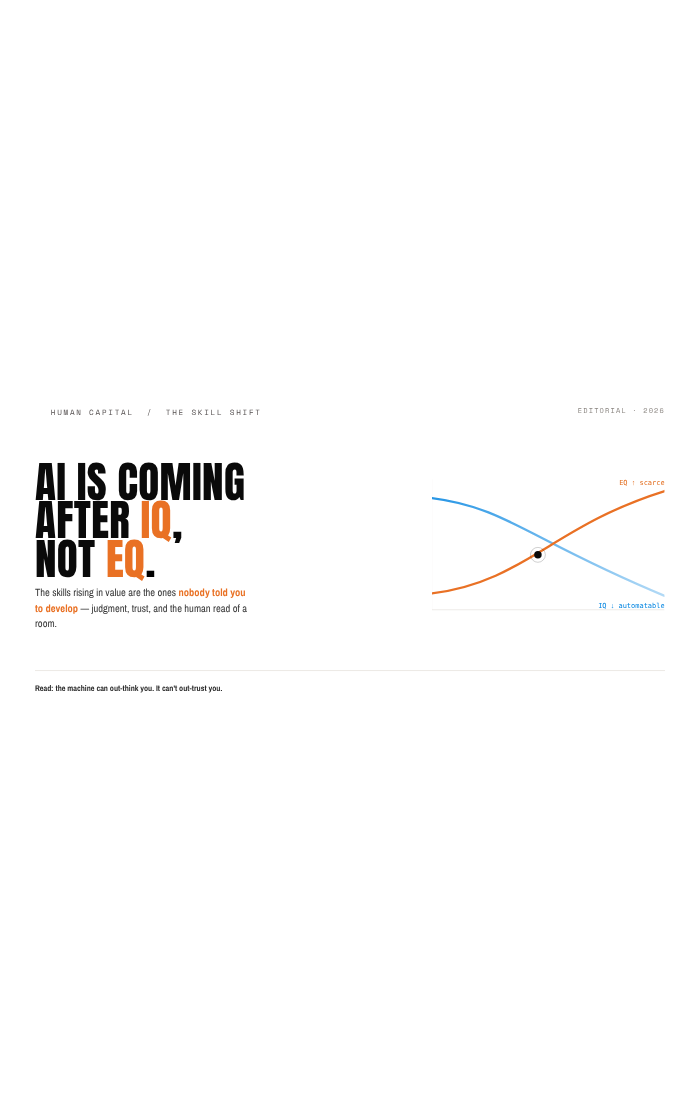
The skills employers are now struggling to find are not the ones universities spent the last decade pushing students toward. Critical thinking, clear communication, cultural reasoning, and the ability to form a sound argument from evidence, these are the capabilities that CBS News MoneyWatch, Washington Monthly, and CNBC all confirmed in the past three weeks are rising sharply in employer demand, precisely because AI is absorbing the technical, structured, process-following work that once kept these capabilities in second place.
This article covers two things: what the research actually shows about which skills are becoming more valuable as AI spreads, and how to know whether your current capability profile is moving toward or away from the part of the market where demand is growing.
What Changed and Why the Liberal Arts Community Is Having a Moment
For roughly a decade, the dominant career advice pointed toward STEM skills as the reliable path to employment security. Computer science, data analysis, engineering, and coding were consistently presented as the skills most resistant to automation and most valued by employers. Humanities and social science degrees were described, often unfairly, as less employable choices.
The research accumulating through 2025 and 2026 is beginning to qualify that picture significantly. Arun Gupta, CEO of NobleReach Foundation, an organisation that recruits professionals into public sector roles, told CBS News MoneyWatch this month: "Artificial intelligence is coming after IQ, not EQ." His point is precise: AI is now performing the structured analytical tasks that once required significant technical training to execute, such as data processing, code generation, contract review, and research synthesis, while the capabilities it cannot replicate, emotional intelligence, cultural awareness, contextual judgement, persuasion, and the ability to identify what a problem actually is before trying to solve it, remain human.
Washington Monthly's May 2026 analysis put the same point in historical context. The artes liberales, the liberal arts tradition dating to classical Greece and Rome, was originally defined as the skills a free person needed to participate in public life. The irony of 2026 is that those same skills, critical thinking, analytical reasoning, cultural and historical awareness, and communication, are what the most advanced AI systems still cannot reliably produce on demand. A language model can generate persuasive-sounding text. It cannot consistently judge whether the argument it is making is actually sound, whether the cultural context it is drawing on is accurate, or whether the conclusion it is reaching serves the person it is meant to serve.
The Data Behind the Claim
This is not a philosophical argument. It is appearing in hiring data.
CNBC and Randstad reported in May 2026 that Randstad's analysis of 50 million job postings between 2022 and 2026 found the fastest-growing demand not in coding specifically but in roles that combine technical fluency with the human capabilities AI cannot replicate. Randstad's CEO said directly: "AI is a fast pass to promotion and pay for new entrants into the labour market, provided that you combine it with social skills, the softer skills, the judgement, the collaboration, the empathy."
The word "combine" is doing significant work in that sentence. The wage premium for AI skills is not going to people who only know AI tools. It is going to people who can use AI tools and exercise the contextual judgement, communication, and relational intelligence that the tools cannot provide. Entry-level software development pay in the US jumps from $85,000 to $105,000 with AI expertise added. The premium is real and large. But it accrues at the intersection, not at either end alone.
Forbes identified the same dynamic through the lens of what it called "meaning-maxxing," a broader cultural shift in which workers are moving toward roles where human judgment and purpose are central rather than peripheral. The biggest shift in the workplace right now, according to that analysis, is that routine work is becoming automated while human-centred work is becoming premium. The people benefiting from this are not simply those who learned an AI tool. They are the ones whose existing capabilities in communication, leadership, and judgment became more valuable as the surrounding work automated.
Payscale's 2026 Compensation Best Practices Report found something that appears to contradict this but actually reinforces it: 55% of companies are not offering premiums, bonuses, or equity for AI skills despite listing them in job descriptions. The explanation is that employers have not yet built the internal frameworks to measure and price AI capability clearly, which means the premium currently accrues less through job description negotiation and more through demonstrated output at work, where the person who can use AI to do genuinely better, faster, more insightful work gets recognised before a formal premium structure is in place.
Which Skills This Applies To, and Which It Does Not
The claim that human skills are rising in value requires some precision before it becomes useful guidance. Not every capability that could be described as a soft skill is equally valuable, and the argument can easily collapse into generic advice to "be more empathetic" or "communicate better," which helps nobody.
The skills showing the clearest evidence of rising market value share a common feature: they operate at the layer above what AI can currently do reliably. AI can draft. It cannot consistently judge whether a draft serves its intended purpose. AI can summarise research. It cannot consistently evaluate whether the research itself is sound. AI can generate options. It cannot navigate the political and relational context within which a decision has to be made.
The practical categories are communication and storytelling, specifically the ability to take complex analysis and turn it into something a non-expert audience can act on. Problem framing, the ability to identify what the actual problem is rather than the stated problem. Stakeholder navigation, the ability to bring people with competing interests and different levels of understanding to a shared decision. Cultural and contextual reasoning, the ability to recognise when a solution that works in one context will not transfer to another. And judgment under uncertainty, the ability to make a sound decision when the information is incomplete and the cost of waiting for more information is too high.
These are not new skills. They are the skills that experienced professionals have been developing throughout their careers, often without naming them explicitly or evidencing them in the way the market currently needs to see.
The Gap Between Having These Skills and Being Credited for Them
Here is the practical problem. The skills described above are genuinely hard to evidence in the formats that hiring systems use to evaluate candidates. An ATS cannot score your ability to reframe a problem. A recruiter scanning a CV for six seconds cannot assess your cultural reasoning. A job description written around technical requirements cannot surface your stakeholder navigation capability unless someone has translated it into language the system recognises.
This is where the current wave of non-commodity skills becoming more valuable runs into a structural obstacle: the evidence infrastructure for these capabilities has not caught up with the demand for them. The professional who spent ten years developing exceptional judgment and communication as a senior operations manager at a large organisation has those capabilities. The challenge is that they sit in the unstructured record of their career, in the decisions they made, the problems they solved, the relationships they built, rather than in a credential that the hiring market can quickly verify.
Building that evidence is not a retrospective exercise done once when a job search begins. It is a continuous practice of capturing specific examples, decisions made, outcomes produced, problems framed differently because of your intervention, in forms that can be retrieved and deployed when the moment requires it.
How Candoorai Supports This
Candoorai's Career OS is built around the specific problem of making these capabilities visible to the market that increasingly values them. The platform reads both your structured career data and your unstructured professional contributions, the thought leadership you have published, the advisory work you have done outside formal employment, the community you have led or contributed to, and surfaces the evidence of your human-centred capabilities alongside the more conventional markers of experience and qualification.
The fit analysis tells you how your specific combination of human and technical capability maps against a target role, and where the vocabulary gap between how you describe your judgment and how the employer is searching for it is costing you. The Career OS gives you the framework to build your evidence continuously rather than reconstructing it under pressure when you need it urgently.
The professional whose human capabilities are genuinely growing in market value deserves a career intelligence system that can surface them clearly. Most tools were built to process conventional career data. Candoorai was built for the full picture.