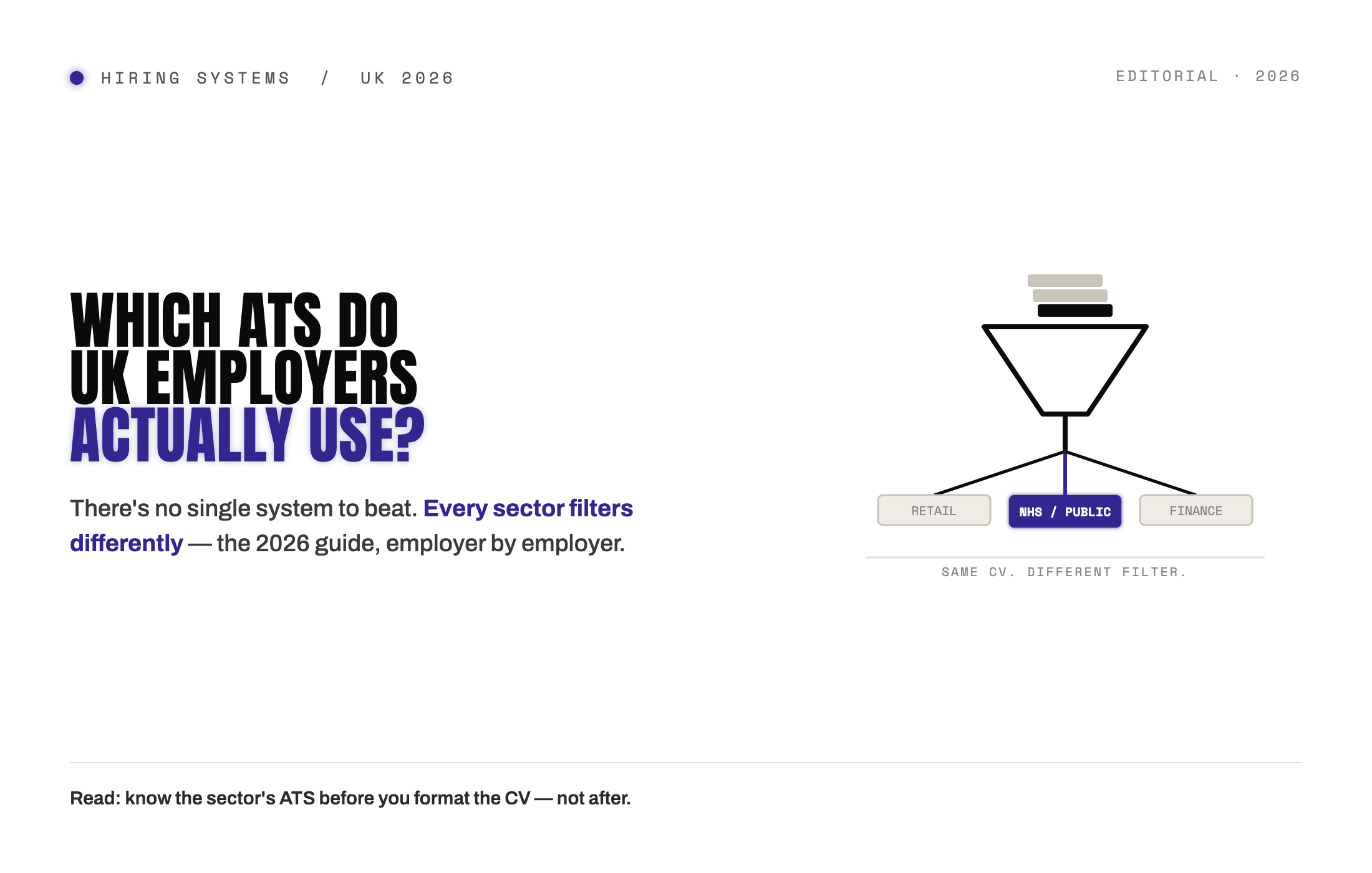
The Applicant Tracking System your target employer uses is one of the most useful things you can know before you apply. It determines how your CV is parsed, how your experience is extracted, which formatting elements will cause parsing failures, and how your application is scored and ranked against every other candidate before any human reads your name. Most job seekers treat ATS as a single uniform system. It is not. The NHS processes applications differently from a FTSE 100 bank. A Civil Service application is evaluated differently from a tech startup. Knowing which system you are applying through, and what that system does to your CV, is the difference between ranking in the top ten percent of applicants and not being read at all. This guide covers every major ATS platform used by UK employers in 2026, sector by sector, and what each one means for your application.
How Widespread Is ATS Use in UK Hiring?
ATS use among UK employers has reached a point where, for most professional roles, the question is no longer whether your CV will be processed by a system before a human reads it, but which system and how it operates. Research by SSR found that 70 percent of enterprise-size UK businesses use ATS software to screen CVs. Among FTSE 100 companies, NHS Trusts, and the Civil Service, use is effectively universal. The CIPD Resourcing and Talent Planning Report 2024 found that 31 percent of UK organisations now use AI within their recruitment process, almost double the 16 percent recorded in 2022, with the trajectory continuing upward through 2025 and into 2026. For the job seeker, this means one thing: the first audience for your CV is almost never a person. It is software. And the software is not the same everywhere.
The Major ATS Platforms Used by UK Employers in 2026
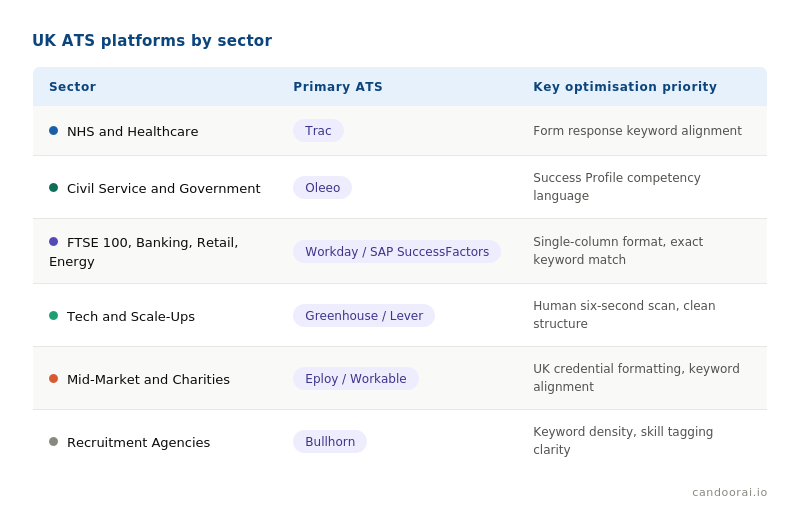
There is no single UK ATS. Different sectors have consolidated around different platforms, and the platforms behave differently at the parsing, scoring, and ranking stages. What follows is a sector-by-sector breakdown of which system you are most likely to encounter and what it means for how your application is processed.
NHS and Healthcare: Trac
NHS Jobs, the primary application portal for NHS roles in England and Wales, runs on the Trac recruitment system. Trac is the ATS you will encounter for the vast majority of NHS Trust positions, from clinical roles to management and administrative functions. Private healthcare employers, including Nuffield Health and Bupa, more commonly use Workday or SAP SuccessFactors for their larger recruiting operations. What Trac does to your CV: Trac processes applications primarily through structured application forms rather than CV parsing. The system extracts information from mandatory form fields, which means the quality of your CV as a document matters less here than your ability to mirror the job description's language within the form responses themselves. Keyword alignment between your application responses and the job description is the primary scoring mechanism. Applications for Band 5 to Band 8 NHS roles typically receive between 200 and 500 applications. Trac scores and ranks them all before any shortlisting begins.
Civil Service: Oleeo
Civil Service Jobs, the central recruitment portal for UK government departments and agencies, uses Oleeo as its primary ATS. Oleeo is one of the most widely deployed ATS platforms in the UK public sector, used across councils, central government departments, NHS Trusts conducting graduate recruitment, and a range of regulated public bodies. What Oleeo does to your CV: Oleeo is built for volume hiring with structured competency assessment. Civil Service applications typically combine an Oleeo-processed CV with structured competency-based questions scored against the Civil Service Success Profiles framework. The system uses intelligent automation to screen and score at scale. A notable characteristic of Oleeo-processed applications is the weight given to specific competency language: applications that use the Civil Service's own Success Profile terminology in their answers score higher than those using equivalent language from outside the framework. If you are applying for Civil Service roles, read the Success Profile framework before you write a single word of your application.
FTSE 100, Banking, Retail, and Large Enterprises: Workday and SAP SuccessFactors
Large UK enterprises, particularly in banking, retail, energy, and professional services, have broadly consolidated around two major platforms: Workday Recruiting and SAP SuccessFactors. These systems are embedded within wider HR management ecosystems rather than operating as standalone ATS tools, meaning they integrate directly with workforce planning and payroll data at the employer's end. Workday is used by a significant number of major UK employers including Marks and Spencer, Rolls-Royce, and large financial services institutions. SAP SuccessFactors is prevalent across banking, pharmaceuticals, and FMCG companies. What Workday and SuccessFactors do to your CV: both platforms are sophisticated text parsers, but each has known sensitivity to formatting. Workday handles multi-column CVs inconsistently. It reads left to right across the full page width, which means a two-column layout with your job title in one column and your dates in the other can produce garbled output where the extracted text mixes content from both columns simultaneously. SAP SuccessFactors has documented issues with CVs using tables, text boxes, or content placed in the header and footer sections of a Word document: this content is frequently either scrambled or not extracted at all. For both platforms, a clean single-column Word document or text-based PDF is the safest submission format. Keyword scoring on both Workday and SuccessFactors operates on near-match as well as exact-match logic, but the near-match capability is less robust than marketing materials suggest. Sector-specific terminology, particularly in regulated industries such as financial services, needs to appear in the exact form the employer used in the job description.
Tech Companies and Scale-Ups: Greenhouse and Lever
UK tech employers, from established firms like Deliveroo and Revolut to earlier-stage scale-ups, predominantly use Greenhouse or Lever as their ATS. Both platforms were designed for structured, collaborative hiring with a focus on reducing bias and standardising the evaluation process across multiple interviewers. What Greenhouse and Lever do to your CV: both platforms are among the most reliable parsers in this group. They handle PDF and Word documents cleanly, manage standard formatting well, and extract structured data with fewer errors than the older enterprise platforms. The scoring on Greenhouse and Lever is less automated than on Workday or SuccessFactors. These systems support structured recruiter review rather than algorithmic pre-screening, which means that for tech roles, your CV reaching a human recruiter is more likely than for an NHS or FTSE 100 application. However, because tech roles attract high application volumes, the recruiter review is rapid: the six-second initial scan is a more accurate description of tech hiring than most other sectors. Your CV needs to communicate the right signal in the first glance.
Mid-Market UK Employers: Eploy and Workable
Mid-sized UK employers, including professional services firms, housing associations, charities, universities, and businesses with 50 to 500 employees, frequently use Eploy or Workable. Eploy is built and hosted in the UK, making it a common choice for organisations with specific GDPR and data residency requirements. Workable is widely used by growing businesses that need an accessible platform without the implementation complexity of enterprise systems. What Eploy and Workable do to your CV: both platforms parse CVs with reasonable accuracy for standard single-column formats. Eploy has good extraction of UK-specific credential formats, which matters for roles requiring professional qualifications such as CIPD, ACCA, or RICS designations. Workable's parsing is solid for standard CVs but can struggle with heavily formatted documents. Both platforms use keyword matching as the primary ranking mechanism, with less sophistication in near-match logic than the enterprise platforms, making exact keyword alignment with the job description particularly important.
Recruitment Agencies: Bullhorn
When you apply to a role through a UK recruitment agency, your CV is almost certainly entering Bullhorn, which is the dominant ATS and CRM platform among UK staffing firms. Reed, Hays, Michael Page, and Robert Half all operate proprietary platforms built on or alongside Bullhorn infrastructure. What Bullhorn does to your CV: Bullhorn functions as a talent database as much as an application tracker. CVs submitted through agencies are parsed and stored in the agency's candidate database, where they are searchable by keyword, skill tag, and availability status. The initial parsing is straightforward, but the way your CV is categorised and tagged when it enters the database determines which future searches surface your profile. Keyword-rich CVs with clear skill tagging are retrieved more frequently than CVs with strong experience described in non-standard language.
The Formatting Failures That Affect Every UK ATS Platform
The specific parsing behaviour varies by platform, but the formatting failures that cause problems are consistent across all of them. Multi-column layouts cause every major UK ATS to scramble the extracted text because the system reads left to right across the full page width. Content placed in Word headers and footers, including contact details and page numbers, is frequently not extracted at all. Content inside a text box or represented as a graphic rather than typed text is invisible to all ATS parsers. Tables used to create visual structure rather than to present data cause parsing errors in Workday, SuccessFactors, Eploy, and Oleeo. Decorative or uncommon fonts can cause character-level extraction errors: Calibri, Arial, and Georgia are safe for all platforms. A PDF created from a scanned document rather than a text-based export cannot be parsed by any ATS. Always export as a text-based PDF directly from your word processor.
What to Do With This Information Before Your Next Application
Knowing which ATS platform processes your application tells you which specific formatting standards and keyword alignment requirements to prioritise. The sector of the employer you are applying to narrows the field significantly. An NHS application through Trac means structured form responses matter more than CV format. Civil Service through Oleeo means competency language alignment is the primary scoring mechanism. A large enterprise through Workday or SuccessFactors means single-column formatting and exact keyword matching are the highest-priority fixes. A tech role through Greenhouse or Lever means the human six-second scan is as important as the ATS score. The universal requirement across all platforms is keyword alignment between your CV and the specific job description you are applying to. This is not about adding keywords artificially. It is about using the employer's terminology to describe experience you genuinely have. The CIPD Resourcing and Talent Planning Report 2024 found that applications using language drawn directly from job descriptions in their work experience sections received significantly higher shortlisting rates than equivalent applications written in the candidate's own terminology. Candoorai's Deep Resume Intelligence module checks your CV against the specific role you are applying to, identifies which ATS platform the employer most likely uses based on sector and company size, and returns your compatibility score alongside the keyword gaps and formatting failures to fix before you submit. Run your first analysis free at candoora.io.
CTA: Check My CV Against the Right ATS Platform Free
Summary: UK ATS Platforms by Sector