

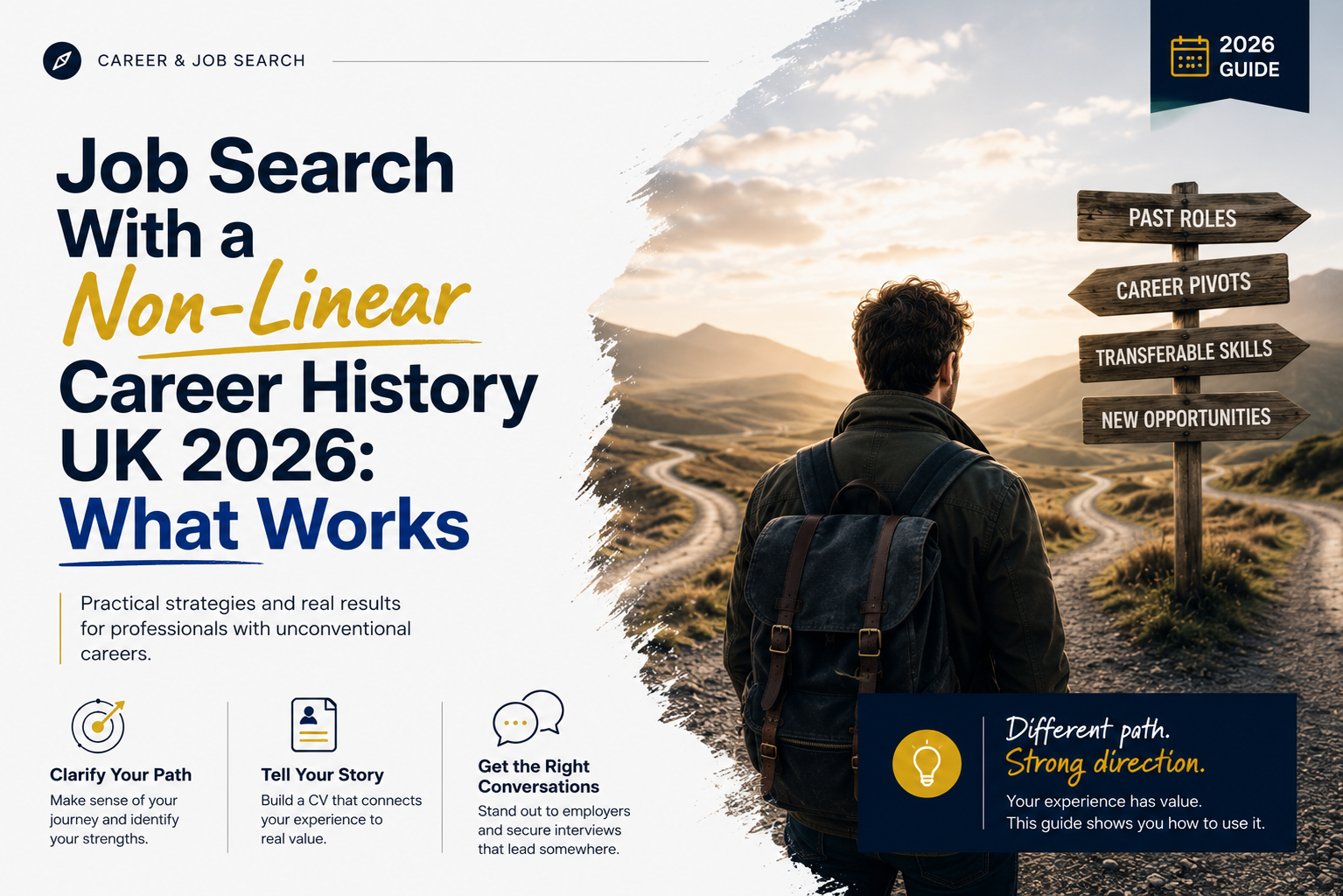
A non-linear career history is not a disadvantage in 2026. It is a positioning problem, and positioning problems have solutions. The professionals who struggle most with a complex career history are not the ones with the weakest experience. They are the ones who have not found the framework to present breadth as depth, to translate transferable skills into the specific language of a new sector, and to navigate an ATS system calibrated for careers that progress in a straight line. This article covers those three challenges and what to do about each.
The Careershifters State of Career Change Report 2026, based on a survey of 11,567 active UK career changers conducted between October 2025 and January 2026, found that 69 percent of respondents were mid or senior level in their careers. Nearly 60 percent wanted to leave their industry entirely. The biggest obstacle was not money, which ranked as the primary barrier for only 12 percent of respondents. The biggest obstacle was clarity: 49 percent said the hardest part was figuring out what they actually wanted to do next. That finding matters because it separates the challenge into two distinct phases. Phase one is deciding direction. Phase two is executing the transition. This article is about phase two. The positioning and strategy work that converts a clear but complex career history into a compelling case for a new employer.
Why Non-Linear Career Histories Are More Viable in 2026 Than at Any Point Previously
The shift toward skills-based hiring that has been developing across UK employers over the past five years accelerated materially in 2025 and 2026. The CIPD Resourcing and Talent Planning Report 2024 found that 57 percent of UK employers had changed their approach to assessing skills in the previous two years, with a growing number placing less emphasis on formal credentials and direct sector experience and more emphasis on demonstrable capability, learning agility, and evidence of outcome at a relevant level of seniority. The UK Government's Skills England report identified future job growth as increasingly skills-led, with over 80 percent of roles requiring digital skill by 2026 regardless of sector.
This matters for professionals with non-linear histories because it changes what employers are willing to look past. An employer using competency-based hiring, assessing whether a candidate can do the specific things the role requires rather than whether their CV shows a direct sector match, is significantly more open to a candidate from a different industry or with a portfolio background than an employer hiring on credential and title matching alone. The challenge is not convincing progressive employers to consider you. It is ensuring your CV communicates your capability in the language of the role you are targeting, clearly enough that the ATS ranks you competitively and the recruiter reading your profile sees the relevance immediately.
The Careershifters data also confirms that the experience of navigating a non-linear career is not marginal: 4 million UK workers have changed careers since the pandemic, and the average British worker changes jobs every five years according to ONS data. Non-linear career histories are the norm, not the exception. The hiring system has not fully caught up with this reality, which is why the positioning work matters. But the direction of travel is toward greater acceptance of complex histories at every level of seniority.
The Three Types of Non-Linear Career History That Require Different Strategies
Not all non-linear careers present the same challenge. Understanding which type of complexity your history represents is the starting point for the right strategy.
Type 1: Cross-sector moves. You have built a strong career in one sector and are targeting roles in a different one. Your skills are genuinely transferable but your CV describes them in the language of your origin sector rather than the language of the target sector. The ATS at your target employer is looking for terminology from their sector and finds different but equivalent terminology from yours. This is a translation problem. The experience is real and directly applicable. The presentation does not yet make that application legible to the system that will evaluate it.
Type 2: Portfolio or multi-strand careers. You have worked across multiple functions, employers, or even self-employed and employed periods in ways that do not map cleanly to a single linear progression narrative. Your value is precisely in your breadth, the ability to operate across multiple domains, the commercial understanding that comes from having worked at both strategic and operational levels, the sector agnosticism that makes you effective in complex or evolving organisations. The challenge is that ATS systems and many CV formats are designed to present depth in a single track, and presenting breadth effectively without looking like a generalist requires deliberate structural choices.
Type 3: Careers with significant gaps or breaks. You have one or more periods in your career timeline that are not occupied by conventional employment. Career breaks for caregiving, health, education, or personal reasons, redundancy periods that extended longer than expected, or time spent in activities that do not have a traditional job title. The ATS challenge here is different from the first two types: it is not primarily about keyword mismatch but about the recruiter view, the six-second scan that assesses progression, and how gaps in the timeline read to a human reviewer who has not yet decided whether to engage further.
The ATS Challenge for Non-Linear Careers
ATS systems were built for linear career progressions. They are calibrated to extract job titles, employers, dates, and progression signals from a document structure that assumes: role at company A, then more senior role at company B, then more senior role at company C. When the input does not match that structure, parsing becomes less reliable and scoring becomes less accurate.
For Type 1 cross-sector careers, the keyword mismatch problem is acute. The same capability described in different sector language produces a low keyword score even where the fit is genuine. A financial services professional targeting a senior role in a healthcare organisation will have a CV full of terms that are accurate and relevant but are not the terms the healthcare employer's ATS is searching for. "P&L management" and "budget accountability" describe the same capability in different languages. The ATS does not resolve the translation. The fix is deliberate: identify the specific terminology the target employer used in the job description for each capability you are claiming, and rewrite the relevant sections of your CV using that terminology before submitting.
For Type 2 portfolio careers, the structural challenge is that a chronological CV format, which is the format most ATS systems parse most reliably, does not present a portfolio career effectively. A functional CV format, which groups by skill rather than employer, is sometimes recommended for portfolio careers but is poorly received by both ATS systems, which struggle to associate skills with specific roles and time periods, and by recruiters at senior level, who want to see a clear progression narrative. The practical solution is a hybrid approach: a strong professional summary that explicitly frames the breadth of the career as intentional and valuable, followed by a chronological experience section where each role is presented in terms of its contribution to the overall capability set rather than as an isolated position.
For Type 3 careers with gaps, the ATS scoring challenge is less significant than the recruiter view challenge. Most ATS systems do not score negatively for gaps in themselves: they score on keyword presence and profile alignment. The gap affects the human review. The fix is in the professional summary, which should address the career narrative directly and frame any significant gap or non-traditional period explicitly, so the recruiter reading the profile is not left to infer from absence what the candidate's experience looks like.
How to Present a Non-Linear Career to a Recruiter
The recruiter reviewing a non-linear CV at senior level is trying to answer one question: does this person's career, however it looks on paper, produce the capability the role requires? The CV's job is to answer that question quickly and affirmatively before the recruiter moves to the next application.
For cross-sector careers, the professional summary is the most important section. It needs to do three things: name the target role and sector explicitly so the recruiter is not guessing your direction, state the years of relevant experience at the appropriate seniority level, and identify the two to three transferable capabilities that are most relevant to the target role in the target sector's language. "Fifteen years of commercial leadership in financial services, now applying expertise in risk management, stakeholder governance, and business transformation to the healthcare sector" is a summary that answers the direction question immediately. A summary that says "senior leader with extensive experience across multiple sectors" answers nothing.
For portfolio careers, the summary needs to frame the breadth explicitly as a strength rather than allowing it to appear as an accident. "Fifteen years operating across strategy, operations, and commercial leadership in both corporate and entrepreneurial environments" is a framing choice that presents range as capability. The experience section then needs to connect each role to the thread that runs through the portfolio, showing that the different positions were coherent expressions of a consistent set of skills rather than a random collection of unrelated jobs.
For careers with gaps or breaks, the summary should acknowledge the non-standard period briefly and move directly to the value the candidate brings: "Following a two-year career break for family caregiving, returning to senior operations leadership with fifteen years of directly relevant experience in supply chain transformation." The brevity matters: one sentence, no apology, direct pivot to the capability narrative.
The Transferable Skills Translation Problem
The hardest practical challenge for professionals making cross-sector moves is not identifying that their skills are transferable. It is translating those skills into the specific vocabulary of the target sector in a way that is convincing to both the ATS and the human reviewer.
This is where the Careershifters 2026 data provides an important insight. The report found that 49 percent of career changers say the biggest obstacle is figuring out what they want to do. But among mid and senior level professionals, who are 69 percent of the survey sample, a second and distinct challenge emerges once direction is clear: making a credible case to employers in an unfamiliar sector when you have no prior job titles in that sector to point to.
The answer is not to rely on the transferability claim alone. "My skills transfer to your sector" is an assertion, not evidence. The evidence comes from mapping specific achievements in your origin sector to specific requirements in the target sector, using the target sector's terminology, and showing the outcome that resulted. A project manager in construction who has built complex multi-stakeholder programmes, managed supplier relationships under contractual pressure, and delivered outcomes on constrained budgets has done exactly what most healthcare capital projects or government transformation roles require. The claim is credible. The translation, rewriting the construction project management experience in the language of public sector programme delivery, is the work that makes it visible to the employer's ATS and compelling to the recruiter who reads it.
What a Fit Score Tells You Before You Apply
For professionals with non-linear histories, the fit score analysis is more important before each application than it is for candidates with straightforward linear careers. A linear candidate applying to their obvious next role has a reasonable basis for intuiting their fit. A professional making a cross-sector move has much less information about how their profile will be read by the target employer's system, and guessing wrong wastes significant tailoring effort.
Running a fit score analysis against the specific role before investing tailoring time tells you: whether your overall profile alignment is strong enough to justify the application, which specific dimensions of fit are strongest (skills, seniority, domain experience, ATS compatibility), and which gaps are presentation gaps you can close with tailoring versus profile gaps that may make the application unlikely to succeed regardless of the CV work. For a cross-sector candidate, the seniority and skills dimensions of the fit score are typically stronger than the domain experience dimension. Knowing this before you apply tells you where to concentrate the tailoring: the domain experience section needs to work harder than the seniority and skills sections to make the case.
The Pivot Navigator: A Structured Approach to Career Transition
Most professionals navigating non-linear transitions do so without a structured framework, relying on instinct and the advice of friends and family, who are the most commonly cited support source in the Careershifters data, used by 38 percent of respondents. The problem with relying on personal networks for career transition support is that they provide encouragement and reassurance more reliably than they provide objective assessment of market viability, transferability mapping, or specific gap analysis.
Candoorai's Career OS Pivot Navigator is built for this phase of the process. It maps your transferable skills from your current profile to your target role, identifies the three most viable transition routes based on your experience, shows the feasibility score for each, identifies the gaps that are significant versus the manageable gaps, and builds the pivot narrative that makes your case legible to employers who have not hired from your origin background before. The Navigator draws on the full structured record in your Career OS Evidence Vault, not just your current CV, which means it can surface relevant achievements and capabilities that are not currently visible in your application materials.