

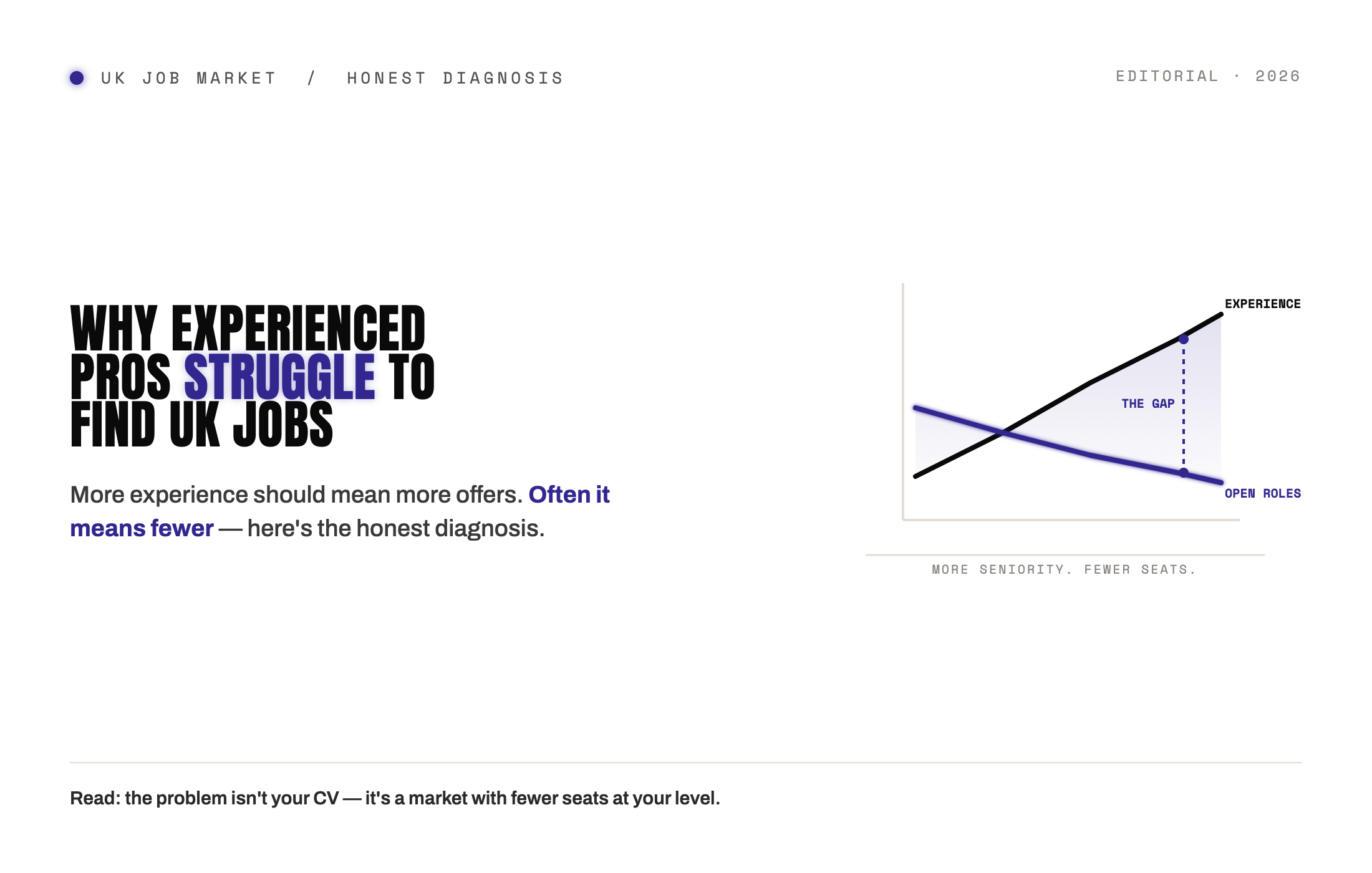
There is a genuine paradox at the centre of the UK labour market in 2026. Nearly three-quarters of UK firms, 71 percent, reported hiring difficulties in the first quarter of the year. Simultaneously, experienced professionals are finding roles harder to secure than at any point since the immediate post-pandemic period. Businesses cannot find the people they need. Experienced people cannot find the roles that should want them. Understanding why this is happening, and specifically which parts of it are within a job seeker's control, is the most useful thing an experienced professional can do before spending another month in a search that is not producing results.
This article covers the full diagnosis: the structural market causes that are real and significant but cannot be addressed by the individual job seeker, and the strategy and presentation causes that are equally real and can be addressed directly. Knowing which category each problem falls into determines what to do about it.
The Structural Causes: What Is Actually Happening in the UK Market
The UK labour market in 2026 is operating under a set of pressures that have converged to make hiring at senior level specifically more cautious and more selective than it has been in recent years.
The Employment Rights Act 2025 and the National Insurance contribution increases introduced in the October 2024 Budget have materially increased the cost of permanent employment at senior salary levels. The CIPD Winter 2025 to 2026 Labour Market Outlook, based on a survey of over 2,000 senior UK HR professionals, found that three in four employers, 74 percent, expect the Employment Rights Act to increase employment costs, and the net employment balance, the difference between employers expecting to increase staff levels and those expecting to reduce them, sits at its lowest level on record outside of the pandemic. Senior roles, which carry higher base salaries, more significant benefit packages, and longer notice periods that increase the cost of a wrong hire, are disproportionately affected by this cost sensitivity.
The result is what economists at The Conversation have described as a "low-hire, low-fire" dynamic. Businesses are reluctant to make new permanent senior hires in an uncertain cost environment. They are also reluctant to lose the experienced people they already have, because replacing senior talent with deep institutional knowledge is expensive and slow. The matching problem this creates is structural: experienced professionals who need to move are entering a market where the buyers of their services are cautious, taking longer to make decisions, and often waiting for the need to become urgent before hiring. Search timelines of six to nine months for Director and VP-level roles are now the norm rather than the exception.
The age bias dimension compounds this. Research by the Centre for Ageing Better found that 36 percent of people aged 50 to 69 feel disadvantaged in applying for jobs due to their age, more than any other age group. A poll of 4,000 UK adults found that the average age at which a candidate becomes "undesirable" to recruiters in the UK is 55. Two-fifths of HR decision-makers surveyed by Totaljobs admitted to having faced pressure to hire younger candidates. More than a quarter of HR decision-makers also admitted to making assumptions about candidates based on age. Analysis from law firm Littler found that age discrimination claims in UK employment tribunals surged by 50 percent in the last year. The Women and Equalities Committee, in a report published in early 2025, described ageism as "widespread and culturally embedded" in the UK. These are not anecdotal impressions. They are documented patterns with measurable legal consequences.
These structural causes are real, significant, and largely outside the control of the individual job seeker. Acknowledging them matters because the alternative, assuming that a slow search is entirely a personal failure of strategy or presentation, is both inaccurate and demoralising. The market is genuinely harder for experienced professionals in 2026 than it was in 2021 or 2022. Knowing this is the starting point for a realistic strategy.
The Addressable Causes: What Is Within Your Control
Within the structural context described above, experienced professionals are also frequently making strategy and presentation errors that compound the difficulty of an already difficult market. These are the causes within the job seeker's control, and they account for a significant portion of why searches produce silence even in sectors and functions where relevant roles exist.
The channel problem: searching where most roles are not. The majority of experienced professional roles in the UK are filled through networks, referrals, and executive search before they appear on a job board. A job seeker who concentrates 80 percent of their effort on publicly advertised roles is concentrating their effort on the minority of the market, and the most competitive part of it. The hidden job market, roles filled through professional relationships, recruiter relationships, and direct conversations, is the primary market for senior hiring. Most experienced professionals know this in principle and continue to behave as if it is not true in practice.
The ATS penalty: the system ranks experienced CVs lower than they deserve. This is one of the least-discussed causes of difficulty in experienced professional job search and one of the most consequential. Applicant Tracking Systems, which process most UK employer applications before any human reads them, consistently score senior CVs lower than junior CVs for the same role. This is not an accident of the technology. It is a structural consequence of how senior CVs are typically written. They are longer, which dilutes keyword density. They are duty-focused rather than achievement-focused, which produces fewer of the outcome-oriented keywords modern ATS platforms now weight more heavily. They are written in the accumulated language of previous employers, none of which precisely matches the terminology the new employer used in the job description. The result is that a well-qualified senior professional can rank below a less-experienced junior candidate in the ATS output, simply because the junior candidate tailored their language to the job description and the senior professional did not.
The volume trap: applying broadly with a generic CV. Under the pressure of a slow search, most experienced professionals respond by applying to more roles. This feels like action. In a market where the primary cause of silence is poor targeting and poor keyword alignment, more volume produces more silence. Each application sent with a CV that scores 50 against its job description produces the same outcome as the last one. The productive response is not to increase application volume but to improve the quality and targeting of each application: running a fit score analysis to confirm the role is a strong match before investing tailoring effort, then tailoring the CV to the specific job description before submitting.
The positioning problem: describing what you did rather than what you produced. Senior CVs written for earlier stages of a career often describe responsibilities and functions rather than outcomes and commercial impact. A CV that says "managed a team" or "responsible for the P&L" is not communicating the same thing as "led a team of 22 through an 18-month transformation delivering 31 percent cost reduction" or "held P&L accountability for a £47m business unit, growing revenue by 23 percent over three years." At senior level, recruiters and hiring managers have high standards for the specificity of achievement evidence. A CV that does not meet those standards reads as a weaker candidate than one that does, regardless of the underlying track record.
The preparation gap: preparing for interviews in general rather than for the specific company. Experienced professionals with extensive careers sometimes under-prepare for interviews, relying on the depth of their experience to carry the conversation. At senior level, the interview is not a general conversation about a career. It is a specific probe into the depth of achievement behind the CV the interviewer has read. The interviewer is testing whether the specific numbers, decisions, and consequences claimed on the CV hold up under questioning. A candidate who has not prepared specific evidence for the specific role, calibrated to the specific company's context, will not perform at the level their track record deserves.
The Paradox That Is Not a Paradox
The apparent contradiction between 71 percent of UK firms reporting hiring difficulties and experienced professionals struggling to find roles resolves when you understand what those firms mean by difficulty. Research by Freshminds found that the challenge for employers in 2026 is increasingly less about a shortage of applicants and more about skills alignment: finding candidates with the precise technical, commercial, or adaptable skill sets required for evolving business needs. The CIPD still reports that one in three employers has hard-to-fill vacancies, even in a market with more candidates available than a year ago.
The matching problem is not about too many or too few experienced professionals. It is about the alignment between what experienced professionals are presenting and what employers need to see. An experienced professional whose CV is written in the language of their previous employers, scored poorly by the ATS against the current role, and positioned around responsibilities rather than outcomes is not presenting their capability accurately to the system that is evaluating them. The capability exists. The presentation does not reflect it. That is an addressable gap, not a structural one.
What Experienced Professionals Can Actually Do
The distinction between structural and addressable causes is the starting point for a realistic strategy. The structural causes, cost caution in hiring, a slower pace of decision-making, and age bias in parts of the market, require patience and the right expectations about timeline. The addressable causes can be fixed, and fixing them changes the trajectory of a search materially.
Fix the ATS position first. Run a role-specific ATS analysis on your CV against the job description of a role you are currently targeting. This tells you your keyword gaps, your formatting failures, and your fit score before you invest tailoring effort. If your score is below 65, the formatting and keyword fixes described in the ATS cluster articles in this series apply. If your fit score is weak overall, the application is unlikely to convert regardless of how well the CV is optimised, and the more productive decision is to target roles where the fit score is strong.
Shift from the job board channel to the referral and network channel. Identify your 15 to 20 target employers and the decision-makers or senior contacts you are connected to at each of them, directly or one step removed. Map those connections, rank them by strength and proximity to the hiring decision, and build a referral package that makes the ask specific and easy. A warm introduction to the right person at a target employer, even before a role is posted, is worth dozens of cold applications to advertised roles.
Rewrite your CV around outcomes, not duties. For each role in your most recent ten years, convert the duty statements into achievement statements: what was produced, at what scale, with what consequence. Use the language of the job description you are targeting rather than the language of your previous employers. The professional summary should state your target role title, your years of directly relevant experience, and two to four specific capabilities named in the job description.
Prepare specifically for each company. Before any interview, research the organisation at depth: leadership priorities, recent strategic developments, the context behind the role. Build your interview answers from the specific achievements in your own career that are most relevant to this company's current situation. The strongest interview performance at senior level connects your specific past to their specific present.