

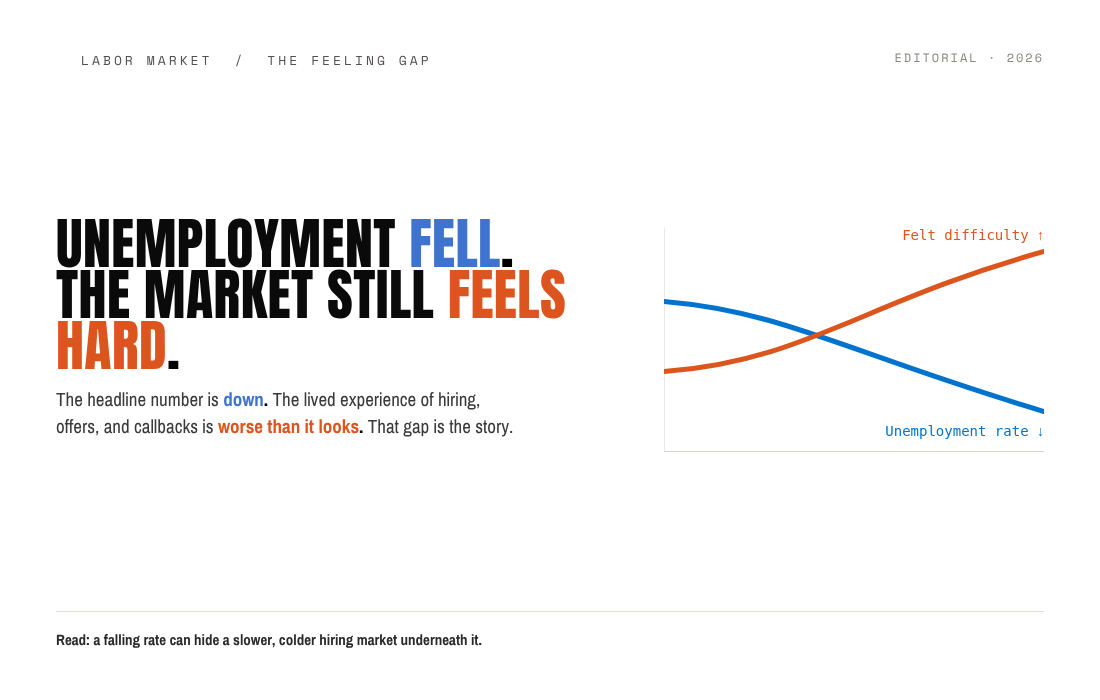
The official unemployment rate fell to 4.2% in June 2026, the lowest in a year. The same month, 507,000 fewer people were recorded as working. Both of those things are true simultaneously, and the reason they can both be true is the most important thing to understand about the job market right now.
The Smoke Alarm That Goes Off When You Cook and Stays Silent During a Fire
Smoke alarms are calibrated to detect a specific type of signal: smoke particles above a certain density in the air. They work well for their stated purpose. But they have a known failure mode. If you leave a window open, enough smoke can escape to stay below the detection threshold even as conditions in the room become genuinely dangerous. The alarm stays silent. You might conclude things are fine. They are not.
The unemployment rate works similarly. It measures one specific thing: the percentage of people who are in the labour force and actively looking for work without success. When that number falls, it is usually good news. But the alarm can also fall silent for the wrong reason: when people stop looking for work entirely, they exit the labour force and are no longer counted as unemployed. The unemployment rate falls. Nothing has improved for those people. The alarm just stopped detecting them.
This is precisely what happened in June 2026. The unemployment rate fell from 4.3% to 4.2%, but the labour force participation rate dropped 0.3 percentage points to 61.5%, the lowest since March 2021. Household employment, measured separately from payroll data, fell by 507,000. The unemployment headline improved because people left the labour force in large numbers, not because the job market improved in any meaningful sense for the people inside it.
Glassdoor's chief economist Daniel Zhao described the June report as putting "a damper on the fireworks," with payroll growth coming in as "more fizzle than sparkle." Newsweek's economists noted the participation rate decline was the primary driver of the unemployment rate's small improvement. This is the smoke alarm staying silent while the window is open.
Who Is Leaving the Labour Force and Why
The composition of labour force exits in 2026 tells a specific story about which groups are most affected and why.
In the US, the Federal Reserve Bank of New York has separately reported that graduate unemployment reached 5.6% in 2026, above the national average, which is historically unusual. Graduates are typically insulated from unemployment spikes because employers prefer credentialled candidates in soft markets. The fact that graduate unemployment is now above the national rate signals that the entry-level and early-career professional market is under its own distinct pressure, separate from the general labour market.
The BLS June data shows teenager unemployment at 14.6%, confirming the Wall Street Journal's recent reporting that this is expected to be the worst summer for teen employment since 1948. Black unemployment remains at 6.6%, Hispanic at 5.2%, Asian at 3.9%, and White at 3.6%. The divergence across demographic groups is significant and points to a market where the burden of deteriorating conditions is not distributed evenly.
In the UK, the ONS has been tracking what economists are calling an inactivity crisis: a sustained rise in the number of working-age adults who are neither employed nor job seeking, primarily driven by long-term sickness at a scale that makes the UK an outlier among comparable economies. The UK's economic inactivity rate remains elevated at levels not seen since the mid-1990s, even as headline unemployment sits at relatively low levels. The pattern is structurally similar to the US dynamic: unemployment looks stable on the surface while the number of people the system has stopped counting grows underneath.
In Germany, the Volkswagen crisis and broader manufacturing contraction are producing a specific version of the same phenomenon. Skilled automotive and manufacturing workers who lose roles are not easily absorbed into the professional services and healthcare sectors that are growing. They either retrain over a period of years or they gradually exit the labour force. Germany's long-term unemployment rate has been rising even as its headline number holds relatively steady.
What This Means for the Experience of Actually Searching
The gap between what the headline unemployment rate says and what it feels like to be searching for work in 2026 is not imaginary. It is structural and it has a specific explanation.
When people leave the labour force, the competitive pool for available roles does not shrink proportionally. The roles that exist continue to attract large numbers of applicants from the people who remain actively searching, often including people who have been in the market for extended periods and are applying to a wider range of roles than they otherwise would. The 108-day median search duration data published earlier this year reflects this: the average time to find a role has lengthened considerably, not because fewer roles exist in absolute terms, but because the density of qualified applicants per available role has increased.
Boutique Recruiting's June 2026 analysis put this plainly: more jobs are being posted, but fewer people are being hired, because companies are not hiring for volume. They are hiring for specialised talent to solve specific, difficult problems. This creates a market where the headline statistics point in one direction and the experience of most searchers points in another, and both are accurate descriptions of different parts of the same system.
The Sectors Where the Smoke Alarm Is Working Properly
Not every part of the June data is ambiguous. Three sectors showed clear, unambiguous hiring growth that is not a statistical artefact of participation rate changes.
Healthcare added 22,000 jobs in June and has averaged 38,000 per month for the past year. Social assistance added 25,000 jobs, primarily in individual and family services. Professional and business services added 36,000 jobs and has been growing since October 2025. These are sectors where real hiring is happening at a sustained pace, and the data for them is not distorted by participation rate effects the way the headline unemployment number is.
In the UK, the NHS and social care sectors are in sustained demand driven by demographic pressures that are structural rather than cyclical. The CIPD's hiring intentions data has consistently shown net positive intent in health, education, and professional services even as manufacturing, retail, and hospitality have turned negative. In Europe, the same pattern holds across France, the Netherlands, and the Nordic countries: healthcare, professional services, and technology are the consistent growth sectors while manufacturing and consumer-facing businesses face sustained structural pressure.
Why Precision Matters More When the Signals Are Misleading
In a market where the headline data is actively misleading, the professionals who fare best are the ones who have stopped relying on the headline and started working from more granular intelligence.
The unemployment rate tells you the aggregate national temperature. It does not tell you the temperature in your sector, at your level of experience, in the specific geography where you are searching. It does not tell you whether the roles you are targeting are in the growing segments of professional services or in the contracting segments of retail and hospitality. It does not tell you whether your profile is positioned to stand out in a dense applicant pool or to disappear into it.
Most career tools tell you how to write a CV, how to answer interview questions, or how to blast applications at volume. None of that helps when the core problem is that the signals the market is sending are genuinely difficult to interpret without more granular data than the headline unemployment rate provides.
How Candoorai Approaches This
Candoorai's fit analysis does not use the unemployment rate to assess your situation. It uses your specific career history, the specific role you are targeting, and the specific hiring behaviour of the specific employer to tell you what your real position in that specific market is. That is a much more actionable piece of intelligence than a national statistic.
The sector mapping in the Career OS helps you identify whether your current career trajectory is in a growth sector or a contracting one, and what the translation work looks like to move from the latter to the former if that is the direction you are heading. The referral mapping bypasses dense applicant pools entirely by routing your candidacy through a trusted internal connection, which is the most reliable way to be seen as a specific person rather than a number in a queue.
The unemployment rate fell in June. For the professionals leaving the labour force, that was not good news. For the professionals who understand the data beneath the headline and position themselves accordingly, the June report is a map. Candoorai helps you read it.