

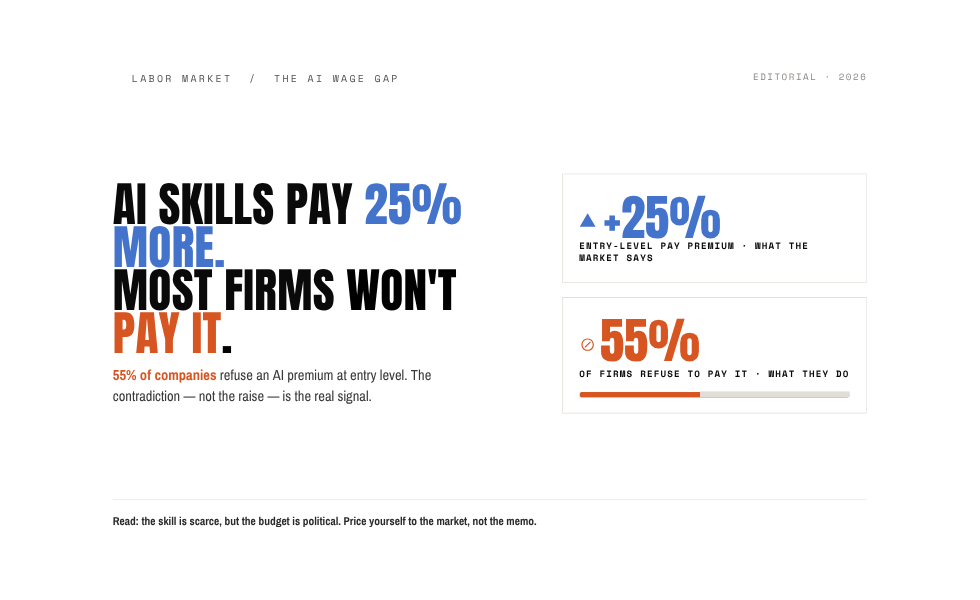
AI skills are simultaneously one of the most demanded and one of the least rewarded capabilities in the 2026 job market. Randstad's analysis of 50 million job postings found entry-level workers with AI skills commanding salaries up to 25% higher. Payscale's survey of companies found 55% are not paying any premium, bonus, or equity for AI skills despite the majority having updated their job listings to say they want them. Both findings are recent, both are from named, primary sources, and both are true at the same time. Understanding why resolves the contradiction and tells you specifically how to position yourself.
This article covers two things: why AI skills pay more in some contexts and nothing extra in others, and what that difference means for how you develop and evidence this capability.
The Gap Between What Employers Say and What They Pay
Payscale's 2026 Compensation Best Practices Report found that more than 60% of companies have updated their job listings to reflect that they are looking for workers with an AI advantage. The same report found that 55% are not offering premiums, bonuses, or equity for those skills. Companies are filtering for AI capability at the screening stage but not pricing it at the offer stage.
This is not hypocrisy, exactly. It is a market in the middle of a transition it has not yet figured out how to measure. Employers know AI capability matters. They do not yet have internal frameworks for assessing what it is worth relative to other credentials, because the range of what "AI skills" actually means is so wide as to be nearly meaningless as a compensation category. A candidate who can use ChatGPT to draft emails is not the same as a candidate who can design and implement an AI-assisted research pipeline. Both technically have "AI skills." Only one of them is producing output that justifies a premium.
The distinction that produces the wage gap is specificity. The 25% salary premium Randstad found is not going to candidates who list AI tools on a CV. It is going to candidates who can demonstrate specific, evidenced, domain-relevant AI capability in the context of the work the employer actually needs done.
Why the Premium Exists Where It Does
Randstad's analysis of 50 million job postings between 2022 and 2026 found that demand for data centre workers grew rapidly alongside AI adoption, with vacancies for robotic technicians increasing by 107%, HVAC engineers by 67%, and industrial automation technicians by 51%. The salary premium in technology roles is specific and measurable: entry-level software development pay in the US jumps from $85,000 to $105,000 with AI expertise added, according to Randstad's CEO Sander van't Noordende, who stated directly that AI is "a fast pass to promotion and pay for new entrants into the labour market, provided that you combine it with social skills, the softer skills, the judgement, the collaboration, the empathy."
The "provided that you combine it" clause is where most of the analysis of AI wages stops short of being useful. The premium does not accrue to AI skills alone. It accrues to the combination of AI fluency and the human-centred capabilities that allow a professional to determine when to use AI, how to evaluate what it produces, and how to communicate its output to the people who need to act on it. This combination is rarer than either component alone, which is why it commands a premium where the individual components increasingly do not.
In the roles where no premium is being paid, the pattern is consistent. Companies requiring AI skills for administrative, support, and coordination functions are treating AI fluency as a baseline expectation rather than a differentiating capability, in the same way that proficiency in Microsoft Office stopped being a premium skill around 2010. It is now a floor, not an advantage.
The Specific Reason Most Professionals Are Not Getting the Premium They Could
The AI skills that command a salary premium in 2026 share two characteristics that are worth naming clearly.
First, they are demonstrated in the context of a specific domain rather than in general. A finance professional who can use AI to build models that identify cashflow risk patterns in ways the team previously could not do is demonstrating AI fluency inside a context where it produces measurable, attributable value. A recruiter who uses AI to reduce time-to-shortlist by 30% for a specific type of role is doing the same thing. General AI proficiency, the ability to use a range of tools competently without any specific application, is increasingly a floor rather than a differentiator.
Second, they are evidenced rather than claimed. The difference between a CV that says "proficient in AI tools including GPT, Claude, and Copilot" and a CV that says "used AI-assisted research tools to reduce competitive analysis cycle time from three weeks to four days, enabling faster market entry decisions on two product lines" is the difference between a claim and evidence. Hiring systems at their best, and hiring managers consistently, score the second version higher because it gives them something specific to evaluate. The first version tells them nothing about what the capability actually produces.
The professionals who are capturing the premium are the ones who have built specific, evidence-based, domain-relevant applications of AI into their practice and can describe the outcome of those applications precisely. This is not as common as the number of people claiming AI skills would suggest.
What This Means for How You Develop and Present This Capability
Three practical conclusions follow from the data above.
Domain-specific matters more than general. Developing AI fluency in the context of your actual work, the specific problems your field faces, and the specific outputs your employer values produces more career value than accumulating general AI tool certifications. A project manager who uses AI to improve risk identification in their specific type of project is developing a more valuable capability than one who completes a generic AI literacy course. The former can describe a specific, evidenced, domain-relevant outcome. The latter cannot.
Combination is the premium driver. Randstad's CEO was explicit about this: AI fluency without the social skills, judgment, collaboration, and empathy that allow you to use it well produces less value than the combination. The professionals capturing the 25% premium are not simply the most technically fluent with AI tools. They are the ones who combine technical fluency with the human capabilities AI cannot replicate, and who can evidence that combination specifically.
Evidence now rather than later. The premium accrues to candidates who can demonstrate specific AI-produced outcomes, not to those who plan to develop these capabilities before their next job search. The career evidence built during the period of AI adoption, the specific things your AI-assisted work produced, the problems it solved, the time or cost it saved- is the raw material that will differentiate your application from the thousands of others claiming AI skills in a market where the term has become nearly as generic as "Microsoft Office."
How Candoorai Supports This
The AI skills wage premium is real, specific, and available to professionals who can evidence domain-relevant AI capability clearly. The gap most professionals face is not in the capability itself but in the evidence of it, and in the translation of that evidence into the language hiring systems and hiring managers are using to evaluate it.
Candoorai's Career OS captures both your structured career history and your unstructured professional contributions, including the AI-enabled work you have produced, the specific outcomes you can attribute to it, and the domain-specific context that makes those outcomes meaningful to a hiring manager in your field. The fit analysis tells you whether the AI fluency on your profile reads as a genuine differentiator for the specific role you are targeting, or whether it is sitting in your document as a generic claim that is not doing the work you need it to do.
The professionals who get the 25% premium are the ones who can show their work. Candoorai is built to help you show yours.