

The CIPD's research on hiring found that 47 percent of interview failures are attributed to inadequate company research. What that figure does not specify is what adequate research looks like at Director and VP level, where the interviewer is a Founder, CEO, or Board member and the expectation of company knowledge is entirely different from a line manager interview. Checking the About page and reading a recent press release is what entry-level candidates do. Senior-level candidates who get offers do something more specific: they understand what the company is working on right now, what the leadership publicly prioritises, and what the role's existence signals about the organisation's current challenges. This article covers how to build that level of research and what it produces in the interview room.
Why Depth of Research Shows Up Immediately at Senior Level
A junior candidate who can summarise the company's product and founding year has done enough for a screening interview. At final-round level, the interviewer already knows what their company does. What they are assessing is whether the candidate has understood why this role exists at this specific moment and how their experience connects to that problem. That cannot be answered from the website's About page.
The question "why do you want to work here?" at senior level is not a test of company knowledge. It is a test of whether the candidate has understood the company's current situation well enough to give a specific, relevant answer about what they would contribute. That requires going beyond what the company publishes about itself.
Three Layers of Research That Produce Different Information
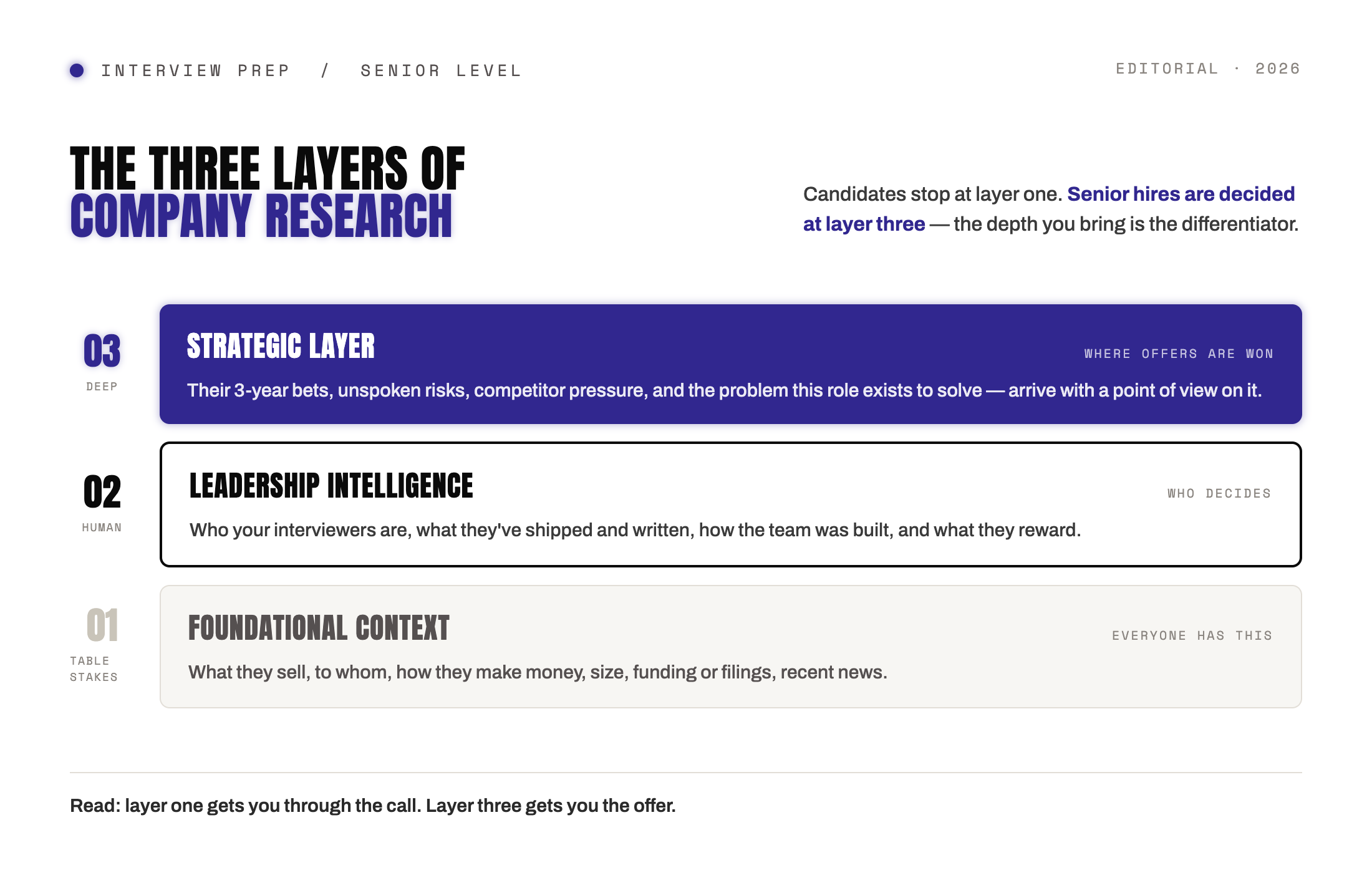
Company research at senior level runs across three layers. Each produces different material and draws on different sources.
Foundational context is the starting point. What the company does, its business model, approximate scale, sector position, recent headline news, and funding status for private companies. Companies House filings for UK entities give financial trend data and director histories. Crunchbase covers funding rounds. Google News filtered to the past six months covers recent events. This layer takes 30 to 60 minutes and is necessary but not sufficient on its own.
Leadership intelligence is the layer most candidates skip. Every senior leader at a target company leaves a public record of what they think and what they prioritise: LinkedIn articles, podcast appearances, conference talks, published interviews, and for listed companies, analyst call transcripts. These are not marketing materials. They are primary sources for how the organisation's leadership frames problems and what they are focused on right now. A candidate who has read the CEO's last three LinkedIn articles before interviewing with that CEO has preparation depth that almost no other candidate will have. It is visible within the first ten minutes of the conversation because the candidate can respond to how the interviewer frames things rather than only to what they literally ask.
Strategic intelligence is the synthesis layer. It answers: what is the company trying to do right now, and what does this specific role have to do with it? Every Director or VP hire exists because the organisation is solving a specific problem or pursuing a specific opportunity. The job description names the role. The strategic intelligence layer reveals why the role needs to exist at this moment. Sources include the most recent annual report or investor letter for listed companies, the Founder or CEO's published commentary on where the business is heading, recent hires visible on LinkedIn that show what capabilities the organisation is building, and the full job board across all open roles, which shows the complete shape of current hiring activity and what it implies about priorities.
What This Research Produces in the Interview Room
Deep company research produces four specific things that change how an interview goes.
A specific answer to "why this company." Interviewers at senior level have heard every generic version of this answer. A candidate who says they are interested because the company's recent strategic move into a new market creates exactly the kind of operational challenge they spent the last four years solving answers the interviewer will remember. That answer requires knowing about the strategic move, which requires research beyond the homepage.
The ability to connect past achievements to the company's current situation. The strongest senior-level interview answers draw a line between what the candidate did previously and what the interviewer is facing now. That line cannot be drawn without knowing what the interviewer is facing. Research is what provides that knowledge.
Better questions. A candidate who asks "the recent announcement about X suggests you are moving toward Y: what does that mean for this role's priorities in the first six months?" is demonstrating that they are already thinking inside the organisation. Interviewers notice this. A candidate who asks "what are the biggest challenges facing the team?" is demonstrating they ran out of research before the meeting.
Composure under pressure. When a senior interviewer probes the candidate on their knowledge of the business, depth of research gives the candidate material to draw on. Without it, the conversation runs shallow quickly, which is itself an assessment signal at this level.
UK-Specific Sources That Most Guides Do Not Mention
For UK companies, the following sources produce information that generic research guides rarely reference.
Companies House: every UK registered company files annual accounts, confirmation statements, and event notifications. Director appointment histories, subsidiary structures, significant transactions, and financial trend data are all publicly available. For private companies with no investor communications, Companies House filings are often the only financial context available outside the organisation.
The interviewer's own published output: UK-specific business publications including Management Today, City A.M., the Times Business section, and sector trade publications regularly feature senior leaders from growing UK companies. Searching the interviewer's name alongside their company across these sources surfaces material not visible through generic Google searches.
Regulatory and public sector filings where applicable: for companies in regulated UK sectors, inspection reports and public sector framework awards are public documents that give insight into the organisation's compliance status and public contract performance. Almost no candidates check these. Interviewers notice when one has.
Glassdoor and Trustpilot for pattern signals rather than individual data points: individual reviews are unreliable in isolation. Consistent themes across multiple reviews about leadership communication, decision-making speed, or transparency are meaningful context for what the working environment is actually like.
How Candoorai's Insider Intel Module Structures This Research
Candoorai's Insider Intel module surfaces the intelligence layer for any company you are targeting: leadership communication signals from published sources, culture indicators from the organisation's external presence, recent strategic developments and what they imply for the role, and the talking points that distinguish a prepared senior candidate from the field. It structures the starting point so preparation time is spent on synthesis rather than aggregation. The three-layer research described above, applied to what Insider Intel surfaces, is what produces the preparation quality that senior-level interviewers identify immediately.
Use the Candoorai research tool to get to know everything about the company and your interviewer: candoora.io/insider-intel