

AI restructuring has left Silicon Valley. The same language tech companies used to explain mass redundancies in 2023 and 2024 is now appearing in the announcements of tobacco manufacturers, automotive giants, pharmaceutical firms, and consumer goods companies. If you work in a traditional industry and assumed you were insulated from this wave, this week's news is worth reading carefully.
This article covers two things: what the BAT and Volkswagen announcements actually tell us about where AI-driven restructuring is heading next, and the specific steps non-tech professionals should take now rather than waiting to see whether their sector is next.
What Happened This Week
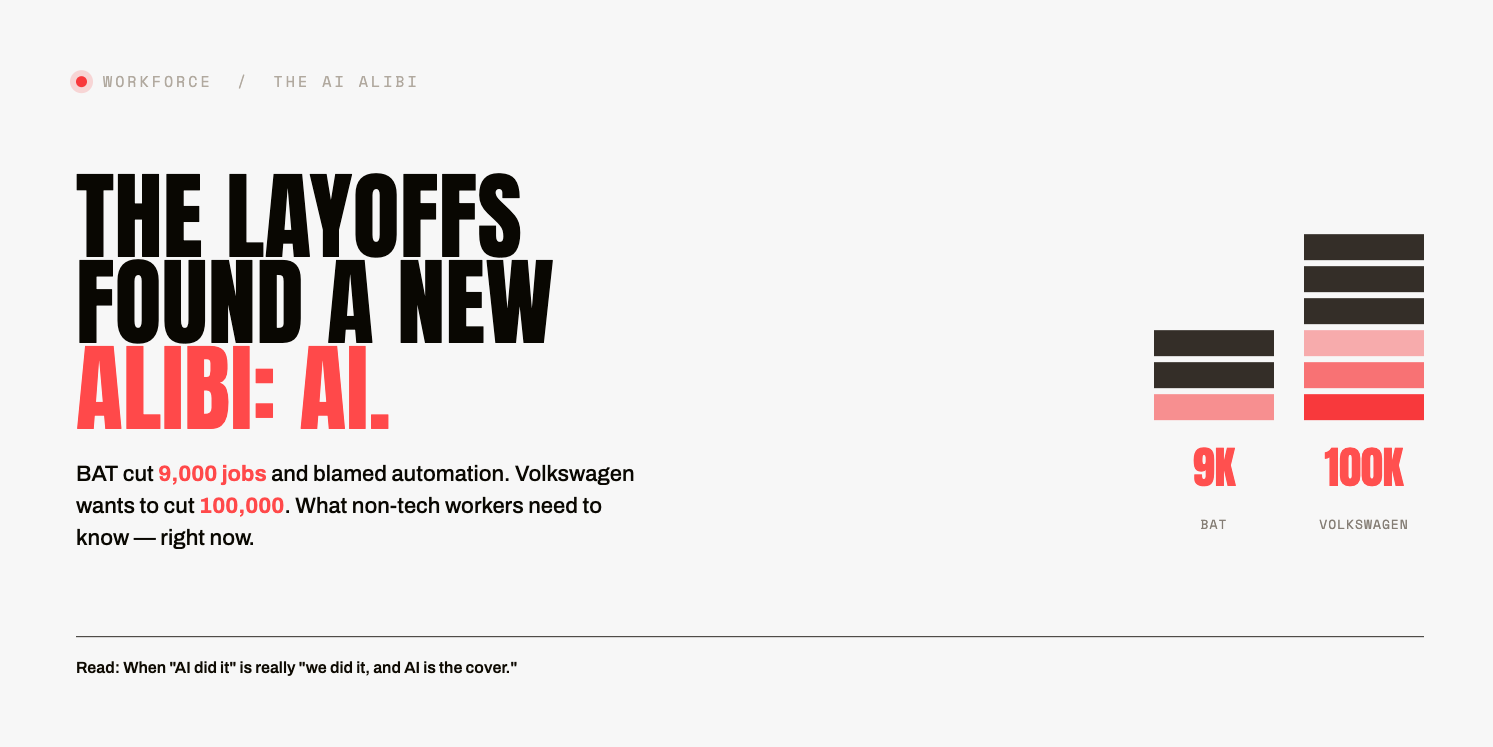
On 29 June 2026, British American Tobacco announced it will cut 5,500 jobs globally and outsource a further 3,500 roles to strategic partners including Accenture, affecting 9,000 employees in total, representing approximately 20% of its global workforce outside the United States. The company called it a "Fit2Win" productivity transformation. CEO Tadeu Marroco said BAT was building a "future-ready organisation" that was "more agile, cost disciplined and technology enabled." The programme is expected to generate £600 million in annualised savings by 2028.
The mechanics of the BAT cut are instructive. This is not a company replacing its own workers with its own AI tools. It is transferring roles to Accenture, which will then use AI to do with fewer people what BAT previously needed more people to do. Roles in Global Service Hubs across Costa Rica, Mexico, Poland, Romania, Malaysia, the UK, and Singapore are being absorbed. The roles being cut sit in Information, Digital and Technology, Supply Network Operations, and support functions, in other words, the operational and administrative backbone of a large traditional company, not its consumer-facing or manufacturing core.
Two days earlier, on 27 June, Volkswagen announced it is eyeing cuts of up to 100,000 jobs alongside the closure of four German factories, adding to 50,000 cuts already planned and representing what analysts are calling the biggest restructuring in global automotive history. The company cited a combination of EV transition costs, Chinese competition, and AI-enabled production efficiency as the drivers.
Cisco filed notice of 471 California job eliminations on 30 June as part of its ongoing AI-focused restructuring. Oracle cut 500 roles in Romania the same week. Takeda Pharmaceutical is cutting 4,500 jobs to centralise corporate functions. The pattern is consistent: traditional enterprises across sectors that have historically provided stable, long-term professional employment are now making the same structural argument that tech companies made a year ago.
Why This Wave Is Different From the Tech Layoffs
The 2023 and 2024 tech layoffs affected a workforce that was relatively young, relatively mobile, and accustomed to a job market where their specific skills transferred across companies within the same industry rapidly. A software engineer made redundant from Meta in 2023 could, in most cases, find a comparable role at another technology company within a few months.
The workforce being affected in the current wave looks different. The people whose roles are being transferred to Accenture from BAT's Global Service Hubs are operations and support professionals with deep institutional knowledge of a specific company and sector, typically older, typically with longer tenure, and typically without the immediately portable digital skills that make a tech-sector move look straightforward. The people whose roles are being cut at Volkswagen's German plants are skilled manufacturing workers with trades certifications and deep technical expertise in combustion engine technology, which is itself being made obsolete by the EV transition running alongside the AI restructuring.
These two groups face a harder immediate market than the tech workers who preceded them, and they face it with less of the cultural and professional infrastructure that helped tech workers navigate the last wave. There are no German automotive equivalents of the Bay Area networks, alumni communities, and recruiter relationships that helped tech workers land quickly after 2023.
The Myth That Traditional Industries Were Safe
The assumption that AI restructuring was primarily a technology sector problem was always imprecise. AI requires training, infrastructure, management, and integration regardless of the industry using it. The reason technology companies announced cuts first was not because they were more exposed to AI displacement. It was because they had already implemented the tools and were therefore the first to see the productivity gains that justified reducing headcount.
Traditional industries have been slower to implement AI at the operational level, which simply means they are now in the implementation phase that tech went through earlier. The BAT announcement is explicit about this sequencing. The company entered its Accenture partnership in July 2025 and is now, one year later, reporting the headcount consequences of that partnership. The gap between "we are adopting AI" and "we are reducing headcount as a result" appears to be roughly twelve to eighteen months, based on the announcements made this year.
For professionals working in operations, finance, HR, IT support, administrative, and process management roles at large traditional enterprises, this sequencing matters because it gives a rough timeline. If your company has announced major AI or automation partnerships in the past twelve months, the workforce consequence of those partnerships may be arriving in the second half of 2026 or in 2027.
What Non-Tech Professionals Should Do Specifically
The response to this news is not to panic and apply to everything available. The structural problem with that approach in 2026 is identical whether the redundancy comes from a tech company or a tobacco manufacturer: the market for cold applications from displaced workers is slower and more competitive than at any point in the past decade.
The response that produces better outcomes is the one that creates optionality before a decision is forced. Three things are worth doing right now, regardless of whether your company has announced anything.
Document what you have built. The professionals who navigate post-redundancy searches most effectively are not the ones with the best CV. They are the ones who can speak with specific, evidenced precision about what they delivered, what the measurable outcome was, and what that demonstrates about their capability. If your most significant work was done inside a large organisation using internal systems and internal vocabulary, translating it into language legible to a recruiter who has never heard of your company's processes is the highest-leverage preparation available. That translation work is significantly easier when you start it while you still have access to the data, the systems, and the context.
Map your network to your target organisations now, not when you need it urgently. The referral premium, being introduced to a hiring manager by a trusted internal contact rather than applying cold, does not diminish in a soft market. It increases, because it is the only reliable way to stand out in a queue where every other applicant is also highly qualified and recently displaced from a recognisable employer. The warm introduction you secure in September because you started building it in July is worth considerably more than the cold application you send in October because you waited.
Understand how your profile reads externally before you need to know. The ATS systems that will filter your application were trained predominantly on tech and professional services vocabulary. If your career was built in automotive, FMCG, tobacco, or pharmaceutical operations, the systems filtering your next application may not recognise your most significant capabilities in the language you use to describe them. Knowing this before your first application goes out, rather than after the first round of silence, changes the quality of every submission that follows.
How Candoorai Supports This
Candoorai's Career OS was built specifically for the situation these 9,000 BAT employees and 100,000 Volkswagen workers are now facing: a career built inside a large traditional organisation, described in internal language, needing to be translated into something the external market can read, score, and act on, under time pressure, in a market that is not set up to surface your value automatically.
The fit analysis reads your career history against a specific role and tells you precisely where the vocabulary gap is before your application goes out. The referral mapping looks at your existing network and identifies the warm paths into your target organisations. The Career OS connects both your structured career evidence and your unstructured contributions, your projects, your advisory work, and your institutional knowledge accumulated over years in a sector into a coherent, evidenced picture that the external market can evaluate without already knowing your company or your sector.